

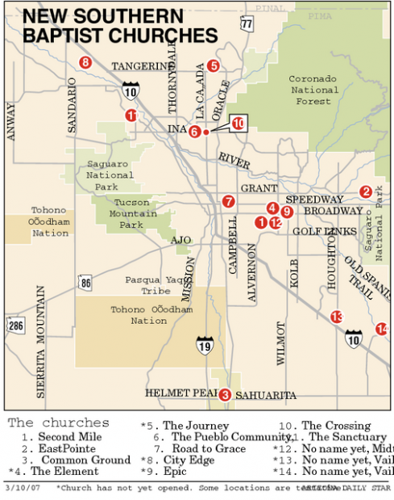
A 33-year-old transplant from Northern California has ambitious goals for expanding the number of Southern Baptist Churches in Pima County, with eight new churches expected to open this year alone.
The new churches appear neither Southern nor Baptist, though, with names like "The Journey," "City Edge," "The Element" and "Epic" — no mention of 'Baptist.'
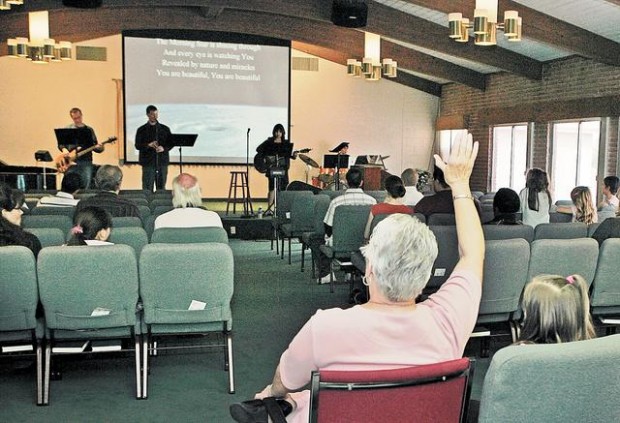
Their music is contemporary — "John Mayer-ish acoustic," as one leader says. And rather than meeting in traditional white-pillared brick and stone churches, the Southern Baptist startups meet in rented space. Some of the yet-to-open churches are even exploring the idea of holding services in movie theaters.
"The Tucson area is very heavily unchurched, which is why I do what I do," said Sean Benesh, a "church planting strategist" for the Catalina Baptist Association, the Southern Baptist Convention's organization in Southern Arizona. "There's no sense going to Alabama or someplace like that."
People are also reading…
Leaders of the upstart churches are generating interest in decidedly modern, youth-oriented ways — on MySpace and Craigslist, and by handing out free cups of Starbucks coffee outside local stores. Most of the churches also have their own Web sites, with podcasts of sermons and church music.
By removing the word "Baptist" and creating non-traditional places of worship, Southern Baptist leaders hope to bring the disaffected back into the fold with the goal of welcoming them into a non-threatening church setting while creating small communities and social networks in the process.
Nationwide, the Southern Baptist Convention increased its membership by 121 percent from 1950 to 1995, though that growth stabilized and then dipped in 1998 — its first membership decline in 26 years. Membership grew by 0.02 percent between 2004 and 2005, the last available statistics.
The Southern Baptists remain the largest Protestant denomination in the United States but as they plan for the future, leaders are looking outside the born-and-bred Southern Baptist core.
Benesh, an Iowa native, moved to Tucson with his wife, children and a 12-person "launch team" three years ago with the sole goal of "planting" new Southern Baptist churches in the area.
The denomination, which has 43,699 churches and 16.3 million members nationwide, had 59 local churches when Benesh arrived. There are expected to be 73 by the end of 2007. About 138,000 Southern Baptists live in Arizona, about 23,000 in Pima County.
Benesh works mostly from a laptop and a cell phone inside a Starbucks near his home, and spends most days taking other church planters to look at prospective sites. He also helps new leaders strategize.
Plant churches should be culturally indigenous, Benesh explained. "If you go into the church it should say, 'This is Tucson' or 'This is Rancho Sahuarita,' rather than transplanting Southern culture into Tucson."
Each church has its own identity. "Road to Grace," which opened in December and meets at First Southern Baptist Church, near the University of Arizona, is geared toward a motorcycle crowd. "The Journey," an Oro Valley church that had a sneak preview of a Saturday night service Feb. 17 and is set to officially open in April, is expected to attract young families, Benesh said.
He'd love to open a church catering to the eclectic mix of people on North Fourth Avenue. Talks are under way for churches in the Dove Mountain area and in Red Rock. He already has opened a church called The Pueblo Community, which meets in homes and caters to people looking to worship in a more intimate setting.
"The Element," a Midtown startup led by 25-year-old Jeremiah McDuffie, sees itself as a church for the varied demographics of Midtown, though its outreach is aimed at young families. On Feb. 20, the church held a dinner at McDonald's for interested worshippers.
On any given Saturday, McDuffie, his 24-year-old wife, Stacy, and prospective Element worshippers can be found outside grocery and department stores handing out free cups of Starbucks and washing windshields at no charge.
One of their mandates is that they won't accept donations for their good deeds, which they title "God's Love in Practical Ways." All they ask is that recipients accept a business card, which advertises the church as a place "relevant to today's world, where everyone is loved."
Like the other new churches, The Element doesn't have its own building. It meets in Central Baptist Church, 5353 E. Fifth St., whose building recently was renamed "The Central Place" because three different churches meet there.
At a sneak preview for The Element on Feb. 18, McDuffie — who moved from Georgia to start the church — led the service in a T-shirt and jeans, backed by contemporary Christian music he says is modeled after popular radio stations KIIM-FM 99.5 and KWMT, The Mountain, 92.9.
Among others, the service attracted Eric Varela Sr., 36, an auto mechanic, and son Eric Varela Jr., 20, a student.
The pair had been looking for a church for several years and the elder Varela got The Element's business card from a colleague. He said the service was relevant and understandable, and both he and his son plan to return in April when it officially opens. As a special bonus, they won a half-pound of Starbucks coffee for being the first to fill out a church questionnaire at the service.
"I loved this service — it's way past due," said Mary Ann Schneider, 52, an antiques dealer and longtime parishioner at Central Baptist Church who took her teenage son to The Element. "Traditional church scares people. We've never been pulpit-pounding here at Central Baptist, but people don't know that. A lot of it is trust. People don't want to be judged."
Probably more than any other denomination in the United States, the Southern Baptists have learned that new churches grow at a more rapid rate than well-established congregations, said Scott Thumma, a professor at Hartford Seminary in Connecticut who studies the sociology of religion. Their growth in Tucson is an example, he said.
"Existing churches often are in the wrong places, and their style doesn't fit with contemporary American religious life," he said. "Part of the way to expand is to plant new congregations. The Southern Baptists have really poured tremendous energy into doing that with the expectation that eventually it will be an investment that pays off well."
Benesh's salary is paid by the Southern Baptist Convention's North American Mission Board, which oversees church planting. Mission board spokesman Mike Ebert says the denomination has 221 church-planting missionaries like Benesh working across the United States and Canada.
"More and more Southern Baptist Convention churches are moving to contemporary style of worship," he wrote in an e-mail. "Style of worship is a methodology and has great variety. And while style of worship may be changing constantly, the message conveyed through worship styles never changes."
That unchanging message, Ebert said, is the Gospel of Jesus Christ, and the belief that the Bible in its original manuscript is the infallible, inerrant word of God.
But a younger breed of Southern Baptist leaders finds the message needs new packaging in the 21st century — a wrapping that minimizes the influence of institutionalized faith.
"Our values are the same, so we decided, why let the name Baptist be a hindrance at all?" said Jake Rasmussen, 26, co-pastor at EastPointe Community church, a young congregation that meets around café tables set up in rented space in the Tanque Verde Unified School District on the far East Side.
"In the Bible Belt, you need Baptist in your name, but not in Arizona," he said. "There's been a black eye in the Baptist culture over the Baptist Foundation, especially in Arizona."
In 1999, the Baptist Foundation of Arizona collapsed in the largest nonprofit bankruptcy filing in U.S. history, costing investors close to $600 million. Two former Baptist Foundation executives were sent to prison and ordered to repay millions.
Another move with mixed results for the denomination's public image was its eight-year boycott of the Walt Disney Co. to protest what it viewed as Disney's pro-gay agenda.
Surveys show Arizona is one of the "least-churched" states in the country in terms of the number of people who identify themselves as belonging to a major organized faith group. A 2000 religious census by the Nashville-based Glenmary Research Center showed 55 percent of Pima County residents did not belong to any of the 149 major religious denominations that were part of its survey.
Benesh, with his soul patch, jeans and North Face jacket, looks more like a mountain biker than a religious leader as he sits in Starbucks working on his church-planting strategies.
Indeed, he's been a mountain bike and hiking guide, and says the people he attracted to the first church he opened here — The Crossing, on the Northwest Side — include outdoorsy people. The church meets Sunday nights, which means it doesn't interfere with daytime rides.
"It's not our goal to perpetuate religion, it's to be God incarnate in our community. If my faith hasn't transformed my life, then all I'm doing is perpetuating some institutionalized religion," he said. "Spirituality is back in. We just need to find a way to compete with all the fun stuff going on every weekend."
Find more coverage of religion at www.azstarnet.com/faith