



It doesn’t get much cuter than this.
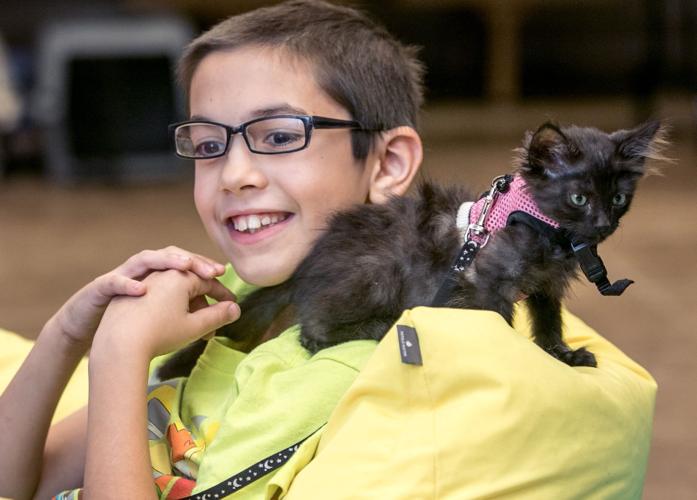
Rowan Testerman, 9, lounges in a floppy yellow chair with a cottony black kitten named Biloxi curled on his shoulder.
“I feel a buzzing noise,” Rowan says, sparking laughter from the grownups in the room. They explain that the cat is purring. “He’s purring! I guess he’s happy.”
How could he not be?
Little Biloxi and his fellow feline friend Leda got sprung from the Hermitage No Kill Cat Shelter & Sanctuary for an hour to hang with cat-loving kids as part of a new program called Purrs for Autism. It’s a collaborative effort between Hermitage, the Autism Society of Southern Arizona and WorkAbility, an employment program to teach and prepare people with disabilities for jobs sponsored by United Cerebral Palsy of Southern Arizona.
People are also reading…
Hermitage executive director Lee Bucyk reached out to the Autism Society with the idea of a cat-centered pet therapy program. Launched in March, the premise is simple: Let kids and cats play together. The results — in a fairly short period of time — have been pretty amazing, say those involved.
Kids who are normally anxious in social situations are able to relax and interact more easily with the cats and other kids.
“When they’re around animals, they come out of their shell,” says Vanessa Zuber, director of employment services for WorkAbility, who’s also on the Autism Society’s Board of Directors.
Pet therapy research shows furry friends can help reduce stress and anxiety as well as depression. Engaging in pet therapy can also increase participants’ self-esteem and improve social skills while teaching empathy.
The kitties get some definite benefits, too. About 160 homeless cats are housed at Hermitage, and its community outreach coordinator, Ashley Davis, picks two or three for the weekly Purrs program. Not only does it give the cats a chance to socialize with people, it allows Davis to better gauge their personalities and prepare them for adoption.
“It’s a win-win for felines and win-win for the kids,” Bucyk says.
Purrs for Autism meets Tuesday afternoons. The kids sign in, get a squirt of hand sanitizer and, if they’re new, are briefed on pet safety and cat behavior. Purr, er, peer mentor Astrid Cambuston, 18, helps Davis work with the kids. Astrid, a senior at Catalina Foothills High School, admits she’s more of a dog person, but …
“I like it because I like to play with the kids, make them smile,” she says.
For 7-year-old Michael Valdez — who’s been a regular for a month — Purrs for Autism is the highlight of his week.
“He wanted to be here at 11,” said his dad, Daniel.
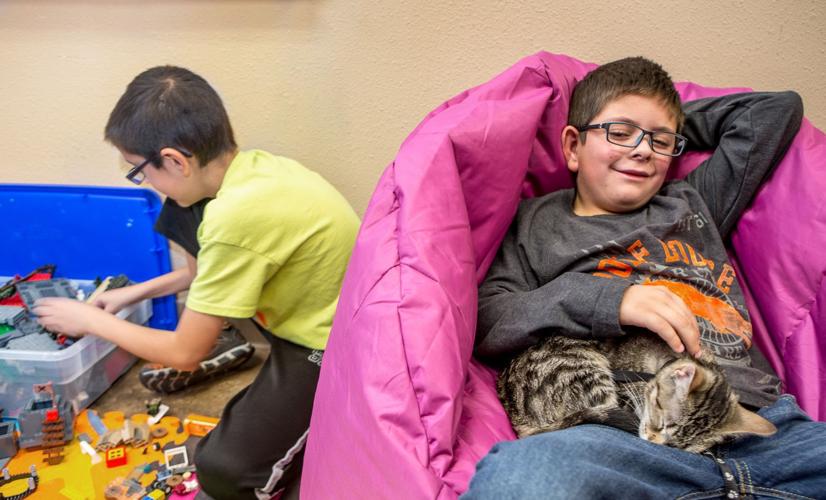
Poor Michael is under the weather, but a warm kitten snuggled on his lap seems to be just what the doctor ordered. He looks close to falling asleep while 7-month-old gray tabby Leda is already enjoying a cat nap.
“Cats are my favorite,” Michael explains. “They’re easy.”
“I have autism and cats have autism. My mom and I read a book ‘All Cats Have Asperger’s,’” chimes in Rowan, referring to Kathy Hoopmann’s photo book “All Cats Have Asperger Syndrome.”
The fourth-grader has been smiling and chatting nonstop since he walked in. Normally, his mom says, he’s very reserved with people in social situations. But get him around cats, and look out.
“I love seeing him open up,” Jessica Swanson says of her son. “It’s kind of a rarity. He feels like he can open up here.”
And, the program may well be pointing him toward the purrfect profession.
“When I grow up, I want to be a catinarian,” Rowan says. “That’s a veterinarian for cats.”


