

It may have been the first herb you met (that dried green stuff in mom's spaghetti sauce) or the one in that pot in your first apartment's garden.
You could throw it on a salad or blend it into a pesto. Somehow, if you had basil on hand, you felt like a chef.
Other herbs may have impressed you over your culinary journey, but basil is an herb worth revisiting.
It was crowned the "royal herb" by the ancient Greeks, washed over the bodies of the dead by grieving Hindus and potted on Italy's windowsills to invite guests. Its rich history and distinctive taste makes us crave it often.
Basil pushes us to try new things. It's quick to pair with pine nuts and finds its way into sorbet, cocktails, even guacamole. Basil is anything but basic.
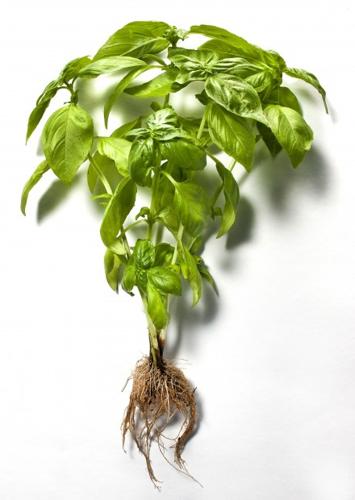
Aside from the familiar sweet basil, there are lemon basil, cinnamon basil, Thai basil and purple basil. And for each type, there's a new way to prep and pair the herb.
People are also reading…
Thai basil, used in Asian-style curries, must be cooked to release its intense flavor, said London chef Paul Gayler, who uses it to spice his monkfish curry with green mango. Purple basil, described as having a ginger flavor, can be used as a stronger substitute in dishes calling for sweet basil.
Chef John Barricelli, a frequent guest on the "Martha Stewart Show," uses purple basil in pesto to create a tapenade for sandwiches in his bakery, SoNo, in South Norwalk, Conn.
To get the "full effect" of sweet basil, Barricelli turns off the heat and uses the freshest leaves - but sparingly. He tears a few leaves from the stalk to add to salads, sandwiches or fresh peaches. However, fresh basil can overpower if used in excess.
"Basil is subtle and strong at the same time," Barricelli said. "Too much in a salad can wash out the taste of the tomatoes, so you have to be careful."
When cooked into sauce, however, basil's flavor is weakened. When Barricelli swirls a bit of pine nut-free pesto into his tomato sauce, he knows he can never add enough green to compete with the aroma of his red. That is because basil, unlike many other herbs, does not release oils when heated.
"You can 'overrose-mary,'" Barricelli said. "But you can't 'overbasil.'"
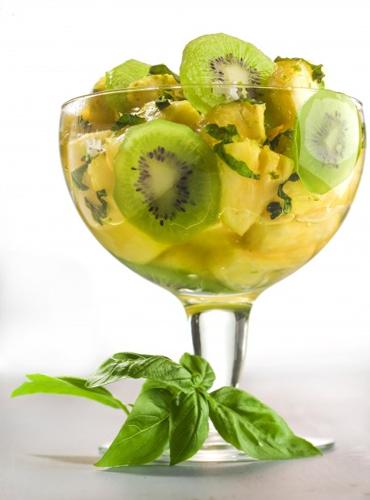
A touch of green basil can capitalize on the sweetness of the fruit season. Deborah Madison, author of "Seasonal Fruit Desserts from Orchard, Farm and Market," pours basil syrup over fruit. One of her recipes calls for pineapples and kiwis, but Madison said she loves it with peaches, nectarines and mangoes.
"It's a great combination that shouldn't be surprising," Madison said, "considering that mint, so often used with fruit, and basil are cousins."
Madison's syrup is heated, but basil is added fresh at the end. Madison, like Barricelli, believes the less heat, the more flavor. "I love the spicier basil with hints of cinnamon, anise and mint," Madison said. "But really fresh basil is wonderful, regardless of shape, size, variety or color."
Basil Tips
Using fresh basil also means spending a little extra love and care with your most delicate ingredient.
It's best to snip basil into pieces with kitchen scissors. It bruises easily and blackens when chopped, or if it gets too cold or too hot.
Author Deborah Madison tears her basil leaves from her garden plants, but recommends refrigerating leaves if they are store-bought.
They will keep up to a week, stored in a plastic bag or put into a cup of water and covered with a plastic bag. Better yet, buy a small basil plant and keep it in a sunny windowsill. Snip the tops of the plant for cooking.
Pineapple and Kiwi with Basil Syrup
Makes: 6 servings
• 3/4 cup water
• 3 to 4 tablespoons sugar
• Grated zest and juice of 2 limes
• 1 pineapple, about 3 pounds
• 3 kiwi fruit, yellow, green or both
• 2 tablespoons kirsch or rum, optional
• 2 tablespoons slivered basil leaves, plus basil leaves and flowers for garnish
Heat water to a boil with the sugar in a saucepan over medium heat. Reduce heat to low; simmer until the sugar is completely dissolved, 3-5 minutes. Add the lime zest. Turn off heat; steep while you prepare the pineapple.
Cut off the top of the pineapple. Slice down the sides to peel, removing the eyes as you go. Quarter lengthwise. Cut away the core. Slice into fan-shape pieces about 3/8-inch thick. Peel kiwi; slice into rounds. Intersperse them among the pineapple slices in a bowl or on a plate. Squeeze over the lime juice; drizzle with kirsch.
Add the slivered basil to the syrup; pour it over the fruit. Chill 1 hour. Garnish with basil leaves or flowers.
Per serving: 122 calories, 3% of calories from fat, 0.5 g fat, 0 g saturated fat, 0 mg cholesterol, 32 g carbohydrates, 1 g protein, 3 4 mg sodium, g fiber
Adapted from a recipe by Deborah Madison.
Goat Cheese and Basil Mousse With Basil and Almond Sauce
Makes: 4 servings
• 2 cloves garlic, unpeeled
• 1 tablespoon olive oil
• 12 large basil leaves
• 1/4 cup half-and-half
• 7 ounces soft goat cheese
• 1/4 cup whipping cream
• 1/2 teaspoon salt
• Freshly ground black pepper, ground red pepper
• 1/2 of a 1/4-ounce package of granulated gelatin
• 2 tablespoons cold water
For sauce:
• 6 basil leaves
• 1/2 small clove garlic, crushed
• 1/3 cup ground almonds
• 1/2 cup extra-virgin olive oil
Heat oven to 350 degrees. Put the garlic cloves in a small dish; pour the oil over. Roast until tender and brown, 20 minutes. Let cool. Remove the garlic from its skin.
Heat a small saucepan of water to a boil; add the basil leaves. Cook 30 seconds; drain. Chill leaves in ice water. Drain; dry well. Place in a food processor or blender with the garlic and half-and-half; blend until smooth. Pour into a bowl; add the goat cheese and whipping cream. Mix well. Season with salt and peppers to taste.
Cover the gelatin with cold water in a small bowl; let soak until dissolved, 5 minutes. Stir the gelatin into the mousse mixture. Pour into 4 ramekins or small coffee cups; refrigerate until set, about 4 hours.
Just before serving, for the sauce, put the basil, garlic and almonds in a food processor or blender. Gradually pour in the olive oil, with motor running, until a coarse puree forms. Dip each mousse ramekin into a little hot water; run a knife around the edge. Turn out onto a serving plate. Top each mousse with about a tablespoonful of the sauce.
Note: The mousse can be made ahead, but make the sauce just before serving for the freshest basil flavor. There will be sauce left over; it can be refrigerated and stored for up to one week. Use it on pasta, salads or as a marinade.
Per serving: 381 calories, 85 percent of calories from fat, 37 g fat, 14 g saturated fat, 49 mg cholesterol, 3 g carbohydrates, 12 g protein, 487 mg sodium, 1 g fiber
Adapted from Paul Gayler's "Flavors."