

They may look weird or scary, but don't be afraid. Winter squash - those hard-shelled varieties showing up in stores and farmers markets - are chock-full of vitamins, nutrients and flavor.
Why are they called "winter" when they grow in summer? Because these squash (unlike their thin-skinned cousins) can keep for weeks, even months - without refrigeration.
Winter squash retain their sugar (and sweet taste) longer when stored at room temperature. Chilling actually degrades the squash. When they're refrigerated, their sugar can turn to starch. Recent University of California-Davis and Oregon State University studies showed that most winter squash preferred storage at 50 to 59 degrees, with moderate humidity and good ventilation. Any colder and they went bad rapidly.
California ranks among the nation's leading producers of winter squash (including pumpkins), second only to Florida. And we're eating more squash, usually fresh - up to 4.2 pounds per person per year. Americans average about 1 pound of canned or processed squash per year - mostly pumpkin or baby food.
People are also reading…
Some varieties of winter squash are so pretty that they're used more for decoration than food. But try some on your plate - you may be surprised.
Something for all tastes
Here's a look at the many varieties you may see this fall:
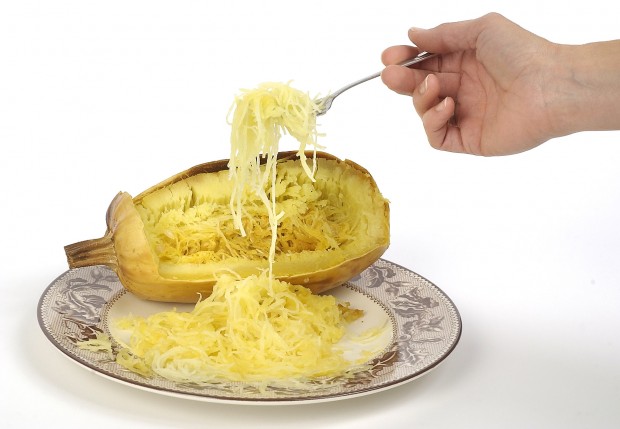
• Spaghetti: The oddball winter squash, this large, lemon-yellow gourd with a smooth skin is packed with fibrous pulp that - after baking, boiling or steaming - resembles spaghetti (and can taste like it, too). It can be roasted whole, then split. The insides are then shredded with a fork.
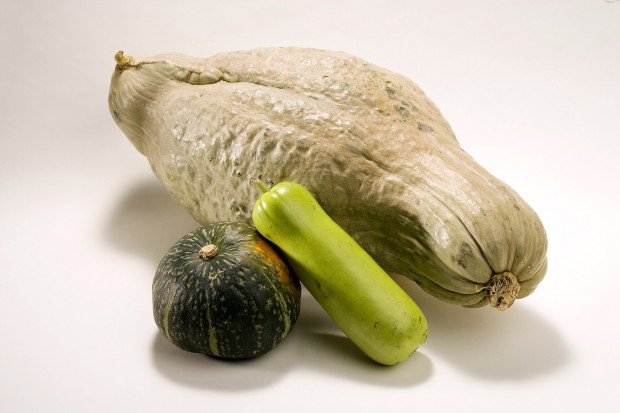
• Kabocha: A favorite in Japan, this squash has a jade to dark-green rind with pale streaks. The flesh is smooth and creamy with an almost honeylike flavor.
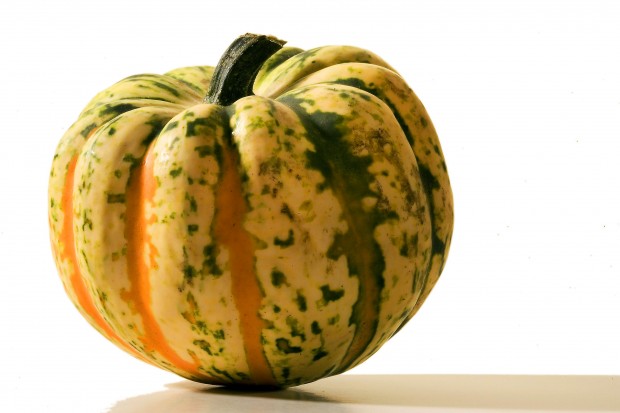
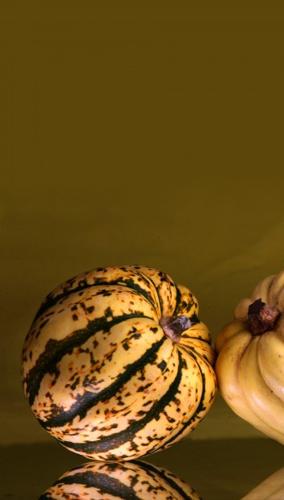
• Carnival: Looks and tastes like acorn, but in a party mood. The skin is striped or speckled in gold, orange and/or green.
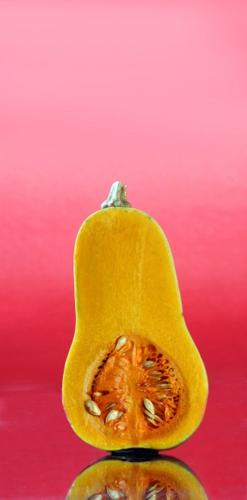
• Butternut: Looking like a fat, beige bowling pin, this winter favorite is the chef's darling. The size is right. It's easy to peel and the neck has no seeds. New varieties have such high sugar content, they taste like candied yams.
• Sweet Dumpling: These look like mini-acorn or Carnival squashes with vertical ridges, but the mostly white background is flecked with green. The inside is pale yellow but tastes like a sweet potato.
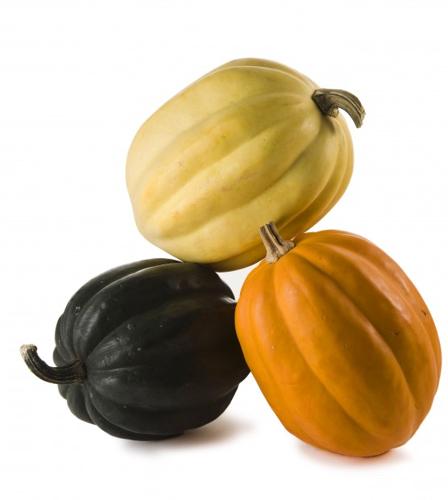
• Acorn: Also known as Danish, this ranks among the top winter squash in stores. It's relatively small and easy to cook. Acorns can be found in gold, creamy white, and the traditional dark green.
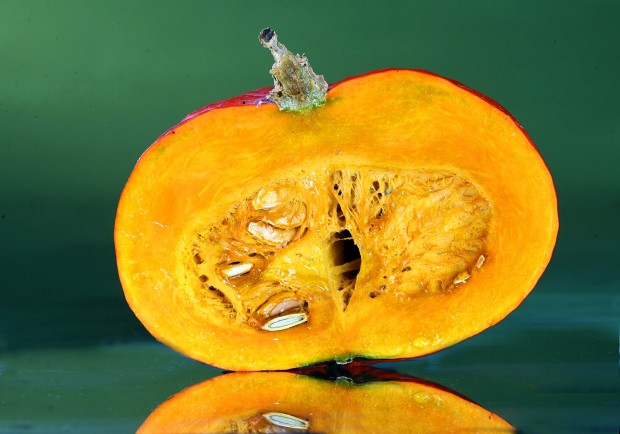
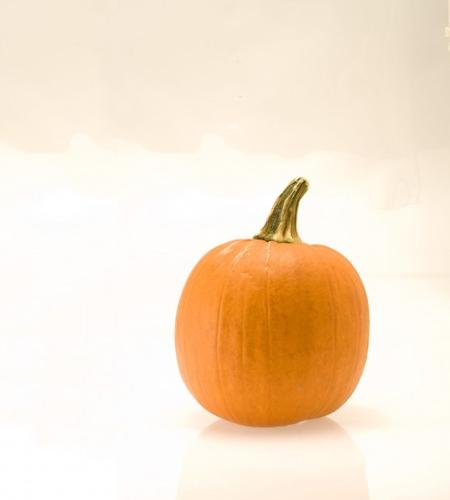
• Pumpkin: We couldn't leave this familiar winter squash off the list, although it needs no introduction. Halloween and Thanksgiving wouldn't be the same without it. But pumpkin is a great low-cal, no-fat, vitamin-rich vegetable. One cup of cooked pumpkin has only 50 calories, but 2,650 units of vitamin A - almost a full day's recommended intake for an adult.
• Hubbard: Big, ugly and often warty, these heavyweights often are the size of bowling balls - and weigh about as much. Skin color ranges from dark green to blue-gray to orange. The fine-grained orange flesh makes excellent custard, soup, cakes, etc., as a substitute for pumpkin.
• Delicata: It's shaped like a zucchini, but the skin is striped in green, yellow and white. The sweet flesh has almost a cornlike taste due to its starch.
• Banana: This familiar squash (a favorite for baby food) is usually sold in chunks. Whole, they weigh 10 to 20 pounds or more. The smooth skin is light pink or orange.
• Lakota: Gaining fans nationwide, this heirloom squash was prized by the Lakota Sioux people. Slightly pointed in shape, this squash averages about 7 pounds. Its green-and-orange coloring makes it an attractive decoration, but it's also good roasted.
• Kuri: It's the size and color of a large pumpkin, but with a pointy end. The flavor is pumpkinlike, too, but the texture is smoother.
• Turban: These large green-and-orange squashes look like their name and are used mostly for decoration. The hide is tough to split, but the pale yellow flesh has a nutty flavor.
• Buttercup: Looks like a squashed green turban, but smaller - usually about 2 pounds. The flavor is sweet and - as you would expect - buttery.
Why eat it?
With relatively few calories, winter squash is high in beta-carotene. That's why it has that great orange color.
It's also high in fiber and dense with other nutrients. In general, the darker the squash, the more vitamins. A half-cup of mashed acorn or butternut squash has 60 calories, but three times the recommended daily allowance of Vitamin A. (It's also high in Vitamin C and cancer-fighting phytonutrients.)
The easiest way to cook winter squash: Roast it.
Cut the squash in half or large chunks or slices. (Peeling optional.) Remove seeds. Place squash in a baking dish. Brush with olive oil or melted butter if desired. Then roast in a preheated, 350-degree oven until soft (about 30 to 45 minutes, depending on the size of the pieces).
Or microwave it: This method works great with acorn, Carnival or Sweet Dumpling squash.
Cut squash in half; scoop out seeds. Place squash cut-side down on a microwave-safe pie plate. Cover with waxed paper or plastic wrap.
Microwave on high for 6 to 8 minutes (depending on size of squash). Turn the squash over and test for doneness with a fork. If desired, add a little butter and brown sugar to the center; cover. Microwave on high for 2 more minutes.
To cook spaghetti squash: Pierce it deeply two or three times with a long fork to prevent it from exploding, then bake at 350 degrees about 90 minutes, or until tender when pierced with a knife. Cut it in half and remove the strands of flesh with a fork. Serve the strands with tomato sauce, as you would pasta.
To toast squash seeds: Rinse the seeds under water, remove the membranes and pat dry. Spread seeds in a single layer on a baking sheet and toast at 350 degrees until crisp, about 20 minutes. Cool, then crack open the shells and remove the seeds. Store in an airtight container.
Butternut Pineapple Spice Cake
Serves: 12-15
• 2 cups unbleached all-purpose flour
• 2 teaspoons baking powder
• 1 1/2 teaspoons baking soda
• 1 1/2 teaspoons ground cinnamon
• 1 teaspoon salt
• 1/4 teaspoon ground allspice
• 1 cup canola oil
• 1 cup granulated sugar
• 3/4 cup light brown sugar, packed
• 4 large eggs
• 1 teaspoon vanilla extract
• 3 cups finely grated peeled butternut squash
• 1 cup drained crushed pineapple
• 1 cup toasted chopped walnuts
For the cream cheese frosting (optional):
• One 8-ounce package cream cheese, softened
• 1/2 cup (1 stick) butter, softened
• 1 teaspoon vanilla extract
• 2 to 2 1/2 cups confectioners' sugar, sifted
Preheat the oven to 350 degrees. Butter and flour a 9-by-13-inch baking pan.
Sift together the flour, baking powder, baking soda, cinnamon, salt and allspice.
In a large mixing bowl, combine the oil, granulated sugar and brown sugar. Beat until well combined. Add the eggs one at a time, beating well after each addition. Add the vanilla. Continue to beat until fluffy. Gradually add the dry ingredients, mixing just until the batter is smooth and blended. Fold in the squash, pineapple and walnuts. Spoon the batter into the prepared pan.
Bake for about 35 minutes, until a cake tester inserted in the center of the cake comes out clean.
On a wire rack, cool completely before frosting.
For frosting:
In a medium bowl, beat together the cream cheese, butter and vanilla. Add 2 cups of the sugar and beat until smooth. If the frosting is too thin, mix in the additional 1/2 cup sugar and beat until smooth.
Spread evenly over cooled cake. Makes about 2 cups.
Per serving without frosting based on 15 servings: 372 calories (49 percent from fat), 6 g protein, 43 g carbohydrates, 20 g fat (2 g saturated, 10 g monounsaturated, 8 g polyunsaturated), 57 mg cholesterol, 335 mg sodium, 2 g fiber, 26 g sugar.
Source: "The Classic Zucchini Cookbook" (Storey Publishing, $16.95).
Butternut 'Lasagna' with Kale
Serves: 6-8
• 1 butternut squash, peeled
• 1 bunch kale or other greens
•1 large onion
• 3 cloves garlic
• 3 tablespoons olive oil
• Salt and pepper
• 2 cups diced tomatoes
• 1 tablespoon chopped fresh sage leaves
• 1 cup grated Gruyere, mozzarella or fontina cheese, for topping
Carefully cut the squash in half lengthwise, then scoop out the seeds. Place the halves face-down and cut in 1/4-inch-thick slices.
Remove and discard the stems from 1 bunch of kale or other greens. Chop the leaves roughly.
Dice 1 large onion and mince 3 cloves of garlic. Sauté the onion in 3 tablespoons olive oil until soft, then add the garlic and cook another minute. Add the kale and cook for 5 minutes. Season with salt and pepper.
Lightly grease a 13-by-9-inch baking dish or large cast-iron skillet, then cover with an overlapping layer of squash slices. Sprinkle with salt and pepper. Spread the cooked greens over the squash, then make another layer of squash.
Spoon 2 cups of diced tomatoes and 1 tablespoon chopped fresh sage leaves over this layer, then make another layer of squash. Top with grated Gruyere, mozzarella or fontina cheese.
Bake the casserole at 350 degrees for 45 minutes or until it is brown on top and bubbling.
Per serving based on 8 servings: 180 calories (46 percent from fat), 7 g protein, 20 g carbohydrates, 9 g fat (3 g saturated, 5 g monounsaturated, 1 g polyunsaturated), 12 mg cholesterol, 272 mg sodium, 5 g fiber, 6 g sugar.
Source: Terra Firma Farms Community-Supported Agriculture Newsletter, Nov. 12, 2008.