

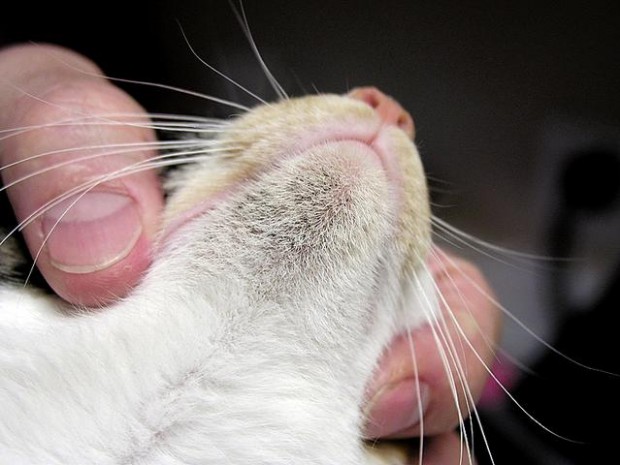
Acne is a common skin disorder of cats. Whereas human acne is typically linked to puberty, feline acne may occur in a cat of any age, although it's more common in adults. Its severity can ebb and flow over a lifetime in affected cats.
Hormones don't seem to play a role, as the problem is seen in male and female cats, both sterilized and intact.
Whereas the stereotypical human teenager can have acne on the forehead, cheeks, chin, nose and back, feline acne is almost exclusively found on the chin and lower lip, appearing as tiny plugs of dark material, or a "dirty chin." It takes a more trained eye to detect the lesions if the cat has a dark coat of hair.
"The typical lesion is a comedone (blackhead) with superficial pimples seen on occasion," says Dr. Gary D. Norsworthy, feline specialist at the Alamo Feline Health Center in San Antonio. "This condition may progress to plugged hair follicles with secretions and ruptures deep into the layers of the skin. If this happens, hair loss and a red, swollen and very angry-looking chin may occur next. At this stage, the cat becomes sensitive and often resists touching and treatment."
People are also reading…
In humans, acne is related to hormone levels and the presence of bacteria in the skin. A clear association involving hormones, skin bacteria and development of acne has not been demonstrated in cats, but there are several possible causes:
● Poor grooming habits.
● Abnormal production or composition of sebum, which is the waxy or oily substance produced by glands in the skin.
● Clogging of the hair follicles when hair is not properly shed.
● Defects in keratin production. Keratin is a protein that gives the skin its protective coating.
While feline acne is most often diagnosed based on its characteristic dirty-chin appearance, to eliminate other possible causes of an infection on the chin, several diagnostic tests may be performed. In most cases, these tests are not necessary but, when indicated, typically involve scraping of the skin to look for mites and a culture for bacteria and/or a fungal infection.
"Topical treatment is usually adequate for most cases of acne; severe cases may require systemic (oral) therapy," Norsworthy says.
"Treatment begins with clipping the fur short on the chin. This permits deep cleaning of plugged follicles and application of medication. Because the cat's chin may be rather sensitive, sedation may be required to accomplish adequate clipping and initial cleaning."
Treatment is continued at home. The pores of the skin are opened with the application of Epsom salt soaks. A washcloth is placed under hot water, and the excess water squeezed out. This hot pack is placed on the chin for two to four minutes. When it is removed, topical medication is applied. There are several effective medications available, and their choice is partly determined by the presence or absence of infection. If infection is present, oral antibiotics or antifungal drugs may be given orally.
While human topical products, including topical retinoids such as Retin-A and benzoyl peroxides such as Oxydex gel, have been used with good success, it is important to obtain instructions from your veterinarian, as these medications can be very irritating to the cat's skin. Cats are much more sensitive to these products than humans and need formulas with concentrations only one-third to one-half as strong.
"To treat and prevent mild chin acne, the blackhead stage, I recommend that owners clean their cat's chin at least twice weekly with hydrogen peroxide," says Dr. Elaine Wexler-Mitchell of Orange, Calif., author of "Guide to a Healthy Cat."
"I also recommend that owners change any food or water bowls to glass, ceramic or stainless steel, because some cats react to plastic. Cleaning food bowls daily with soap and water or putting them through the dishwasher is another good idea, because the greasy residues that build on the edge of the bowls can contribute to clogging the pores on the chin."
Acne will recur in many cats. At the first sign of return, begin hot-packing the chin and applying the topical medication. If the problem persists, consult your veterinarian.