

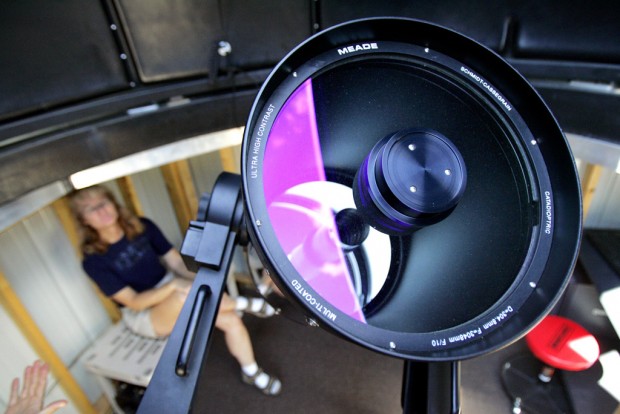
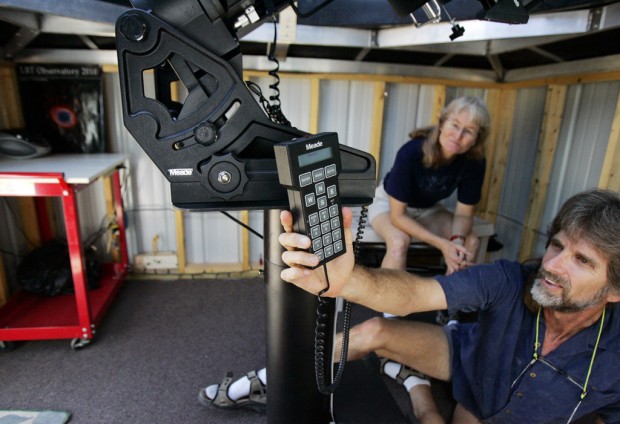
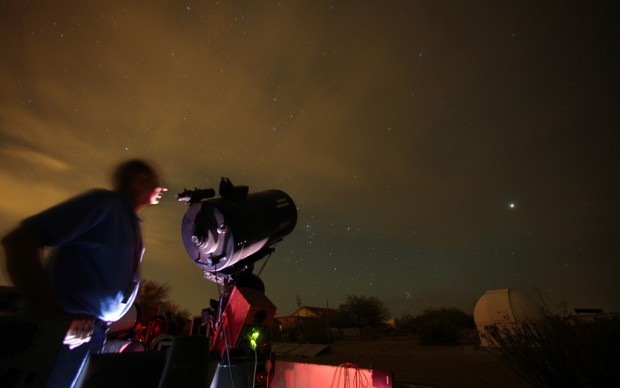
Claude Plymate calls his backyard home observatory the clubhouse that he never had as a child.
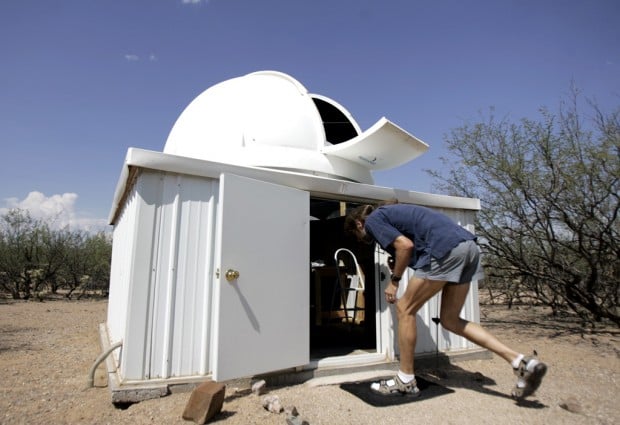
The solar astronomer and his wife, Teresa Bippert-Plymate, ordered the white 10-by-10-foot domed structure two years ago, and had it built just a short walk from the back door of their west-side Tucson home.
With a computer hooked up to their cobalt blue Meade LX-200 telescope, the couple sit together in the small space for hours at a time.
They document the skies while listening to jazz and classical music on the radio, taking detailed photos of whatever the universe might have to offer.
"We look at pretty objects mostly," Teresa said. "There are a ton of them out there, especially in the summertime."
With an average of about 300 clear nights a year, Southern Arizona has long been a haven for amateur astronomers looking to build home observatories for their own stargazing needs.
People are also reading…
Frank Lopez, founder and owner of Stellar Vision Astronomy and Science Shop, built his first home observatory for a customer in 1991 and has since made it part of the company's regular offerings, with more than 45 of his units set up around the state.
Lopez said there are two primary types of observatories available for amateur astronomers.
The domed observatories, like the one he constructed for the Plymates, are often prefabricated and do a better job of keeping out ambient light and wind that might interfere with observations.
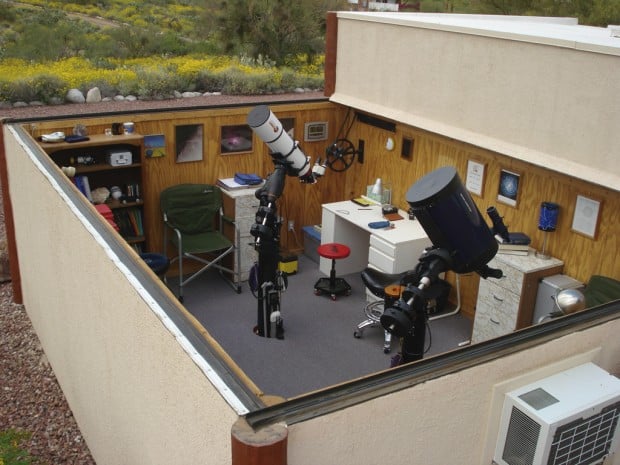
Other amateur astronomers prefer the slide-off roof observatories, which can be a bit more expensive and are shaped to look like sheds, with rooftops that slide off, providing a larger viewing area.
"They can look at the whole sky that way, rather than just through a slit," Lopez said. "It also allows them the ability to use more than one telescope at a time."
Home observatories start at about $3,000 at Stellar Vision, Lopez said, but can cost as much as $30,000 depending on what features customers want - things like automated rooftops or domes that synch up to rotate along with the telescope.
Noted astronomer David H. Levy, has 15 telescopes set up at his slide-off roof observatory, about 100 feet south of his Vail home.
Levy, whose is best known for his co-discovery of the Shoemaker-Levy 9 comet in 1993, runs all 15 telescopes simultaneously and shoots more than 700 images a night as part of his comet-hunting program.
He prefers the slide-off roof design for its ease of use and convenience.
"The technology to operate a sliding roof is simpler," he said. "The main roof lumbers off fairly quickly, using a chain hoist and the front (area) opens by hand."
Jerry Farrar, a retired train conductor for Union Pacific, also went with a slide-top roof when building his observatory on Tucson's eastside.
Farrar received his first telescope, a gift from his parents, when he was 9 years old.
"When I first saw Saturn, I felt like I had discovered a planet," he said.
Today, he watches the skies from his custom-built structure, designed to look like the rest of his Santa Fe-style home.
Farrar spends most clear evenings on the hunt. It's not uncommon for him to stargaze until 2 or 3 in the morning.
"Having an observatory like this is an astronomer's dream," he said. "You don't have to go far or take time to set up the telescope. It keeps the availability of astronomy at your fingertips."
The Plymates went with the classic dome, in part because of the "cool look," but also because it was affordable.
The couple have been prudent with the extra bells and whistles on their unit. They cover their telescope with a garbage bag to keep the dust off and opt to rotate the dome by hand, rather than installing an automated system, in an effort to cut costs.
"We call that the 'arm-strong' method," Claude joked.
The observatory is simple by design but suits their needs.
"It's nice to have an observatory you can have up and running in 5 minutes," Teresa said. "And when 9:30 rolls around, you can close up and go to bed, without having to drag in the telescope, the mount, the power supply … taking eight trips back and forth."
Things to consider
Making a choice - Observatories are available in two basic models. The slide-off roof observatories resemble sheds with rooftops that slide off, allowing you to see the entire sky and use more than one telescope at a time. Dome observatories are more classic in design and block out excess light and wind by providing a smaller viewing area.
Consult with fellow star watchers - The Tucson Amateur Astronomy Association boasts nearly 400 members and is one of the biggest, most active astronomy clubs in the country. Many of its members have home observatories and would probably be willing to dole out a tip or two. Visit tucsonastronomy.org for links to member pages and information about club activities.
Think about your location - Tucson is a much bigger city than it used to be. That means more light to interfere with your observations. Your proximity to town might determine whether you want a slide-off roof or classic dome observatory, or if you want to build one at all.
Local astronomy resources
•UA Science: Flandrau, 1601 E. University Blvd. on the University of Arizona campus; 621-7827; flandrau.org
• Kitt Peak National Observatory Visitor Center, 318-8726; noao.edu/kpno
• Mt. Lemmon SkyCenter, 626-8122; skycenter.arizona.edu
• Starizona, 5757 N. Oracle Road, Suite 103; 292-5010; starizona.com
• Stellar Vision Astronomy and Science Shop, 3721 E. 37th St.; 571-0877
Gerald M. Gay is a Tucson-based freelance writer. Contact him at geraldmgay@gmail.com