

Q: My neighbor’s orange tree had a severe dieback several years ago and the entire top of the tree is dead wood while it is beginning to grow from the rootstock. We have had a recent infestation of dry wood termites and it is my understanding that any dead wood can attract these termites. Is it important to prune out the dead wood in this orange tree to remove potential habitat for these destructive termites?
A: Regardless of your termite concern, it is important to prune out the dead wood after the danger of frost has passed. Also, if the tree were only growing from the rootstock it would be best to cut down the whole thing and start over. In nature, termites function as decomposers that break down dead wood that accumulates in and on the soil, so if our homes weren’t built with wood parts we would be fine with termites. Since drywood and subterranean termites are the most destructive insect pests of wood and their presence in structures is seldom noticed until damage is discovered or the termites swarm within the building, it is wise to reduce the amount of attractive sites near your house.
People are also reading…
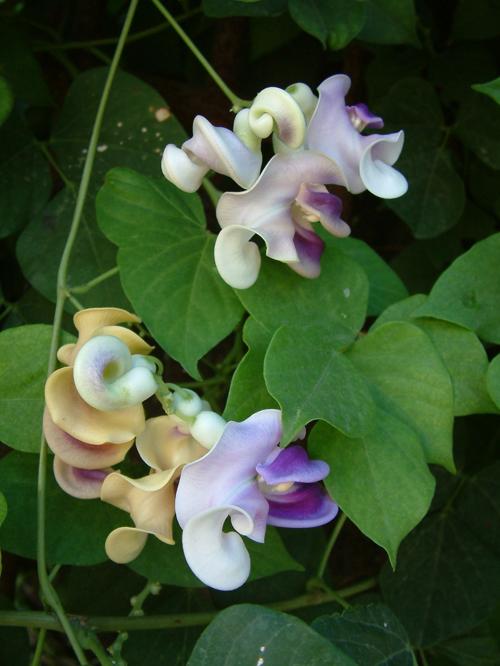
Q: I came across a “Landscape Vines for Southern Arizona” article online and you were listed as the contact. I’m hoping you might be able to give me some advice. I have snail vines growing along the walls in my backyard. As the weather started to heat up, the vines started to grow. The vines on the northwest wall initially grew at a faster rate. However, as it got hotter, I noticed those vines starting to shrivel up. The leaves went from a healthy, rich green to a light, pale unhealthy color. This was especially true for the leaves closest to the root. The leaves farthest from the root still look good and have new purple flowers. I also noticed there were speckles on the leaves. This is the same thing that happened last year, but it happened at the end of the season. Do you have any suggestions on how to remedy this problem?
A: I am glad you were able to locate my publication online. The University of Arizona Cooperative Extension has a huge quantity of online publications on all sorts of topics. The snail vine (Cochliasanthus caracalla) is a vigorous, semi-perennial, twining plant that may die back to the ground during the winter, when we have one. If frost kills top growth, it can be cut back in early spring to rejuvenate growth. This plant bounces back in the spring and grows quickly, reaching 30 feet in a year. It makes an excellent screen trained on wire fences, trellises, and block walls. Masses of snail shape, lavender flowers bloom throughout the year. It is a high water user and from your description it seems like the vine might not be getting enough water and possibly needs a dose of fertilizer as well. I recommend watering these every seven to 10 days in the spring and maybe every five to seven days once it gets really hot. A slow release fertilizer like composted manure would be appropriate to spread around the root zone so it can be watered into the soil.
Q: I have Bermuda grass growing in a few unwanted places in my yard. I have some growing in a bed of African aloe and also in my cactus garden. In both the aloe and the cactus garden, I can’t get to the roots of the grass because of the dense spines of the other plants. I’ve successfully used glyphosate to rid my yard of the rest of the grass in open areas, but I’m worried that I will spray desirable plants where the grass grows in tight spaces. Help!
A: You are in a tight spot. Glyphosate will kill any green thing it touches so you might be forced to continue removing the Bermuda grass by hand. If you are very careful, it is possible to use a piece of cardboard or other barrier to protect your desired plants while you spray the grass. You can also paint the glyphosate onto the plants you are trying to kill. Be careful to apply herbicides during the cool part of the day and when there is no wind or the chemical might volatilize and drift to your desired plants.
Otherwise, if you can temporarily move your desirable plants to another garden or containers, you could do a wholesale renovation of the area with glyphosate as you did with other areas of your lawn and move the plants back after the herbicide has dissipated. As always, it is best to read any pesticide label before applying and make sure to follow the safety instructions to protect any nontarget organisms in the area — including you.
Peter L. Warren is the urban horticulture agent for the Pima County Cooperative Extension and the University of Arizona. Questions may be emailed to plwarren@cals.arizona.edu

