

AKRON, Ohio - Karmi James and Jeff Boni brought little more than interest to their urban gardening venture.
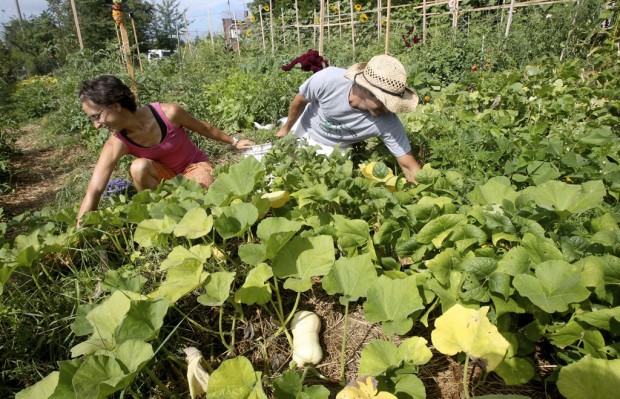
James had done a little gardening as a kid, but neither knew much about growing food before they planted their first garden not far from the old Firestone factory in Akron, Ohio. Today, however, they're operators of Paqarina Farm, an organic garden on Ira Avenue just south of downtown that produces fruits and vegetables to feed themselves and sell to others.
The two grow an array of crops on what James estimates at maybe a quarter of an acre. In the process, they're trying to encourage others in their low-income neighborhood to try growing food themselves.
"The simplest thing a person can do is put some seeds in the ground and grow them," Boni said. "If you give people a shovel and some seeds, a lot of people could get off public assistance."
People are also reading…
The couple taught themselves by reading, asking questions of gardening friends and neighbors and just doing. They started with a garden last year behind their home in a building that once housed Parasson's restaurant and later the studio of artist P.R. Miller. Their intention was to help make ends meet and have a supply of the organic foods they like to eat, but they ended up with so much that they were able to preserve some and give away the rest.
This year they expanded to what used to be a grassy patch next to their home. There they grow enough to provide biweekly food boxes to the seven customers who bought shares in their community-supported agriculture venture, and they also sell produce at a farmers' market.
They named the minifarm Paqarina, which means "dawn" or "beginning" in the indigenous Quechua language of the Andes. It's a nod to the experiences of James, who for about 10 years divided her time between the United States and South America.
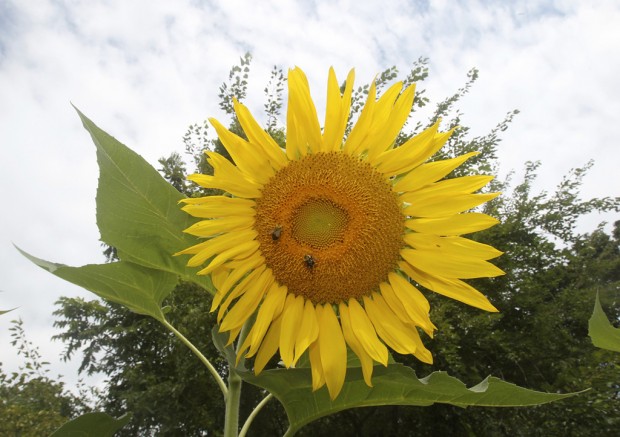
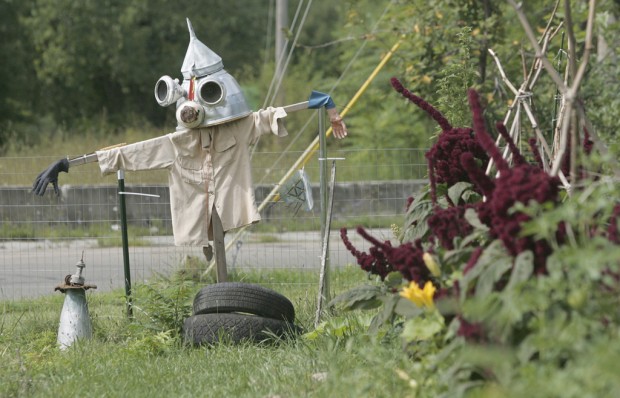
The garden is a cheerful, abundant oasis on a bleak street. It's edged by sunflowers, dotted with petunias and marigolds and decorated with sculptures made from junk in the style of Miller, with whom Boni has worked on art pieces.
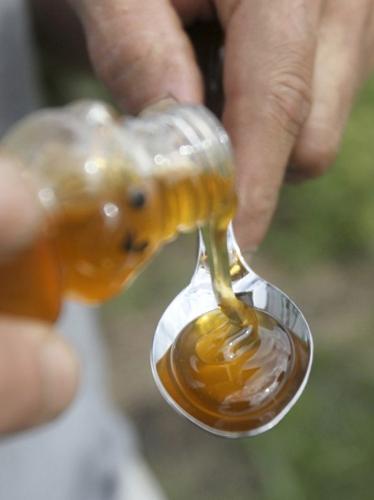
Near the back of the garden a hive buzzes with honeybees, which Boni considers the secret to the couple's success. The bees pollinate their food crops and produce the honey that Boni and James share with their CSA participants.
A rain barrel equipped with a solar-powered pump feeds a drip irrigation system that waters about a fourth of the garden. The trellises that support the tomato plants are made from string, wood and stems from the aggressive Japanese knotweed that grows on the property - an example of the resourcefulness the couple brings to the project.
The garden teems with plants - carrots and herbs, rutabaga and kale, a "little bit of everything," James said. Fruit comes from mulberry trees, cherry trees and raspberry bushes that were already on the property, probably a legacy of a World War II victory garden.
The garden is a bit of a jumble, because James and Boni try not to control its growth too rigidly. A winter squash vine snakes through an amaranth flower, which produces seeds the couple use as a grain. Cornstalks planted on mounds form supports for climbing beans, while broad melon leaves serve as a living mulch around their base in a planting arrangement Native Americans call the Three Sisters.
They're intentional about improving the soil naturally. Newspaper and straw are used for mulch, because they'll break down over time and enrich the soil. Sunflowers and legumes were planted for their ability to accumulate nutrients. A trench holds garden waste that will be covered over the winter and turned into compost.
Every day brings new surprises and problems to be solved, Boni said. Right now it's powdery mildew, which the couple tackles by removing the infected parts of the plants. They know pests and diseases are just part of farming, so they planned for them by planting abundantly and choosing a wide diversity of plants so no single destructive force would wipe out everything.
The garden serves as a sort of role model in the neighborhood. Neighbors stop by to ask questions, and some have started plots of their own. Just seeing the garden has encouraged some people to try, they said.