

Q: My father brought this silk screen out of China around 1905. It's been in the family all that time. We would like to sell it, along with other pieces. Any info?
A: This is an ideal time to sell early treasures from China. As often stated in this column, the political rise of mainland China, plus its booming economy, has created a new class of collectors.
Chinese collectors and investors are falling all over themselves to buy back their heritage. Scouring auctions and sales throughout the world, they seek traditional art and decorative items from the mainland.
The acquisition of the reader's screen in the early 1900s is a perfect example. A large piece, it consists of four panels, each 68 inches high by 16 inches wide. Embroidered with gold or gilt thread, it depicts figures, horses, battles and the like. Panels, the same on both sides, are mounted into a gilt wood frame.
People are also reading…
As director of Asian sales at Leslie Hindman Auctioneers in Chicago, Andrew Lick just finished a two-day, $3 million sale that saw astounding results for Chinese works of art. The highest prices were for traditional Chinese works snapped up by mainland buyers. To an individual, these are bidders who pay top dollar for what they want.
A damaged 17th- or 18th-century carved rhinoceros horn cup brought $292,000. An ivory and hardwood screen sold for $244,000, and a spinach jade brush washer came in at $97,600. An enameled snuff bottle with Qianlong mark went for $51,240.
Name a top auction house, and equally stunning results are the rule for current sales of Asian treasures.
Lick looked over images our reader sent and told us the screen is 19th-century kesi, probably made around 1850. Kesi is a type of embroidery.
Characterized by the use of gold thread, kesi screens are ranked by their detail. The best have facial features, hands and other fine work woven into the design. Lesser screens were woven and detail was added later with paint or ink.
"You look at that first," he added. Happily, the reader's screen has woven details.
The detail and its large size make this screen desirable. Never one to gush, Lick did volunteer that it is "a good example," and "should sell well." A smaller kesi screen brought $1,464 recently at Hindman.
He thinks this screen could bring $1,500 to $2,500. And remember, in this superheated market, many traditional Chinese goods new to the market soar way above estimate.
A carved soapstone piece seen in images dates from the 1920s. "We see a lot of these," Lick told us. Made for export, they sell for $100 to $200. Superbly carved 18th-century figures bring big bucks, but they are another story. Reach him at andrewlick@lesliehindman.com.
Q: What is this interesting bottle? It's 6 1/2 inches tall and 1 1/4 inches in diameter. The silver top is a shaker.
A: The small tubular pressed glass bottle was no doubt part of an early 20th-century traveling dresser set. It is a utilitarian piece.
Imagine a gentleman's kit bag with a small bottle for bay rum and tubes such as this holding talc or other powders. Similar travel kits were made for women, where tubes held talc, face powder - you name it.
The raised shield with R inside bottom mark is for C.F. Rumpp, a Philadelphia maker of glass tablewares and other utilitarian glass, including flasks.
COLLECTOR QUIZ
Q: Can you rank these "Star Wars" collectibles - cheapest to most expensive - according to their book value?
a. Yoda pencil cup (Sigma)
b. Jar Jar Binks battery-operated Pez handler
c. Light saber (Tomy)
d. Boba Fett holiday ornament
e. Naboo fighter, electronic remote control (Estes)
A: Answers are b, e, d, a, and c at $325. Source: "The Star Wars Super Collector's Wish Book" by Geoffrey Carlton (Schiffer, $34.99).
AUCTION ACTION
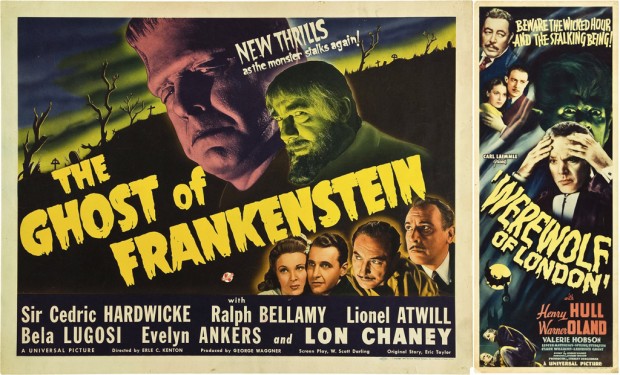
When Heritage Auctions sold more than 1,200 collectible movie posters in a $1.3-plus million sale last summer, a rare poster from the 1935 classic film "Werewolf of London" sold for $47,800. Not many posters from the film exist, and this unrestored version with very minor flaws was as pure as they come. In the same sale, a three-sheet poster featuring Boris Karloff as Frankenstein in the 1938 Universal movie brought $29,875.
Danielle Arnet welcomes questions from readers. She cannot respond to each one individually, but will answer those of general interest in her column. Send email to smartcollector@comcast.net or write Danielle Arnet, c/o Tribune Media Services, 435 N. Michigan Ave., Suite 1400, Chicago, IL 60611. Please include an address in your query. Photos will not be returned.