

Q I recently came across an old newspaper that appears to be a complete edition of the Honolulu newspaper from Dec. 7, 1941. How do I have its authenticity verified and find out its value?
— Kathy, Tulsa, Okla.
A The date is the day of the Japanese attack on Pearl Harbor. In the newspaper-collecting world, headlines from the locale of a historic event are more desirable than a paper removed from the action. A Honolulu paper from the site of the event trumps all other papers reporting on the attack.
Timothy Hughes of Timothy Hughes Rare Newspapers in Pennsylvania knows that particular paper. Hughes deals in collectible newspapers, from the founding of our country to the present.
"The Honolulu Star Bulletin of Dec. 7, 1941, is one of the more common reprints," he told us. Many reprints are older and end up on eBay, where they are sold unknowingly as genuine.
People are also reading…
"Genuine issues do exist, and we've sold them for close to $2,000 each," Hughes continued. "But they are quite rare."
Here's how to spot the real thing: The genuine issue is eight pages and has an ink smear between the "A" and the "R" in the large word "WAR!" in the headline. Go to Hughes' Web site, www.rarenewspapers. com, and type in "December 7, 1941" to see an authentic version. You'll see the spot clearly.
Typically, reprints have cleaned up the spot to make the paper look better, Hughes said. Reprints also have "2nd Extra" and "3rd Extra" headlines on inside pages. Originally printed independently, the 2nd and 3rd Extras were incorporated into reprint versions. You can still buy reprints at the souvenir stand of the Pearl Harbor Memorial.
"Issues must be viewed by us, in our hands, for proper authentication," Hughes said. The fee is $35, plus the cost of return shipping. If you still think you have the real thing, authentication is the way to go.
Q Many years ago, I inherited a painting by Victor Vasarely in the cubist style. I recently saw it on the Internet and wonder what the value is.
— Eida, Fort Lauderdale, Fla.
A Vasarely, born in Hungary in 1908, was a leading figure in the development of op art, not cubism. He became a graphic designer in Paris in the 1930s and was popular in Europe in the 1960s. He is often referred to as a Hungarian-French artist. He died in Paris in 1997.
Vasarely churned out prodigious amounts of product, including op abstracts rendered in acrylic on canvas or board, oil on canvas or board, tempera on panel, embossed compositions and screen prints. Some pieces are dimensional.
Your piece needs to be seen firsthand to determine the matrix and if it indeed is a painting.
I'm wondering how you found an image of this piece on the Web. Since Vasarely's works are widely copied as art prints, perhaps your piece is a print, produced in multiples. There are thousands. If it's a print and an early strike, that needs to be determined.
Here's how prints work: The artist produces the original plate. Each successive strike, or printing, wears the metal or stone plate a bit more. Strike 100 out of 251 would therefore be sharper and more desirable than strike 250 of 251. Contemporary prints are digital and remain sharp throughout production.
If you sincerely believe yours is an original from the artist and not a copy, a professional appraisal would be worthwhile. If the object is to sell, a good auction house will tell you if it is worth its time.
Q Is there any value on my metal Quaker Oats can with "1982" on the bottom? The can is exactly as it looks today.
— Stephanie, Deerfield Beach, Fla.
A I'll bet that tin also has an embossed "Limited Edition" mark on the bottom. Right?
Look, we're talking about a company that has been in business since 1877. Old and authentic Quaker Oats packaging can run into serious money, but smart collectors know that items produced as limited editions will never achieve bankable amounts.
Quaker produced limited edition versions on a regular basis. The 1982 tin, 7.5 inches tall, sells for a dollar or so, when it sells. And that's for mint condition.
● Send e-mail to smartcollector@comcast.net or write to Danielle Arnet, c/o Tribune Media Services, 435 N. Michigan Ave., Suite 1400, Chicago, IL 60611. Please include an address in your query. Photos can't be returned.
The Smart Collector
By Danielle Arnet
» AUCTION ACTION
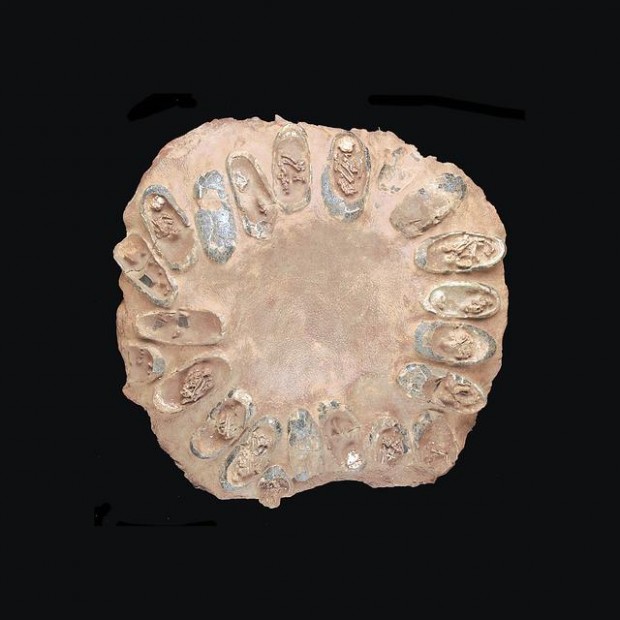
A raptorid dinosaur egg nest from the Cretaceous Period that sold for $419,750 in a natural history sale at Bonhams & Butterfields in Los Angeles displayed the greatest number of raptor egg embryos ever offered at auction. Found in China, the nest measures 27 by 24 by 12 inches, and contained 19 eggs with embryonic remains.