

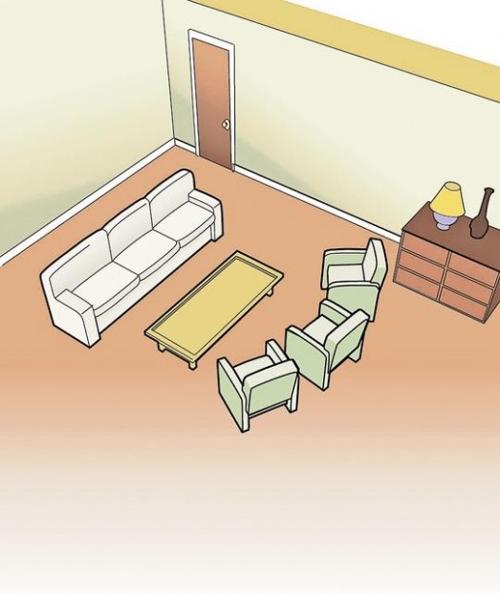
CHARLOTTE, N.C. — When a room is well designed, it simply clicks. Chairs are placed at precisely the correct distance apart, allowing people to sit close enough to talk but not knock knees. Tables are at perfect arm's length from chairs and sofas.
Space planning is one of those tricky tasks in any home: How do you arrange furniture to make the most of your space, drawing attention to the pieces you love and minimizing the pieces you don't? Oh, and you need to allow comfortable traffic patterns, too.
We asked designers to share hard-and-fast rules — and secret tips.
Living/family room
● Your coffee table should be about half the size of your sofa.
Michael Cooper, part owner of Cooper-Kirby Interior Design in Charlotte, warns that a room will look smaller if pieces are too big or if they're all the same size.
People are also reading…
"Don't have a coffee table that's the same length as your sofa, lined up like they're going off to march."
The coffee table should be placed at least 18 inches from the front of your sofa.
● Don't try to fill up the space.
Oversize furniture is a big trend now, and many people are putting huge pieces in rooms that can't accommodate them, Cooper says.
Instead of one giant sofa, think of a smaller one with a few chairs around to accommodate more people.
● Start with a small area and work out from there.
For example, if your family enjoys playing games on a game table, perhaps start by placing the table in one area of the room, then build out from that spot.
● Make conversation areas.
Try to group two or more chairs about 3 or 4 feet apart from each other. People will feel comfortable sitting and talking in those cozy areas where they don't have to shout at one another.
● Floating furniture in the middle of the room is a fine idea, but don't create hallways.
Think about how you want people to pass through the room. Consider what traffic patterns make the most sense and what you want visitors to walk by and to notice. If you're floating an upholstered piece, like a sofa or chair, consider its height.
"Don't make them so low that you feel like you might fall over the edge of it," Cooper says.
Lighting
● Keep your lamp in scale with your furniture.
A rule regarding lighting, Cooper says, is "when you turn up to look at the lamp, you don't want to see the light bulb." Pick a lamp of the right height, with the correct lampshade, so the light bulb is never exposed.
Dining area
● Don't try to cram a sideboard, china cabinet and large table with eight chairs into a small space.
You should leave at least 36 inches behind a tucked-in dining room chair to allow people to get in and out of their chairs comfortably. If you're putting an area rug in your dining room, it's a good idea to make sure it's big enough so the chairs stay on the rug even when people are pulling them out to sit down and stand up.
» RESOURCES
• The Web site www.spaceplanning.com offers space planning systems such as The Furniture Arranger. It contains more than 250 magnetic symbols scaled one-quarter-inch to 1 foot and a magnetic layout grid board, which allow homeowners to lay out their furniture and see how items will fit. Price: $109.
• For a less-expensive option, consider a space-planning workbook. "The Space Planner: A Home Decorating Design Workbook" by Meg Mateo Ilasco (Chronicle Books, $19.95) is available online or at local bookstores. It includes design tips, laminated grid pages, graph and note paper and more than 300 vinyl furniture stickers.
