

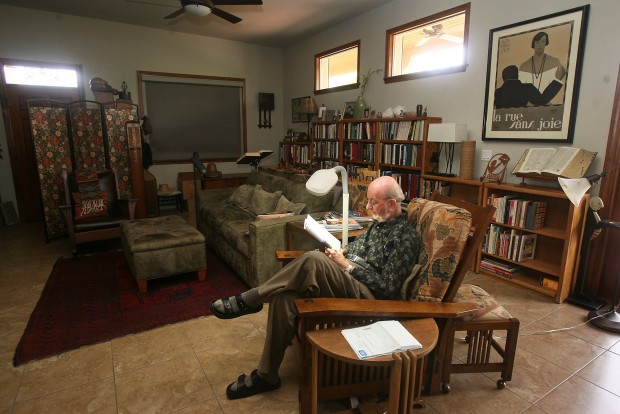


In a month when many Tucsonans are set to see their electricity bills begin to soar, one couple will pay just $7.88.
That's the price Susan Klement and Allen Veaner have been paying each month since they moved in to their downtown home in October 2008 .
Klement and Veaner bought the home, part of Armory Park del Sol, for its downtown location. But just as attractive was the brag of builder John Wesley Miller that it would carry with it little or no electricity bills.
The price Klement and Veaner pay is Tucson Electric Power Co.'s customer charge plus a few standard monthly charges. But they don't pay for usage of electricity, because their solar system produces way more energy than they need.
"We've been told this may be the most energy-efficient house in the U.S.," says Klement of their all-electric home. And she may be right.
People are also reading…
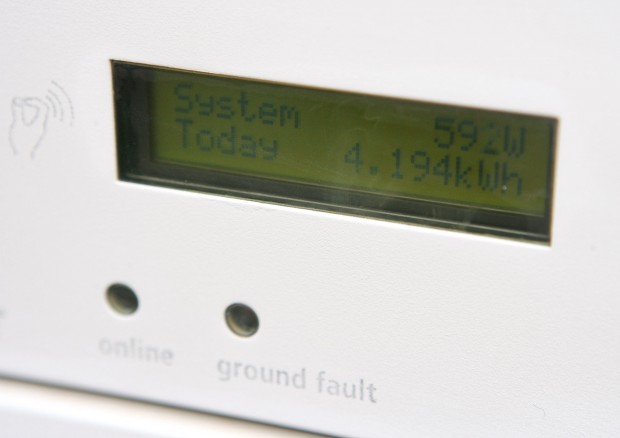
In 2009 the house consumed 7,566 kilowatt hours of electricity and produced 12,154 kilowatt hours - that's 20.7 kilowatt hours consumed and 33.3 kilowatt hours produced per day, according to the National Association of Home Builders Research Center.
The over-production of energy puts it in the class of a net-zero-energy home, and Miller in a category not many home builders have achieved.
"Achieving the full net-zero-energy home performance has been fairly rare. This home is fairly unique in that its total energy supply is actually a net production," says Joe Wiehagen, senior research engineer with the NAHBRC, which has been monitoring the structure since it was first built as a model home.
This makes Klement and Veaner energy philanthropists, something which Klement is delighted about. "We help the rest of the people in Tucson by generating power for them."
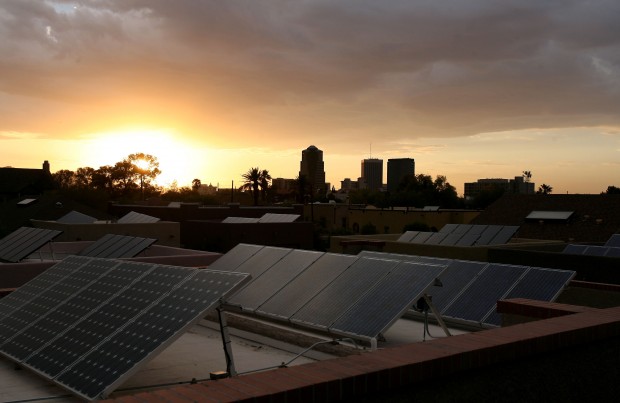
The 2,168-square-foot home has photovoltaic panels on the roof and a solar water heater. Miller built the 2006 home similar to his others in the subdivision, with 11-inch-thick concrete walls and a layer of insulation that's been covered with stucco. But this one got an extra half-inch of insulation, around the walls and in the roof. The same construction - concrete with a layer of polyisocyanurate insulation - is under the floor, creating a thermal mass that holds the same temperature all year round. There are also argon-filled windows.
Wiehagen's equipment monitors the home's electricity production and consumption, with data being sent back to the NAHBRC in Maryland via an electric panel.
Both Miller and Wiehagen say the occupants themselves have contributed to the home's success; Klement and Veaner admit they're "fairly cautious" with electricity, making sure not to leave lights on, using major appliances and air conditioning at night when electricity is cheaper, and keeping their thermostat at a reasonable setting.
But despite the construction and high-tech systems, Klement says they came to this house for the same reason anybody does: location.
They moved to Tucson in 1991 from Toronto. Both were in the library sciences field and had attended conferences in the Southwest. "Every time we would head home, Susan would say 'Alan, we are driving in the wrong direction,' " says Veaner.
Then, after Veaner stopped an elderly neighbor from falling on an icy street near their Toronto home, he asked his wife: "Who is going to save me when I slip on the ice aged 85?"
They packed up their car and took a two-month road trip, checking out Colorado, New Mexico and Arizona. Phoenix they deemed too big, Santa Fe "would have been like living in a postcard." Tucson seemed just right.
They first moved to Tucson's Foothills, where they stayed for 17 years, both working as adjunct staff at the University of Arizona. Then they decided they wanted to be closer to downtown.
Both are retired from their previous jobs and Klement runs a jewelry design business (she uses what would be a third bedroom as her studio, and the second bedroom is an office).
"We're more than pleased - we're absolutely delighted," says Klement, 68, of their new neighborhood, one that began selling homes in spring 2001. (There are still three building lots left).
"Armory Park del Sol is a true neighborhood. The people are concerned for one another, they care about each other, they help one another. Together we are creating a community," says Klement, pointing out that neighbors cook each other meals when there's an illness and do bulk buying trips for the neighborhood to the likes of Costco.
Financially, says Klement, the move wasn't the most sensible. They are in the priciest of homes in the subdivision, with a double lot and a four-car garage. At their age, she says, they are not going to recoup that cost. When it came to their home being appraised for a mortgage, they say it was appraised for far less than it was priced. It helped that Miller bought and later sold their Foothills home.
Says Klement of home appraisers: "They think, probably correctly, that purchasers do not attribute much value to (solar energy)."
But what's important to this couple now is that they're living in a neighborhood where Veaner, 81, can rest assured that if he did take a fall, there would be a ready helping hand.
Giving back to the grid: How it works
At the end of last year there were 298 homes in Tucson with solar power systems and a potential to give back electricity to the grid, according to Tucson Electric Power Co.
The homes, each with photovoltaic panels on the roof, show their greatest surplus of energy during the winter and spring months, when there are sunny days but little electricity use, says TEP spokesman Joe Salkowski.
"If the sunny days are coming in the middle of the summer, they're probably also running air conditioning," he says.
Electricity flow into and out of the house is monitored by a net meter. In the past, TEP customers producing more electricity than they consume have been able to build up credit with the power company, which is absorbed during higher-energy periods like the summer.
But starting in October 2010, TEP will also offer annual cash payments to customers, like Klement and Veaner, with energy credits.
Did you know
TEP offers its customers incentives for solar: one-time payments for installing a photovoltaic system; and up to $1,750 for installing a solar water heater. In addition, the state offers personal tax credits of up to $1,000. For more information go to www.tucsonelectric.com
Coming next week
A challenger to Miller's home: another local builder gets set to unveil his own near-net-zero-energy home.
Resources
• John Wesley Miller Cos., 325-3313 or www.johnwesleymillercompanies.com
• The National Association of Home Builders Research Center, www.nahbrc.com
• The NAHBRC is monitoring the house through a program run by PATH, a public- private partnership for advancing housing technology. Learn more at www.pathnet.org