

Q What is value on a handblown Jim Beam whiskey bottle dated 1911? There are not too many (if any) 1911 anythings around! Two anniversary shots were poured, and the bottle was resealed with wax.
— Norm, Columbus, Ohio
A Think again, Norm. 1911 is recent history as far as collectors are concerned. And certainly for glass bottle collectors in the United States, where bottles date to the Revolutionary War and before. As a matter of fact, the first successful glass house in this country opened in New Jersey in 1739.
Californian Michael Polak, author of "Bottles Identification and Price Guide: 5th Ed." (KP Books, $19.99), knows both old Jim Beam bottles and the newer figural decanters. Without more description, he could not identify your bottle as old. "Most likely it is not," he told us.
People are also reading…
Before Beam's decanter era began for the 1953 Christmas season, the product was sold in amber or clear regular glass bottles. Most bottles had a cork. If yours had a wax seal (you mention resealing with wax), it is not a period bottle.
"It was rare that any manufacturing facility would have had the date on the label or embossed on the bottle," Polak added. Not until the 1940s did Beam and other major distillers include the date of when the company started on the label.
Polak and any bottle expert would have to look at the item and label in person to determine if it is indeed old. Most likely, yours is a commemorative bottle marking 1911 as a milestone.
Lo and behold, on the distillery grounds in Clermont, Ky., is the home of T. Jeremiah Beam, Jim's son. Listed in the National Register of Historic Places and part of distillery tours, the house was built in 1911. Souvenirs sold on the site promote Beam lore — see how the label could happen?
Smart collectors know that not all dated objects trace to the date mentioned. And a bottle that looks handblown may be machine-made but designed to look authentic.
If (and that's a big if) the bottle is authentic, Polak says it would be worth a few thousand dollars, even though it has been opened. Early Beam glass bottles are rare.
"If a collector thinks they have the real thing, do not open the bottle for any reason," he advised. An unopened valuable bottle is prime. If the bottle is standard or recent, open away.
FYI: Go to www.bottlebible. com, Polak's Web site, for links to bottle information.
Q I inherited a set of six framed ink drawings of Rip van Winkle. Apparently F.O.C. Darley did the illustrations for Washington Irving's "The Legend of Sleepy Hollow." These appear to be originals for the first publishing of the book. How do I sell the sketches?
— Roxanne, Lubec, Maine
A Felix Octavius Carr Darley, an American illustrator and printmaker, lived from 1822 to 1888. His outline drawings were rendered into lithographs and book illustrations, scenes of pioneer life and bucolic farm views.
Many illustrators have created art for Irving's classic tale. The story itself did not have an early illustrator; it was published in text installments and reached America from England in 1819.
The illustrator most identified with the story is Arthur Rackham. While Darley may have created art depicting Rip, he is not linked with Irving's publication.
Illustration art, especially that by known artists, does very well at auction. Original Darley watercolors and ink on paper have sold at major houses. According to Art Fact, www.artfact.com, a database of auction results available to the public at sliding rates, recent results range from $403 for a Darley ink drawing to $3,055 for a large watercolor of a street in Rome.
The key is to determine if the Darley art is original. Since the object is to sell, I suggest you contact several auction houses for an opinion. Illustration House in New York, www.illustrationhouse.com, is another resource.
● Send e-mail to smartcollector@comcast.net or write Danielle Arnet, c/o Tribune Media Services, 435 N. Michigan Ave., Suite 1400, Chicago, IL 60611. Please include an address in your query. Photos cannot be returned.
The Smart Collector
By Danielle Arnet
» AUCTION ACTION
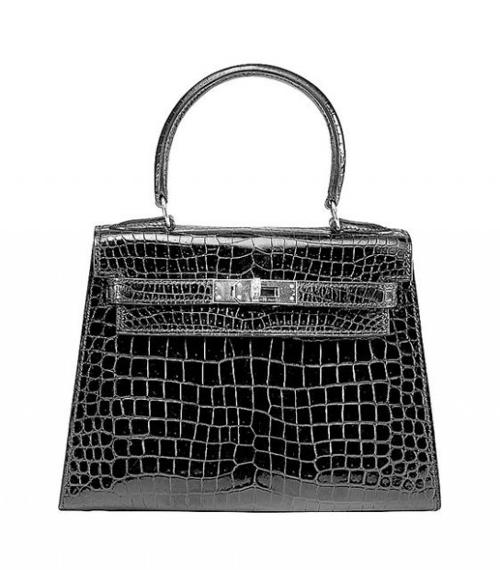
An unusual black crocodile "Baby Kelly" handbag by Hermes brought $12,000 in a recent sale of couture, textiles and accessories at Doyle New York. At 20 by 15 inches, it was a smaller version of the standard 32-by-23-inch Kelly bag. Small renditions of the design created by Hermes for Grace Kelly are rare. The bag featured 18-karat gold hardware and a pave diamond closure.
