


As Tucson environmental consultants, Thomas Staudt and John Durham had a stack of books to help them identify all sorts of plants and animals they saw in the field — except a book on the latest succulent species.
“There were good books, but they were out in the ’50s, ’60s, ’70s, ’80s,” says Staudt, a wildlife biologist. “I didn’t have any current reference book.”
There has been a lot of research and new identifications emerging over the decades, Staudt says. It struck him that the time for an update was now — that was two years ago — and that he would do it.
Durham got on board.
It turned out to be a herculean effort by two guys who didn’t know how to publish a book. But they had very good connections: the brainpower and support of the Tucson Cactus and Succulent Society.
People are also reading…
“I felt that with our 1,000-plus membership, we had the knowledge base and the creative base to put the book together,” says Staudt, who with Durham were society board members at the time and volunteered to lead the project.
Members rallied around the idea of creating a comprehensive Arizona succulent field guide for the 21st century. The two-year project involved four paid authors; 44 volunteer authors, contributors, reviewers, field workers and book production staff; and 143 financial donors.
The group included widely known local plant experts Mark Dimmit, Mary Irish and David Yetman. Yetman, along with Doug Dawson, Matt Johnson and A. Dean Stock, were uncompensated co-authors.
Academics, professional growers and longtime hobbyists donated their expertise to review the text, contribute photos and graphics and provide leads to species information.
Maria Voris, Staudt’s wife, did the design and production work.
“Some people may charge for a regular book,” says Staudt, the book’s project manager and uncredited editor, “but to support our cactus society, they donated that.”
That effort culminated in “The Field Guide to Cacti & Other Succulents of Arizona,” a hefty, colorful paperback that details the features and habitats of 28 genera and the 101 species within them.
“We thanked these contributors and donors with a book release party,” Durham writes in an email. “Thomas summed up the night by stating, ‘If it takes a village to raise a child, it took the entire membership to produce this book.’”
The club fronted $40,000 to pay for the four credited authors, some expenses for field work and printing.
Member donations and two grants totaling $18,500 were used to pay back some of that seed money.
Durham, who is in charge of raising funds and for marketing the book, says it’s the first time a cactus and succulent society has created a field guide this extensive.
FOR FIELD WORK
Small enough to carry in the field, the book appeals to every succulent fan, from plant nerds to winter visitors learning about desert flora, Durham says.
Each species is described in detail and its range and habitat are explained. Each set of photos includes one with its flower.
Both the common and scientific names, the latter with a pronunciation guide, are included. Hybrids, subspecies and varieties also are noted.
It’s this taxonomy, or categorization of plants, that makes it useful in the field, especially for plant professionals.
“This is the first redo of this information in the last 30 years,” Durham says.
Author Peter Breslin was assigned to comb scientific papers for the latest research on species and categorization.
One species, Opuntia diploursina, has never been included in a general field guide until now, Staudt says.
As for categorizing, “taxonomy is a moving target,” Durham admits.
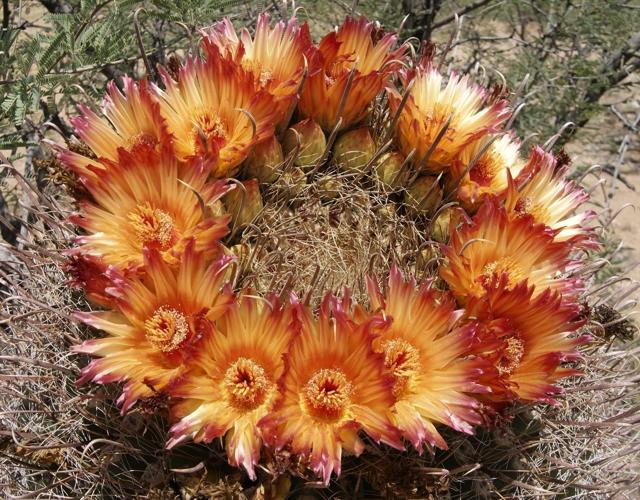
During the course of working on the book, he notes, the scientific name of a barrel cactus species went from Ferocactus acanthodes to Ferocactus cylindraceus and back again.
“To regular folk, it’s not a big change, but it’s the kind of thing that a bunch of cactus nerds will argue over endlessly,” he says.
FOR PLANT FACTS
The book does have plenty of information for regular folks. By describing how a species received its scientific name, the book teaches readers about prominent botanists and researchers (Echinocereus bonkerae), a plant’s location (Agave yavapaiensis) or its characteristics (Epithelantha micromeris).
Readers will find out that a common name might actually describe several species (fishhook barrel cactus), while a single species will have several common names (Cylindropuntia acanthocarpa).
Notes will reveal how early Arizonans used plants for food, medicine and material.
Though not a gardening or landscaping book, the text sometimes includes comments on whether a plant is easily cultivated.
“It’s not written for landscaping, but I see no reason that people that are involved in landscaping couldn’t use this,” Staudt says.
“We wanted to make it general,” he says. “This is not a scientific book. The goal was to make it a general field guide accessible to everyone.”
