

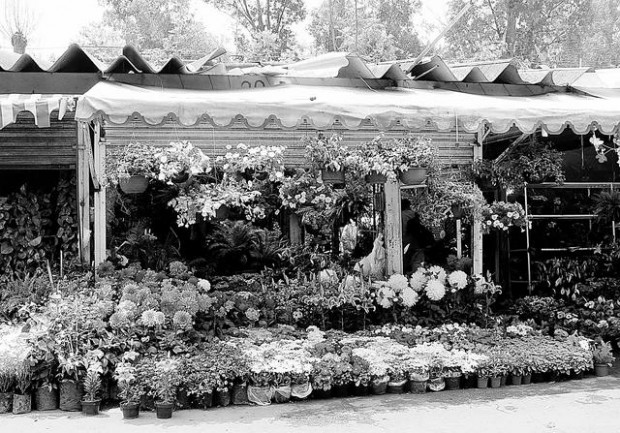
In the south of the Valley of Mexico, the Xochimilca — people of the flowers — founded their city on a verdant wetland.
They dwelled on earth just inches higher than the shallow lake surface that surrounded them. To create more dry land, they hauled lake bottom muck in baskets to create man-made islands known as chinampas, linked by a system of spring-fed canals.
On this land, among the most fertile places on Earth, they cultivated gardens of flowers and vegetables. Today it's called Xochimilco — place of the flowers.
From the highlands that surround their valley, the Xochimilca brought wildflowers, both the cempacuchil (marigolds) and bright wayside blossoms known today as dahlias.
The Xochimilca were conquered by the Aztecs, and their agricultural region was taken over to support the needs of a rapidly expanding empire centered farther north at Tenochtitlan.
People are also reading…
The Aztecs were avid gardeners, and dahlias soon found their way into the gardens of the emperor and the homes of the wealthy, tended by slaves. Flowers, with their short life and fleeting beauty, became vital to celebrations of the Aztecs' many gods and of death. Their god of the flowers was called Xochipili.
There is no doubt that the dahlias collected in Tenochtitlan from far corners of Mexico and Guatemala began to naturally cross-pollinate in these gardens, producing ever more varieties.
But again the dahlia and its people were conquered. Spanish conqueror Hernando Cortés wrote of the flowers, known in the Nahuatl language as acocotli, and even sketched them. Sadly, this and other Spanish works are all that remain of the Aztec records detailing how dahlias were used in the garden and as medicine.
Only seeds were sent to Spain. Flowers of three species eventually grew in Madrid: purple Dahlia pinnata, pink Dahlia rosea and vivid red Dahlia coccinea.
Xochimilco remains today the horticultural heart of Mexico, the chinampas farmed by boat just as they have been for centuries.
Farther afield in that city you'll find a flea market of plants and flowers where you can feel the original commerce of pre-Columbian Mexico, driven by local growers on a cottage-industry level.
Here you'll find the dahlia blooming big and bold in nearly every stall, just as it has since the Xochimilcan times. But these are not the original wildflowers. These are the bold beauties developed in Europe and farther North, and which have come home again.
Now, when we celebrate the Mexican holiday of Cinco de Mayo, consider the dahlias. After being conquered by intruders from the Old World, they have returned to Mexico bigger and better than ever.