

For most plants, a little pruning goes a long way.
This is especially true when it comes to dormant pruning of rose bushes in Southern Arizona.
Unlike their northern counterparts, our warm climate bloomers don't freeze back in the winter, so heavy pruning isn't recommended.
Our pruning is more of a fine tuning — just enough to keep bushes healthy, vigorous and producing a bounty of roses spring and summer months.
First, the thinning
The best time to prune our roses is January, and the first step is to eliminate crowding of the interior of the rose bush.
Growth of new canes can be so vigorous that over time the crown of the plant becomes choked and in need of thinning. Using long-handled pruning loppers, reach into the center of the plant and begin pruning out the smallest canes. Prune them off as close as possible to the plant base.
People are also reading…
Old, nonproductive canes should also be removed.
After thinning, you should be left with four to eight vigorous canes that are thumb-size or larger in diameter. If your bushes are young, the canes may not be quite as thick or numerous.
On mature rose bushes, the oldest canes will be a gray color and several inches across. The most vigorous canes will be somewhat younger, not quite as thick and have a reddish-green stem color.
These vigorous canes over time will be allowed to replace the older, less vigorous ones. Try to keep a balance of old, vigorous and young (green) canes.
Next, the pruning
The next step in the process is to reduce the overall size of the rose bush by half.
Each cane should be pruned back to an outward-facing shoot or dormant bud.
Shoots will be obvious, but dormant buds are harder to see. They're located at the base of the leaf petiole (stem). So, cutting just above an outward-facing leaf will ensure that when the bud breaks dormancy, the new shoot will grow out and away from the center of the bush.
Directing growth outward is very important.
The more light that penetrates the center of the rose bush, the more flowers the plant will produce. So, try to eliminate any inward-growing shoots, stems or canes. Over time, with proper pruning a standard rose can become very large and wide.
Keep this in mind when planting new rose bushes. Allow for a minimum 3-foot spread per bush.
Unlike all other plants I know of, pruned roses require the cuts to be sealed.
Sealing prevents cane borers (various beetle larvae) from penetrating into and down the cut stem.
The best and easiest way to seal cut ends is to dab on some Elmer's glue. It's not toxic to the rose, is environmentally safe and does a great job of sealing the cut and keeping bugs out.
Apply the glue to all cuts one-half inch or greater in diameter.
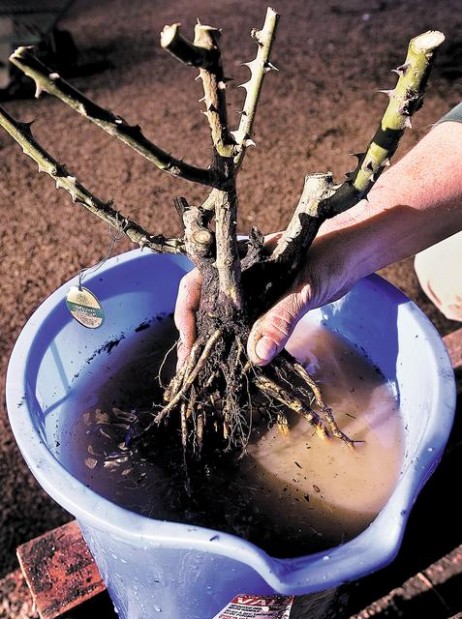
In addition to pruning, this is also the time of year to plant new bare-root rose bushes.
Bare-root roses
Right now, bare-root rose bushes are available at local garden stores in an array of colors. They should be planted in the garden as soon after purchasing as possible to prevent the roots from drying out.
Roses grow very well in containers and raised beds. If you are preparing a bed for planting in the ground, mix in lots of organic matter prior to planting. After planting, keep the soil moist to encourage new root growth.
» Demo topic
"Patio & Container Gardening" is the topic of this week's gardening demonstrations. Presentations will be at 1 p.m. Wednesday at the Wilmot Library, 530 N. Wilmot Road, and at 1 p.m. Friday at the Oro Valley Public Library, 1305 W. Naranja Drive.