

Homeowners are increasingly designing the layout and look of their kitchens — a task that builders once traditionally drafted.
That means moving away from a galley style, where everything is in a straight line, to more of a triangle design with separate areas for food preparation, storage and cleanup.
When builders designed kitchens in the past, it usually meant placing countertops and areas for appliances near utility lines.
Now, "more consideration has been put on the ergonomics of that space," said Jim Busche, owner of Kitchen Solvers of Tucson, a kitchen and bath-remodeling franchise.
Homeowners are creating work zones and tweaking the look of existing cabinets and countertops — an acknowledgment that stylish yet practical kitchens are the hub of family life and entertaining.
People are also reading…
The idea of work zones is to have a station in the middle of appliances such as the refrigerator, stove or oven, and sink. Kitchen islands are a popular addition. Another is a counter that extends past the cabinets in an "L" shape like a peninsula.
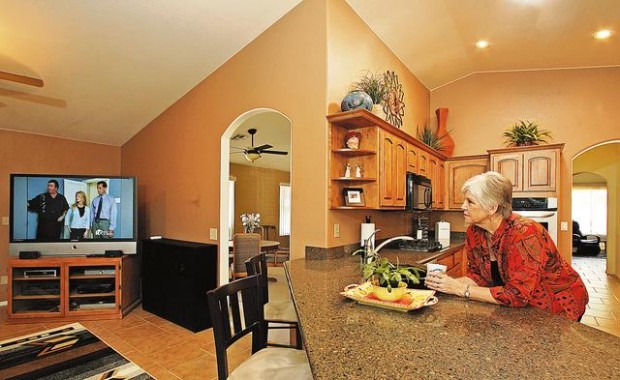
The peninsula style sold Pam Holder and her husband, Craig, on their home in SaddleBrooke. Just past this counter is the living room.
"When you're in the kitchen, you're still part of what's going on," said Holder, who moved to Tucson from Pasadena, Calif., with her husband. "You don't feel isolated. It gives you a much greater feeling of space."
The couple embarked on an extensive kitchen remodeling shortly after buying their house in January. They opted for terra cotta-colored floor tiles, stripping the existing sky-blue ones.
The couple replaced peach-colored Formica countertops with Silestone, a composite of quartz and plastic.
Using one solid sheet of material for countertops has become one of the most popular trends in kitchen design. It looks modern and is practical.
"We're seeing more people come back to Corian or solid-surface-type material because bacteria don't build up in it," said Burton Kaye, a sales representative and designer for Davis Kitchens.
Holder and her husband relied on Home Depot for new tiles and countertops.
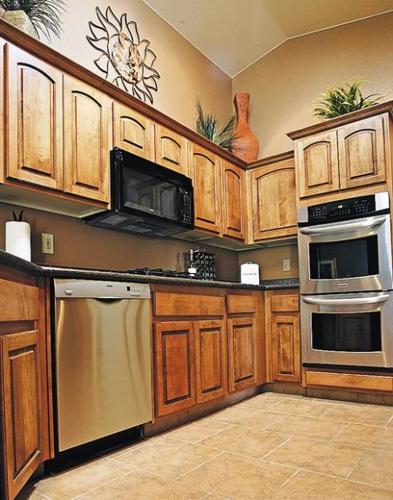
The cabinet work went to Busche, who came in with a bid of about $8,000. He suggested refacing, which involves replacing doors or drawer fronts and a new finish on other parts of the existing frame.
"It's more economical. It's much cheaper and easier to reface the cabinet than to have a complete replacement," said Don Carpenter, owner of Carpenter's Custom Cabinets.
He estimates homeowners could see a 50 percent to 60 percent savings in cost by refacing instead of going for new cabinetry.
While remodeling can total thousands of dollars, research shows much of that expense can be recovered should the house go up for sale.
Homeowners who completed a minor remodeling, which averaged $17,928 nationwide last year, recouped about 85 percent of the cost, according to Remodeling magazine's "Cost vs. Value" 2006 report.
The value recovered from major work, averaging $54,241, stood at about 80 percent.
"People are just drawn to the kitchen," said Rick Hodges, chief executive officer of the Tucson Association of Realtors. "The kitchen speaks for the house."
» Remodeling Costs
• New cabinetry: Available in an endless array of styles, woods and stains, prices range from $175 to $300 per linear foot.
• Refacing cabinets: A variety of custom-made, solid woods are available, including oak, birch, hickory, maple and cherry, ranging in price from $150 to $200 per drawer or cabinet opening.
• Countertops: Available in granite, solid surface or laminate. Prices for granite and quartz range from $45 to $75 per square foot.
• New flooring: Plenty of design options and materials are available to choose from, including engineered wood, laminate, cork and ceramic. Prices range from $3 to $10 per square foot.
• All prices depend on the size of the kitchen and the style/option selected.
Source: Kitchen Solvers of Tucson