
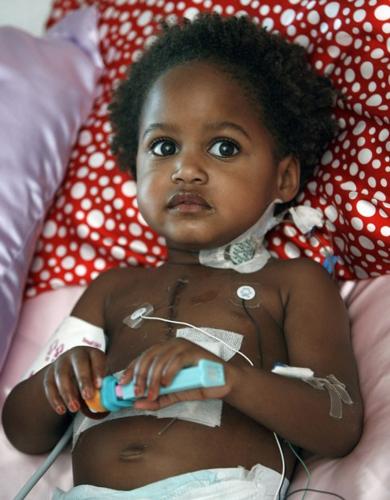
As new foster parents, Taber and Burke Bingham hadn't planned to adopt.
Their goal was to provide a temporary haven for infants like Mary, a beautiful, weeks-old baby whose birth mother could not care for her.
As Mary grew, however, her need for a home changed from temporary to permanent, and the Binghams, smitten with this girl, now 18 months old, realized they couldn't let her go.
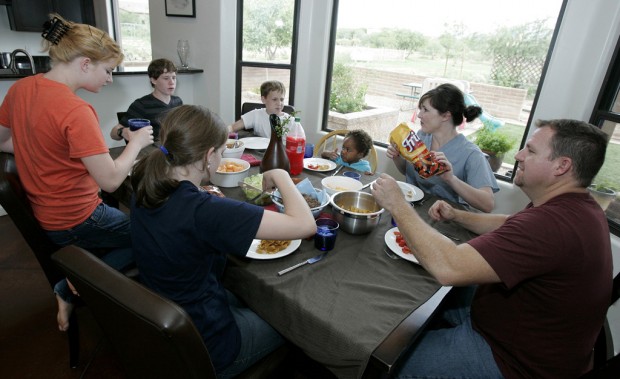
She had become their fifth child.
"It was easy to fall in love with her," Taber said, "and to be her mom."
And so when they learned, just hours before they were to adopt her, that she had leukemia, there was no question: They would see Mary through whatever came next.
•••
Taber, a labor and delivery nurse, prayed it would be acute lymphoblastic leukemia and not its more sinister sister, acute myeloid leukemia.
People are also reading…
As they awaited results at University Medical Center, a judge visited to make the adoption official, sealing them together as a family and giving the Binghams the authority to make medical decisions for their daughter.
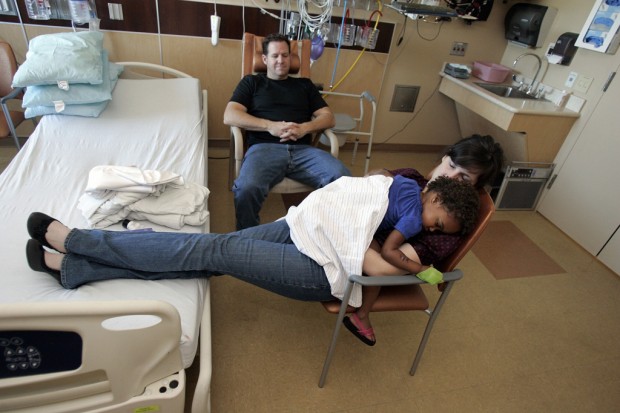
The news was what Taber dreaded: AML. Mary would need five doses of chemotherapy spread out over five months, and she would not be allowed to leave the hospital.
With four other children at home, the Binghams faced balancing their home lives, work and hospital time.
"When it happens to you, it's just so unbelievable and overwhelming," Taber said.
Pediatric oncologist Puja Gupta said the most common childhood leukemia is acute lymphoblastic leukemia, which has a survival rate of 85 percent.
"AML, on the other hand, is more aggressive and has an overall survival rate of 70 percent, but that includes a significant number of patients that survive after relapsing," Gupta said.
Chemotherapy for AML is more intense, she said, and wipes out the bone marrow completely. This, in turn, inhibits the patient's ability to fight infection and requires they stay in the hospital during treatment.
After everyone was gone that evening at UMC, Taber and Burke were left alone with their anxiety about the months that stretched before them.
Mary was finally restful, with pain medication easing the restlessness she'd exhibited for weeks before her diagnosis.
"We just held her and cried the whole night," Taber said.
•••
On a recent Tuesday morning at the Binghams' home in Vail, Mary, now 3, ran back and forth between her mother, seated in the sunny kitchen, and the play room, her feet pounding along the painted concrete floor.
"It's been quite the journey, and it will continue," Taber said.
Mary and her parents spent five months in the hospital as Mary underwent chemotherapy, fighting hard against this cancer that hits only 500 children each year.
It's critical she doesn't relapse during the first two years. They are almost at 18 months.
But Mary's challenges aren't limited to cancer anymore.
Within a month of her release from the hospital in April 2011, the Binghams learned Mary was again falling among medical minorities. The chemotherapy had severely damaged her heart.
They hoped her heart would last a couple of years. They tried various heart medications, but soon realized it wasn't helping.
Last Thanksgiving, she had a hypoglycemic seizure and turned blue. They thought it was cardiac arrest and that she was dying.
"They dropped a helicopter in our yard. They shot sugar into her arm. She was still not responding, but she was improving," she said.
Mary made it through that only to have her system fail her again around Valentine's Day.
"Her lungs filled up with fluid, her liver filled up with fluid," Taber said. "That was truly the beginning of the end."
More tests followed. They needed to make sure she was healthy enough to receive a new heart. By April she was listed for a transplant.
"I think the most difficult parts of our experience have been the unknowing, and the feeling of helplessness as we watch Mary suffer and wonder if our child will survive," said Burke, who works for the city of Tucson.
"For so long it felt that each time we had a positive resolution, it was followed by a heart-wrenching setback."
On April 10, Mary collapsed again and arrived, once again, at UMC.
Coincidentally, her cardiologist had just learned that a heart was available. A child was on life support. They needed to act fast. The doctor left in a private jet to check if the heart was the right size and ensure that it hadn't been damaged by CPR.
"It was very overwhelming," Taber said, wiping tears. "I kept thinking, 'Somebody is going to lose their child right now so our child can live.' "
The heart was perfect.
•••
Burke Bingham can't help but wonder sometimes if Mary is here for a special purpose and if that has enabled her to endure so much.
He has been "overwhelmed," he said, "with the abundance of hard-working, caring people who give their best because they believe in what they are doing."
Child Protective Services, their foster agency and Mary's birth relatives all come to mind, he said, as well as the doctors and medical staff at UMC.
"The power of good people doing good is undeniable," he said.
Her oncologist said the praise goes both ways.
"Despite her cancer, treatments and heart failure, Mary continues to thrive and be amazing," Gupta said. "The dedication of her parents is one of the reasons Mary is thriving today."
Mary's biological grandmother provided them with tremendous support throughout the little girl's illness, Taber said, often calling to recite something inspiring or sing a lullaby.
"She's been my rock through the whole thing, and we've become good friends. She always reminds me that what was going to happen to Mary was in God's hands and we could only do so much," Taber said.
The days remain challenging for the Binghams. Mary's immune system is suppressed so her body doesn't reject her new heart, and the immunizations she received as a baby no longer provide any protection against infectious disease.
Taber and Burke have worked out their schedule so one of them is always home with her. Blood draws are still needed regularly, and Mary has painful neuropathy in her feet.
They hope their daughter can eventually join a small, home-schooling group in their neighborhood. For now they keep her home as much as possible.
"She's a fighter. When she's mad, she's mad, but that's probably what saved her," her mother said. "She wanted to live."
Contact reporter Patty Machelor at 806-7754 or pmachelor@azstarnet.com