
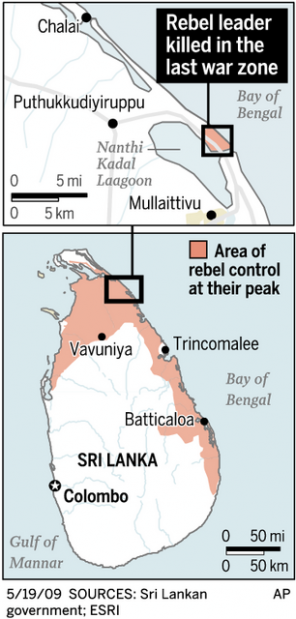
COLOMBO, Sri Lanka — After more than a quarter-century of civil war, peace could be even more daunting for Sri Lanka.
When many in the Sinhalese majority heard that Tamil Tiger rebel leader Velupillai Prabhakaran was killed Monday by government forces, they erupted in cheers, banged drums and set off fireworks.
Many in the Tamil minority, however, worried that their lives would only grow more difficult following the rebel group's battlefield defeat.
The far different reactions underscored the difficulty Sri Lanka will have in trying to reconcile and rebuild in the wake of a civil war that killed more than 70,000 people.
State TV played Sinhalese nationalist songs and many Sinhalese poured into the streets in celebration.
On the beaches surrounding the southern port city of Galle, overjoyed Sri Lankans ignited chains of firecrackers. Groups of motorbike riders raced through the city streets, waving flags. As night fell on the nearby beach town of Unawatuna, a group of 30 children paraded near the beach, banging homemade drums and singing.
People are also reading…
"We are happy today to see the end of that ruthless terrorist organization and its heartless leader. We can live in peace after this," said Lal Hettige, 47, a Sinhalese businessman.
But Tamils feared the government would not be magnanimous in victory.
"The general triumphalist mood is only an indication that Tamils may never get their due place," said S. Prasanna, a sales representative.
Many other Tamils refused to speak on the record after what they said was years of police raids, harassment, arbitrary detentions and even abductions.
"I believe the arrests and detentions will only increase from now on," a 34-year-old Tamil businessman said. "The government will be suspicious with everybody, thinking the Tigers may have come out and mingled with the civilians."
One of the world's most sophisticated insurgencies, the Tamil Tigers were brought down by a string of fatal misjudgments and an unrelenting government onslaught aimed at crushing the separatist rebellion at all costs.
President Mahinda Rajapaksa, who plans to officially declare victory today in a speech to parliament, has promised a power- sharing deal with the Tamil minority. But the end of the war, which killed more than 70,000 people and displaced 265,000 others, could complicate efforts to forge a lasting peace.
The destruction of the rebels' conventional forces does not mean the threat is over. Insurgents hiding in the jungles of the east have emerged periodically to attack government forces and civilians, and the rebels had sleeper cells planted in Colombo and other towns.
The Tamil Tigers also retain a vast international smuggling network and the financial support of some of the 800,000 Tamil expatriates. At least one top rebel leader, Selvarasa Pathmanathan, the reputed smuggling mastermind, remains at large.
"Now (there) is a historic opportunity, and hopefully things will change. But the demonstrable record so far is not particularly encouraging," said Paikiasothy Saravanamuttu, a political analyst and executive director of the Colombo-based Center for Policy Alternatives.
In Washington, State Department spokesman Ian Kelly said the U.S. is "relieved that the immense loss of life and killing of innocent civilians appears to be over," and he urged Sri Lanka to build a tolerant society and help those hurt by the fighting.
While Velupillai Prabhakaran was a hero to some, his group was branded a terrorist organization by the United States and European Union. It was accused of waging hundreds of suicide attacks, including the 1991 assassination of former Indian Prime Minister Rajiv Gandhi, and forcibly recruiting child soldiers.
In recent months, government forces ousted the rebels from their stronghold in the north and cornered the retreating fighters in a tiny strip along the northeast coast.
On Monday morning, the troops closed in, the military said.
Prabhakaran and his deputies drove an armor-plated van accompanied by a bus filled with rebel fighters toward the tightening cordon, sparking a two-hour firefight, two military officials said.
Troops eventually fired a rocket at the van, ending the battle, and pulled out Prabhakaran's body as well as those of Soosai, his naval commander, and Pottu Amman, his feared intelligence chief, the officials said. Prabhakaran's son, Charles Anthony died along with 250 rebel fighters, the military said.



 Historic bank vault now new Tucson speakeasy