

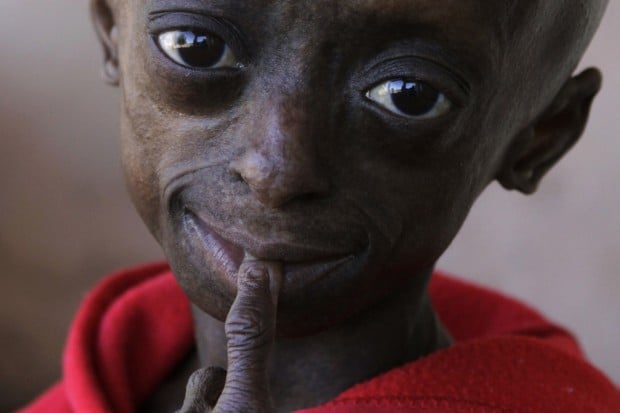
JOHANNESBURG - The elfin child with the big personality and bright smile calls herself "the first lady" and dreams of the future.
But doctors say 12-year-old Ontlametse Phalatse has only a couple of years to live.
"I call myself a first lady because I'm the first black child with this disease," she said.
Ontlametse is, in fact, the first black child diagnosed with progeria, a rare and fatal genetic condition that accelerates the aging process, the Progeria Research Foundation said.
Nobody knows how many kids in the world have it. In a two-year campaign to identify them, the Progeria Research Foundation says the number of children diagnosed around the world has soared from 48 to 80 on five continents.
The foundation's executive director, Audrey Gordon, says only two Africans have been diagnosed and both live in South Africa - Ontlametse and a 5-year-old white girl. That is probably because South Africa offers some of the best medical care on the continent.
People are also reading…
Gordon says there are several black holes on the map in her office studded with colored tacks where they have found children living with progeria.
"We know that there are children (with progeria) in Africa, in China and Russia, but we just can't seem to get to them," she said in a telephone interview from the foundation's office in Peabody, Massachusetts.
Ontlametse's mother, Bellon Phalatse, says her baby was born looking normal but that she realized early that something was wrong. The baby suffered constant rashes and by the time she was 3 months old Phalatse thought she had a skin disease.
Before Ontlametse celebrated her first birthday "her hair was falling, her nails weren't normal, the skin problems, we were going up and down to the doctors."
Her father abandoned the family when Ontlametse was 3 years old.
Despite her frequent illnesses, Ontlametse enrolled in school at 6 and proved a bright pupil. But she was often scorned by classmates, teachers and others who thought she was so small and skinny because she had AIDS.
It was not until two years ago that her condition was diagnosed. The diagnosis came with the news that most children with the disease die at 13.
But it also brought specialized care she needs. Each school holiday, Ontlametse and her mom fly to the United States, where she takes part in research funded by the progeria foundation at Children's Hospital Boston.


