

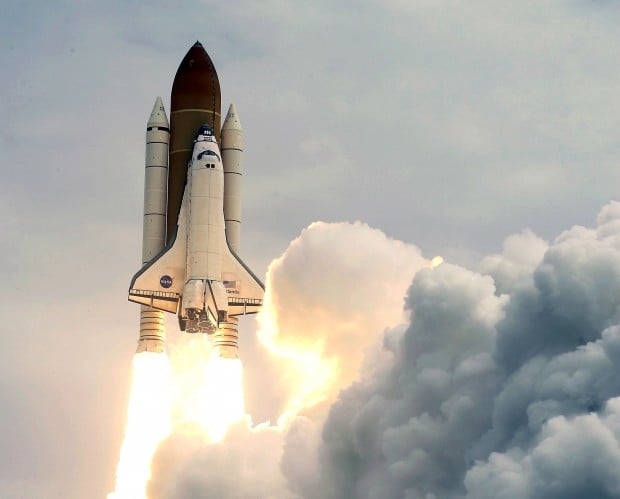
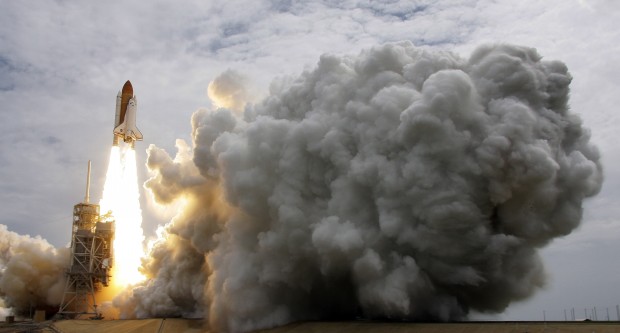
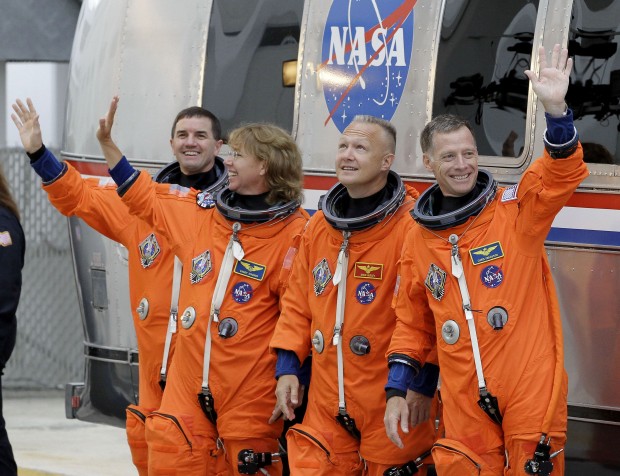




CAPE CANAVERAL, Fla. - With a cry from its commander to "light this fire one more time," the last shuttle thundered into orbit Friday on a cargo run that will close out three decades of triumph and tragedy for NASA and usher in a period of uncertainty for America's space program.
After some last-minute suspense over the weather and a piece of launch-pad equipment, Atlantis and its four astronauts blasted off practically on schedule at 8:29 a.m. Tucson time, pierced a shroud of clouds and settled flawlessly into orbit. The crowd watching the launch was estimated at close to 1 million, the size of the throng that watched Apollo 11 shoot the moon in 1969.
It was the 135th shuttle flight since the inaugural mission in 1981.
"Let's light this fire one more time, Mike, and witness this great nation at its best," Atlantis commander Chris Ferguson told launch director Mike Leinbach just before liftoff.
People are also reading…
Atlantis' crew will dock with the International Space Station on Sunday, deliver a year's worth of critical supplies to the station and bring the trash home. The shuttle is scheduled to land on July 20 after 12 days in orbit, though the flight is likely to be extended by a day.
Thirty years of flight by NASA's space shuttles will end once Atlantis returns home. The space agency will be looking to deeper space exploration, but the future is still unclear.
NASA is looking to private companies to develop a new space vehicle, and it will be at least three years, maybe longer, before one is ready. Some basics about the shuttle program and why it is ending:
Question: Why are the shuttles retiring?
Answer: The shuttles are aging and expensive, and their chief task of building the International Space Station is essentially done. Now NASA wants to do something new.
Q: Who decided to stop flying the shuttles?
A: President George W. Bush made the decision in 2004. He wanted astronauts to go back to the moon, and eventually to Mars. But President Obama dropped the moon mission. His plan has NASA building a giant rocket to send astronauts to an asteroid, and eventually Mars, while turning over to private companies the job of carrying cargo and astronauts to the space station.
Q: Why were the shuttles built?
A: It was supposed to make getting into space cheap, simple and safe, flying into low orbit virtually every week. It didn't accomplish that. But it was the best way to get big items - such as satellites and the Hubble Space Telescope - into orbit and fix them if needed. For the space station, it was a combination moving van and construction crane. What made the shuttle unique was its ability to do all kinds of things.
Q: What happens to the space shuttles?
A: They'll be on display across the country. Endeavour goes to the California Science Center in Los Angeles, and Atlantis will stay at Kennedy Space Center for its visitor complex. Discovery's new home will be the Smithsonian Institution's hangar near Washington Dulles International Airport. Enterprise, a shuttle prototype used for test flights, goes to New York City's Intrepid Sea, Air and Space Museum.
Q: What about the space station?
A: The life of the space station has been extended to at least 2020 and it could continue even longer. It's now big enough for six people. They conduct science research, from astronomy to zoology, and help scientists understand the effects of people spending long periods of time in space.
Q: What about the astronauts? Do they still have jobs?
A: Some will. More than a dozen astronauts will still go into space and live on the station. Others will wait around for slots on still-to-be-built spaceships, including the ride to an asteroid. Others will leave the program. The same thing happened after the Apollo program ended nearly 40 years ago.
Q: How will astronauts get to the space station?
A: NASA will continue to buy seats on Russian Soyuz capsules to ferry space station residents. The $56 million price per head will go up to $63 million, which is still cheaper per person than the space shuttle.
Q: Is there any other way to get into space?
A: Not from U.S. soil once the shuttles retire. NASA could eventually use the commercial rockets and capsules being developed by private companies. Two companies predict they could fly astronauts to the space station within three years. NASA is under orders to build a giant rocket to go beyond Earth orbit.


