

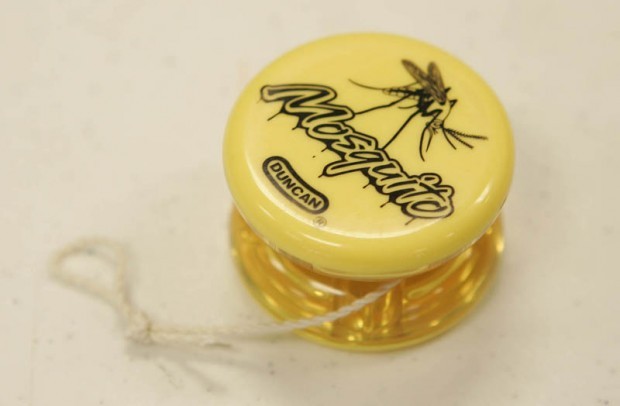
The first yo-yo craze began in the United States in 1928. It hit Tucson a few years later and a contest at a drugstore inspired this article.
Pretend you have never seen a yo-yo. Would this description make you want to try one?
From the Arizona Daily Star, March 13, 1932:
Grandsires Vie With Youth in
Promotion of Yo-Yo Fad
__________
William Dunpiece
A mob of jostling, gesticulating youngsters crowded about the front doors of an East Sixth street drug store Friday afternoon. Most of the were junior high school age, but a plentiful supply of older and younger yo-yo fans were also in evidence. In fact, quite a few adults were doing their best to enjoy the show from the edge of the crowd.
The drug company was conducting its first yo-yo contest.
A yo-yo, in case you do not know, is a wooden contraption which looks something like the bulbous portion of a darning egg, except that it has been split through the narrow side and pegged together in the middle. Tied to the center peg is a specially twisted string of a yard or more in length. Painted in a variety of attractive colors, the latest amusement fad is not without its claims to beauty.
At first glance, a yo-yo is about the most useless appearing toy one could hope to see. But watch one of the juvenile experts perform with his; perhaps he will change your mind.
Standing in the center of a proudly admiring crowd, the local champion struts his stuff.
Winding the string rapidly about the center peg of his yo-yo, he places a small loop in the end of the string over his first finger. Then with a deft movement of the wrist he sends the yo-yo down the length of the string. To this point everything is easy to understand, but when the yo-yo promptly rolls itself back up the string to its owner's hand, the newcomer's eyes usually become bright with attention.
The trip down and back up the string is the first movement in yo-yoing. After this has been learned the real bag of tricks is in order.
But back to our champ. With the greatest ease in the world he sends his yo-yo through the easier tricks, such as the inside and outside loops over the operating wrist. Then come the skyrocket, around the world, and the Palm Beach and Long Beach specials.
By a quick jerking of the cord as the yo-yo is on the upward climb, the toy suddenly starts skyward at an unusual rate of speed. Back it comes, just as the plate glass show window seems doomed to destruction. And that's the sky rocket.
"Around the world" is done by making the yo-yo gyrate in a sweeping vertical circle.
The pocket loop consists of the primary inside loop over the operating hand, plus making the yo-yo land in the performer's shirt pocket. This one is difficult because of the accuracy necessary.
"Make 'Em Walk" is one of the show tricks, and the operator has his yo-yo bouncing along the ground much after the fashion of a kangaroo or jackrabbit.
The champion of a yo-yo meet generally depends on how many different tricks the contestants are able to produce from their private collections.
Among those that have just been invented are the "jumping jack" and the "bumblebee."
While his yo-yo is going through a difficult side-to-side movement, the contestant jumps over the moving yo-yo; that's the way the "jumping jack" gets its name.
The "bumblebee," according to some of the experts, is still more difficult. After the yo-yo seems to be climbing well, the performer suddenly shoots it between his widely-spread legs. On the return trip, the yo-yo climbs up the yo-yoer's back. Rather, that's what it's supposed to do; usually it gives him a smart slap on the under side of his lap.
There is a difference in yo-yos, just as in nickel cigars, according to Gordon Randolph, one of the clerks at the drug store.
"Ten centers are too light to use for tricks," said Randolph in demonstrating the various sizes. "Fifteen centers are better, but the best are these large quarter ones. See how the edges of the string groove have been smoothed off? That makes it easier to keep the yo-yo in action.
"These strings are of a special twist, too," continued Gordon. "Some kids use as many as four a day in spite of the fact that these last much longer than ordinary wrapping twine."
How the craze has caught on in Tucson may be judged from the distributor's sales figures for the first month and a half. Five thousand yo-yos have been distributed through local merchants, and there seems to be little decrease in the demand. One hundred gross have been sold in Phoenix since the first of the year, and Nogales is just now getting the spirit of the thing, much to the joy of Nogales merchants and the despair of Nogales parents.
After the close of the recent contest, a two and a half pound box of candy went to the winner, Carl Hees of East Fifth street, a two-bit yo-yo studded with ten brilliants went to second place winner, Bill Willis, East Seventh street, and a similar yo-yo with one brilliant was awarded Carl Griffith, who gained the third place in the judges' estimation.
Across the street after the prizes had been awarded an elderly business man was seen walking slowly toward home. Up and down, up and down, went his hand. He had just learned how, and he paid no attention to his clamoring son. He was having too much fun himself.
Have you a little yo-yo in your home? Guaranteed to keep you husband home nights and also to furnish first class entertainment for the troublesome bridge dummy.
People are also reading…
For any younger readers, the yo-yo probably needs less description than the darning egg it to which it was compared. Those who don't know what a darning egg is must ask their grandmas for a demonstration.
The Morgue Lady wants to know if the yo-yo really kept husbands home at night if they were otherwise disposed to spending their nights out with the boys — or worse, the girls. And she thought the bridge dummy was kept occupied refilling coffee and tea cups. However, her experience is a bit more recent than 1932.
The best-known brand of yo-yo appears to be Duncan. The Morgue Lady did a little research on yo-yos and came upon the Duncan YoYo website, which gives a history of the yo-yo:
Yo-yos have been around as early as 550 B.C., according to paintings on Greek vases from the period. In the 1700s and 1800s they were referred to as "quizzes" in English and "bandalore" in French. The first recorded use of the word "yo-yo" was in 1860 in a dictionary of Filipino words.
Pedro Flores made a yo-yo in the United States in 1923 and opened his first yo-yo factory in 1928. The craze began when Flores started promoting contests. Donald F. Duncan —yes, that Duncan — saw his first yo-yo that year.
In 1930, Duncan teamed up with Hearst Newspapers to promote yo-yo contests and bought out Flores, who then went to work for Duncan.
The first World Yo-Yo Competition was held in 1932 in London, England.
Since that time, the yo-yo has varied in popularity, but has always been readily available in stores. Most are no longer made of wood; plastic is cheaper and more durable. There is even a National Yo-Yo Museum in Chico, California. (March 28, 2011: This originally said the museum is in Chicago. A reader noted the mistake, for which the Morgue Lady offers her thanks and an apology for the error.)
The term "yo-yo" is as popular as the toy, referring to the ups and downs of dieting, moods, the economy and life in general.
The Morgue Lady never mastered the art of yo-yoing beyond making the thing go up and down. Her brothers did a little better. How about her readers?


