

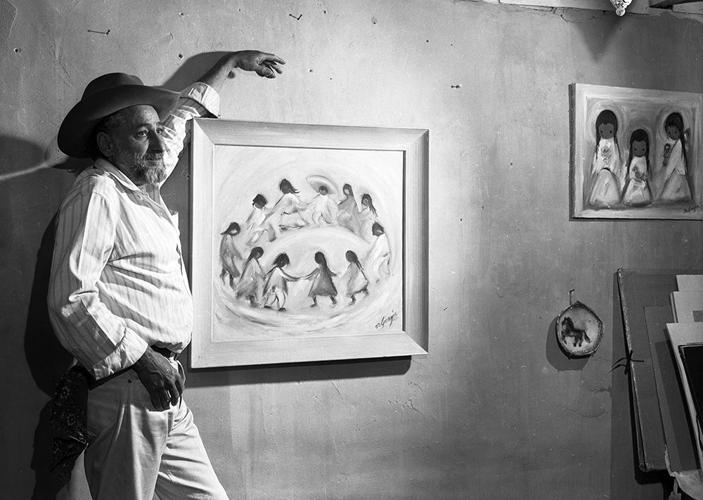
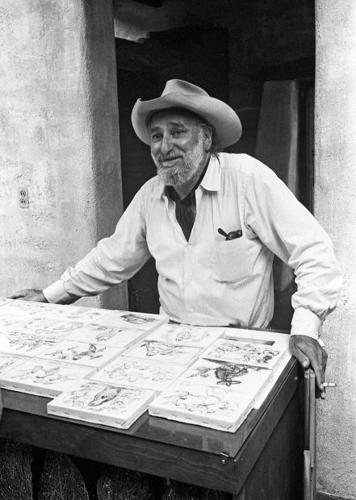
Ted De Grazia was a prolific artist who left a legacy of art and a gallery.
Some called him an artist-merchandiser. His art could be found not only on Christmas cards, but on playing cards, puzzles, and other merchandise.
White this may have lowered the value of his art in some people's view, it contributed to the name of De Grazia being well-known even years after his death.
He was born Ettore De Grazia June 14, 1909 in Morenci.
From the Arizona Daily Star, Sept. 29, 1949:
Arizona-Born Artist Returns Home to Continue Art Work
By Judy Friedman
Arizona-born Ted De Grazia has returned home, both in spirit and in art work.
"And I'm my own welcoming committee," said De Grazia.
Born in Morenci, De Grazia spent his first 16 years in Italy. He returned to Arizona until 1942 when he went to Mexico to study art with Diego Rivera and Orozco.
Up until this year, most of De Grazia's work has been of Mexico. Scenes depicting the native people in their every day life is his favorite topic.
Came Home
But this year De Grazia came home with his work. He has spent the summer traveling to various southwestern Indian reservations. His new paintings are of Apache, Papago and Yaqui tribes and of scenes like San Xavier mission.
His choice of coloring has changed too. De Grazia, an impressionist, has previously been known for boldness in color and sweeping designs. Now he paints in shades leaning toward the pastel. However, movement of design is still definite, though his surface is flat. De Grazia does not believe in perspective.
Promote Tucson
Now De Grazia wants to lend his talents to promote Tucson and the southwest in general. He feels that his paintings will help to show the cultural aspects of native-born Arizonans.
Yesterday in his adobe home on North Campbell avenue, De Grazia met with Mayor E.T. Houston and Russell L. Soden, manager of the Tucson Sunshine Climate club. Tentative plans discussed include a preview showing of the artist's new works, with proceeds going to the Climate's club fund. De Grazia's work may also be used in the Climate's club future advertising.
Tentative Arrangements
These tentative arrangements will be brought before the Sunshine club's board of director's meeting Oct. 11.
Main showing of De Grazia's southwestern works will be held in Los Angeles Nov. 20 to Dec. 4. "Only two weeks in California," said De Grazia. "I can't stand a longer stretch."
Outstanding pieces include a view of the San Xavier mission with a cart full of Papago Indians in the foreground; an Apache devil dance, done with bold outlines of the moving figures; and two Yaqui men performing the traditional deer dance.
The Bronc-Rider
Reminiscent of De Grazia's well-known Mexican cockfight, bullfight and dancing figure paintings is the Indian bronc-rider. It is done in the circle design of broad, palette-knife lines. Speed describes the racing horse with Apache Indian rider. The dashing form is symbolized by streaks of grey and blue, emphasized by the rider's red shirt.
De Grazia will show 30 paintings in Los Angeles. He has scheduled showings in Santa Fe, N. M. in January and in Minneapolis in early spring. De Grazia has also been invited to present his southwest scenes at an early 1950 showing in La Jolla, Calif.
Discuss Plans
Today De Grazia will discuss preliminary plans for a newspaper mural at the Tucson Press club.
Once a month De Grazia will present showings of other artists in his studio-home. The first showing will be works of De Grazia's newest discovery, Mrs. E. J. Nagoda of Tucson. A primitive artist, Mrs. Nagoda's paintings are done in oil. Her works will be shown in December.
People are also reading…
As he approached his 68th birthday, De Grazia was profiled by the Star's J.C. Martin.
From the Star June 12, 1977:
De Grazia at 68
Artist-merchandiser says he 'never expected to hit it big' — but he did
By J. C. Martin
The Arizona Daily Star
Ted De Grazia will be 68 years old Tuesday.
This compact, bearded, tattooed, jewel-bedecked, chino-clad artist and entrepreneur extraordinaire, born on Flag Day in Morenci when it was in Arizona Territory, can still muster a little wonder when he says he "never expected to hit the jackpot, never expected to hit it big."
But that's exactly when he did.
If he is not Arizona's most celebrated artist, he is certainly its most successful artist-merchandiser.
You want a deck of playing cards? A paperweight? A laprobe? All are embellished with those famous faceless figures of Indians or Mexicans with the impossible anatomies — little more than graceful pear-shaped swirls of color. (A critic once called him "an expressionist Walt Disney.")
Or a jigsaw puzzle, dart board, T-shirt, wall plaque onto which the De Grazia figures have been painstakingly transferred and a few (authorized by De Grazia himself) brush strokes added to give it a final cachet.
Can't decide? There's a 56-page catalog to take with you (that costs $1).
"I'm glad," De Grazia will say absently from time to time, "I never really did develop a taste for money."
Nothing has De Grazia merchandised more persistently or successfully than himself. All the best De Grazia stories still belong to him, although they are available for purchase in books, albums and movies. Last April De Grazia conducted two five-day pack trips into the Superstition Mountains where, for $235, you could probably hear him tell them in person.
The stories are a shrewd mixture of humor, humility and showmanship.
De Grazia is proud and he has reason to be. An Italian miner's son who was 23 years old before he graduated from high school, he became a millionaire by doing exactly what he wanted to do — paint.
He likes to recall that he once told an aspiring woman artist to "grow a beard. That's what I did and it worked for me."
He also likes to tell how he attempted to attract customers at his first gallery at the corner of Prince Rd. and Campbell Ave.: "I propped my paintings up on a wide flat board that went from the gallery's doorway to the curb. And sometimes I'd get drunk and forget to bring them in at night. The next morning, they'd all be there. People wouldn't even steal them."
He remembers when he painted patio walls. One wall owner, years after De Grazia had become famous, remembered that wall and, to his dismay, that he had had it painted over. The wall owner decided that his insurance company should share in the loss, and he appealed to De Grazia for an estimate of the wall's value. "I told him," says De Grazia happily, "$25, $50 was the most I ever got for painting a patio wall."
If De Grazia owes his success to anyone outside his family — and today is the 30th anniversary of his marriage to his second wife, Marion — that person would be Raymond Carlson.
De Grazia first met Carlson, long-time editor of Arizona Highways magazine, in Phoenix in the lobby of the old Adams Hotel where De Grazia was conducting a one-man show with his pictures ranging from $3 to $15.
"Carlson bought $50 worth," De Grazia says, then pauses. "But all he had with him was $20."
It was a loan wirth floating. De Grazia first turned up in Highways' pages when it was still black and white. Highways continues to spread De Grazia's fame around the world, and he is still a steady contributor.
No longer Highways editor, Carlson lives today in a nursing home in the Salt River Valley where De Grazia visits him.
"He still calls me 'Barbon' (bearded.) "'Barbon,' he says to me, 'I don't give a damn what you do, I like your work.'" De Grazia grins mischieviously. Like a lot of basically conservative people, he enjoys making himself out to be a rascal.
"Rough" is the word he uses. "I like to come through a little rough." Somehow a Los Angeles Times reporter recently got the impression that De Grazia's mother, whose decidedly Italian name is given in De Grazia's Who's Who listing as Lucia Gagliardi, was a Tarahumara Indian. Discovered at this game, De Grazia shakes with silent glee. Sometimes, he acknowledges, he gets bored with the same questions and "roughs out" an answer.
De Grazia estimates it has been 15 years since he personally sold one of his own paintings. He has a representative in Scottsdale. It's been more than a year since he produced an oil painting at all. A restless sleeper, he often awakes at midnight and sketches in pen and ink on anything at hand. One of his favorite surfaces is a U.S. Post Office envelope.
Of all the De Grazia items sold, not only in his own three galleries but in a variety of other outlets including several well-known department stores, the biggest moneymakers are the fine china serving plates and the plastic pendants. The plates are made by Fairmount and Gorham; there are two new designs each year, fired in "limited editions" of 10,000. They sell for between $45 and $60. The plastic pendants, made in Tucson, carry established De Grazia figures and retail for $10 and $20.
"People come to me and say, 'I've got an idea for a new product,'" De Grazia explains. "If I like it, I say go ahead, but I don't get involved. On everything I get my cut — 10 per cent of the retail price. When I autograph it, I ask for more. How much more? A lot."
Not counting oils, which are said to have sold for as much as $30,000, or area rugs, of which De Grazia has only allowed one to be sold (for about $1,200), and an occasional doll, probably the most expensive item in the current inventory is a limited edition of a book of Papago Indian legends. Each volume contains an autographed original De Grazia watercolor. There are 50 of them selling for $1,000 each.
The cheapest thing is a 5-cent gift tag.
"You come here," says De Grazia, looking around his comfortable, cheerful Gallery in the Sun which he completed in 1965, "and spend a nickel or a thousand dollars.
"Or," he adds as an afterthought, observing with satisfaction a roomful of people busily exchanging cash for greeting cards, enamel earrings, handmade wastepaper baskets, "nothing at all. I'm glad I never really did develop a taste for money."
On the same page was another article about De Grazia's antics with a film crew and getting bumped by Queen Elizabeth:
NBC visitors leave stymied but well-fed
The NBC film team has been here for two days. That's a producer, a cameraman, light and sound technician and a writer. They've shot five 400-foot reels — 55 minutes' worth — of film. They've poked and probed and been wined and dined, but they are still not sure whether the stash is for real.
The stash in question consists of an indeterminate number of paintings that De Grazia has told the Los Angeles Times and now NBC that he has started hiding in the Superstition Mountains.
A year ago De Grazia led a cortege, which included a camera crew of his own, into the Superstitions and burned 100 paintings. NBC producer Dianne Wildman has that film tucked tightly under her arm. The well-publicized burning was De Grazia's protest against current inheritance tax laws which, the artist says, make it financially impossible for family and friends to accept any work he may will them.
Now, De Grazia tells NBC, "I hide my paintings, mostly in caves and that way, if you find one, you can have it."
Finders, keepers. Who needs to know?
On the other hand, De Grazia adds, he is not planning on any of the many casual hikers who annually traipse around the Superstitions, often on conducted tours, to stumble over a real De Grazia oil.
"No one," he says positively, "is gonna find them." And that's all the NBC team has been able to squeeze out of him.
Tuesday, De Grazia took the team, along with a quart of Chivas Regal, to the Fiesta Mexican Restaurant in his Prince Rd.-Campbell Ave. crafts shops complex. They spent the whole afternoon. The cook ate with them. De Grazia says he got drunk and he doesn't know what he told NBC. The NBC team says that's okay because none of them remembers.
Suddenly De Grazia's tone is sharp. "You know what I hate? I hate growing old. I'd give everything I've got if I could go back 25 years." He recalls a few days ago trying to saw off a swinging tree branch. "After about 10 stroked back and forth with the saw, I couldn't do it any more. I hate that. I just cracked off the son of a bitch."
He's not joking. There's a silence. A little girl comes up with a post card to be autographed. It's for her grandmother. The NBC team begins to say goodbye. Wildman says the two days' work could wind up as two minutes as an "ender" for an NBC news show. "It's kind of upbeat, you know."
But if NBC decides to wait for the Today Show, De Grazia could get five minutes. He's been bumped this past week for the Queen of England.
At least getting bumped by the queen might be good for bragging rights.
Ted De Grazia died Sept. 17, 1982. His Gallery in the Sun is still doing business.


