

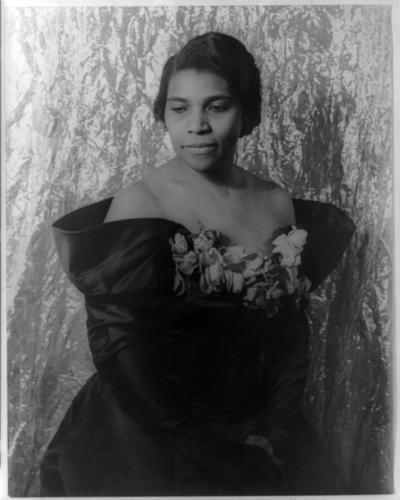
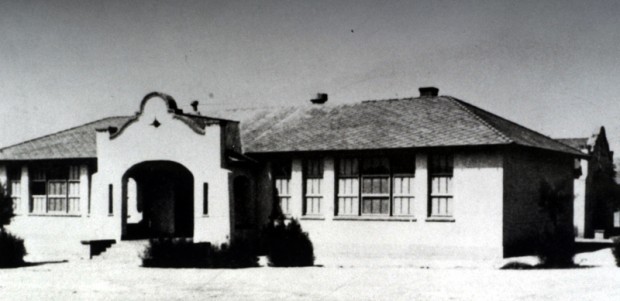
In 1942, singer Marian Anderson visited Tucson to perform in a concert at the University of Arizona. While here, she visited, ate lunch with and performed for students at Dunbar school, which at the time, was for black students only.
The school didn't yet have an auditorium (it was built in 1948) so Anderson sang in the hallway.
From the Arizona Daily Star, Jan. 31, 1942:
Excited Children Jam Hall To
See and Hear Marian Anderson
__________
By Bernice Cosulich
Inspired dark faces and shining eyes filled with admiration looked up to Marian Anderson. Out over the packed hallway at Dunbar school rolled the rich, beautiful voice of the great singer. It vibrated with feeling as the clear words came— "Nobody knows the trouble I've seen, nobody knows but Jesus—"
She stood there on a small platform placed in the narrow school hall, with an American flag hanging on the wall behind her. She faced the 352 upturned faces of the school children, who sang with her the chorus of the Negro spiritual. Packed were the children in the hall, but not the smallest was unmindful of his privilege in having to himself for a half hour one who the world calls great. Somthing of that feeling crept into the voices of the children, and much responsive feeling was in Miss Anderson's voice.
Then she spoke to these boys and girls of her own race and gave them from her heart a credo of much inspiration, long to be remembered.
"I cannot thank you for the flowers you sent to the university last night nor can I tell you how deeply that gift impressed me," she began quietly, the deep tones of her speaking voice reaching the smallest ears. She referred to the bouquet of carnations which those children's penhnies had bought for her, and which Susanna Preston presented during the concert on the campus Thursday night.
"Nor can I tell you how you made me feel when all of you came to the station to meet me. You sang with such fervor in your song of welcome that you touched my heart.
"Unfortunately I am a poor speaker. But I must say to each and every one of you that you will be able to achieve something very worth while. The way is open to each of you,. You need only to apply yourselves, keep your good character, work very hard, and do everything you do better than anyone else.
"It has been a great time for me, here in Tucson, to be with you at your school. Your songs for me have touched me and I can only say that I am frightfully happy to have been with you. I regret that I cannot sing for you all the songs that I would like, but I am one of those persons under contract and must keep that promise."
Faces Crowd Windows
The eager, young faces showed that understanding was there, and when Miss Margaret Phillips, music teacher, lifted her hands, there burst from every throat the song, "Steal Away." Solo voices trembled in youthful excitement at being heard by Miss Anderson. Then through the hall swelled "America the Beautiful," and a pathway down the hall was made so Miss Anderson could go to the school office to leave treasures behind for them.
Every window in that office was filled with the faces of children watching as she stood quietly, thinking, solemn and earnest, at the office counter. Then across one of her own photographs, provided the school by the University of Arizona music college, she wrote a special dedication to Dunbar school. And on a piece of school stationery this message:
"Have A Star"
"To the boys and girls of the Dunbar school: Have a star and try to reach its height. All things are possible to the courageous."
There was much of her own long, hard climb to musical fame compressed into the firm, fine handwriting on that paper, with its message of inspiration to the Negro boys and girls of Dunbar school.
While she wrote these messages small pieces of paper were being pushed through the crack in the office door, held firmly against the pressing throng outside by Miss Anderson's manager. Morgan Maxwell, principal of the school, shook his head, but the singer smiled on the eagerly demanding autograph hunters. Some few programs and scraps of school book paper she did sign until Maxwell himself stemmed the tide. The children had been warned not to ask such favors, to be on their good behavior yesterday. They were.
Called "Happiest Moment"
Not many outsiders intruded on Dunbar's private party with the great singer. A few representative citizens of Tucson had been invited by the principal, among these Mr. and Mrs. Robert Morrow, Mr. and Mrs. Martin Schwerir of Colonia Solana, who have been among the school's chief benefactors, and perhaps a dozen others.
Morrow, superintendent of Tucson's schools, told Miss Anderson how "happy and privileged are the boys and girls of Dunbar school to have you here, and I know they appreciate being in the presence of so great, gracious and lovely a lady." As the program proceeded and the superintendent saw the packed, standing school children in the dark hall, he said, in an aside: "I hope the school system soon provides Dunbar with the auditorium it needs."
Maxwell reflected the whole school's excitement in the morning event. He called it "the happiest moment in the lives of those at Dunbar school, as we entertain a great American in this land of united people. We honor a true American who is known over the world."
New Meaning In Words
The children recited the pledge to the flag with 352 hands held high in the air and that many voices giving new meaning to the words. Then they sang "America." It was after this that Miss Anderson sang the solo part of "Nobody Knows the Trouble I've Seen," and the school children joined in the chorus.
Dunbar children had not known such a day. No classes from 11 o'clock on, a great visitor, and then, after she left at 11:45 a.m., dashing home to tell parents "she shook my hand as she walked down the aisle" or "she smiled at me" or "I got an autograph." There must have echoed in every young head not only the beauty of her voice, but the inspiration of Miss Anderson's message.
People are also reading…
Anderson told the children she was a poor speaker, but the Morgue Lady thinks she spoke quite well.
One must remember that this was 1942. When Marian Anderson came to Tucson she was not permitted to stay in a Tucson hotel or eat in a restaurant because she was black. She stayed at the home of the president of the University of Arizona, Dr. Alfred Atkinson, and dined with Tucson school superintendent Robert D. Morrow, according to an article by Bonnie Henry in the Star archives.
Still on the way: A series about a woman who game pioneer housekeepers a bad name.


