

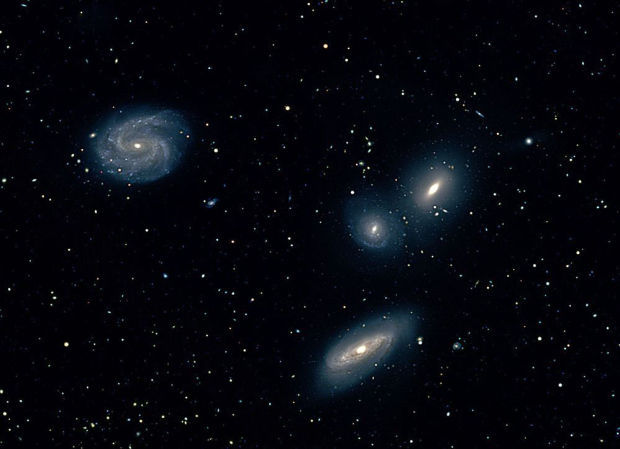
A compact cluster of galaxies is one of many being studied by astronomers of the Australian Astronomical Observatory, using images taken at the Victor M. Blanco Telescope at Cerro Tololo Observatory in Chile, which is operated by Tucson-based National Optical Astronomy Observatory (NOAO).
NOAO astronomer David James describes one image as “the opening act in a cosmic ballet.”
“Each galaxy in this group, called a ‘first in-fall group,’ has only just started to feel the effects of gravity of all the others,” he wrote in an email.
Stars are bursting into being, but the interactions between the galaxies are not yet evident, he said.
This image, released recently by NOAO, is of HCG 07, one of many images of clustered galaxies planned and captured by James, working with an Australian team led by astronomer Iraklis Konstantopoulos.
People are also reading…
Astronomers will pair this and other images of galaxies with spectroscopic data to reveal the mechanics of how clustered galaxies affect each other’s formation and evolution.
The 4-meter Blanco Telescope is a good example of the renewal of older telescopes in an era of newer giants.
The Blanco, like its near-twin, the Mayall Telescope operated by NOAO on Kitt Peak, was one of the largest telescopes in operation when it was completed in 1976.
It was recently retrofitted with the world’s largest CCD camera, developed at Fermilab, the Fermi National Accelerator Laboratory in Illinois.
It takes advantage of Blanco’s wide-field imaging capability for its Dark Energy Survey, seeking clues to the mysterious forces that shape the cosmos.
When not being used as a survey instrument, it is available for projects like this one.
The U.S. Department of Energy, which bankrolled the Blanco transition, is now undertaking a similar retrofit of the Mayall Telescope in cooperation with NOAO.
Mayall, which had been targeted for defunding by the National Science Foundation, will receive a 5,000-fiber spectrometer known as the Dark Energy Spectroscopic Instrument (DESI). It is expected to be operational by 2018.
It too will map the sky to measure the effect of dark energy on the expansion of the universe, and, when it is not being used as a survey instrument, will be available to other astronomers on a competitive basis.
More images of compact galaxy clusters are available at http://noao.edu
For a good explanation of what the Dark Energy Survey is doing and what it hopes to discover, visit its website at http://darkenergydetectives.org


