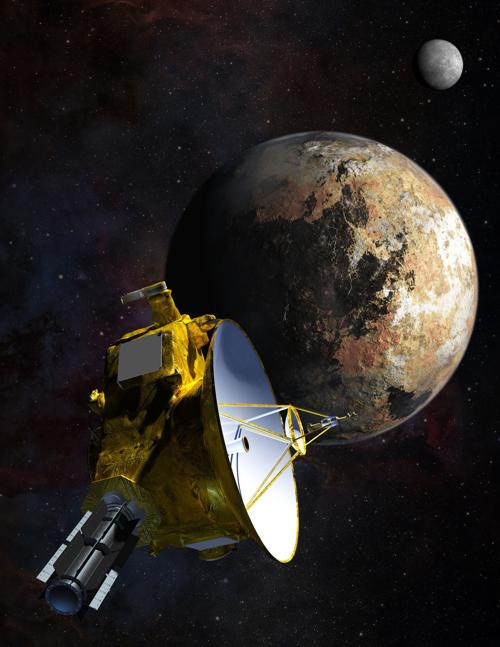
Scientists with NASA’s New Horizons Mission to Pluto say they will “turn a point of light into a planet” over the next three months.
“This is pure exploration; we’re going to turn points of light into a planet and a system of moons before your eyes,” said Alan Stern, the mission’s principal investigator from Southwest Research Institute (SwRI) in Boulder, Colorado, at a NASA news conference Tuesday.
Stern said the journey to Pluto has been much longer than the nearly 10-year, 3-billion-mile flight of the compact spacecraft that will fly by Pluto and its moons in mid-July.
Stern said he personally has worked on the mission in all its earlier incarnations, beginning long before Pluto was demoted to dwarf planet and before scientists had a good understanding of the magnitude of objects in the Kuiper Belt — that icy region of comets and dwarf planets at the outer edge of our solar system.
People are also reading…
Stern said he participated in NASA proposals for Pluto exploration as early as 1990. “I just want to unwrap that Christmas present that’s been under my tree for 25-plus years and see what’s inside.”
This first spacecraft encounter with Pluto comes as NASA continues to robotically explore a host of planets, moons, asteroids and comets.
“It’s hard to imagine a more exciting time in solar system exploration,” said John Grunsfeld, former astronaut and head of NASA’s Science Mission Directorate, “but it will get more exciting this summer.”
Pluto and its largest moon, Charon, are still fuzzy dots in the color image released by the New Horizons team Tuesday. The image was taken from a distance of 71 million miles by a camera onboard New Horizons named Ralph.
By July 14, when New Horizons makes its closest approach to Pluto, its cameras will be able to resolve features as small as a quarter-mile across.
Those photos won’t be immediately available, said Cathy Olkin, deputy project scientist for the mission.
New Horizons will be focused totally on gathering as much information as possible and not transmitting data back to Earth.
Some photos will be available the next day, however.
Pluto will have already revealed itself during the spacecraft’s approach, she said, “starting in May and getting better every day.”
“Each day is going to reveal something new,” she said.
The “surprises and discoveries” will continue over the next 18 months, she said. That’s the time needed to unload data from all seven of the spacecraft’s scientific instruments about the atmosphere and composition of both Pluto and Charon.
When the mission launched 10 years ago, Pluto was still the ninth planet in the solar system, but evidence was mounting that it was not alone, and possibly not the biggest object in the dark, icy region know as the Kuiper Belt.
Today, scientists estimate that the Kuiper Belt hosts hundreds of thousands of icy bodies larger than 100 kilometers (62 miles) in diameter and a trillion comets.
The knowledge that caused Pluto’s demotion to dwarf planet elevated interest in the region, which Stern called “the largest structure in the solar system.”
Once, he said, we thought there were two regions of planets, the rocky terrestrials and the gas giants. Now there is a third, and New Horizon’s investigation of Pluto, Charon and objects beyond will be the first close-up scientific look at it.
First, though, the interest is on Pluto — our former ninth planet, discovered at Lowell Observatory in Flagstaff by Clyde Tombaugh in 1930. It is the only planet discovered from the United States.
“With quarter-mile resolution, we’ll be able to see great detail on Pluto and Charon. This is a scientific wonderland — a binary planet. Pluto and its Texas-sized moon are like nothing we’ve ever visited,” said Stern.
Pluto has four other known moons, and New Horizons may discover more, Stern said.
Our least known planetary system is about to come into focus.
“We’re really about to have a revolution in our knowledge,” said Stern.