

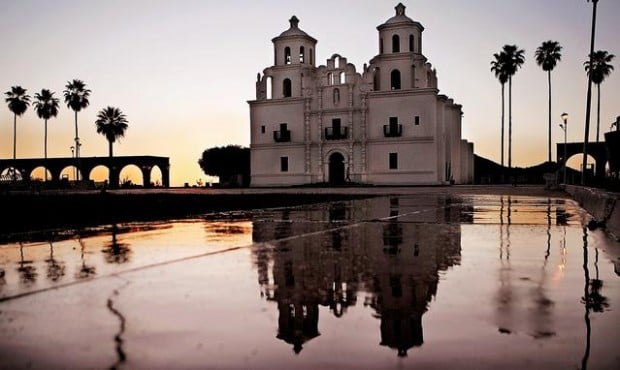
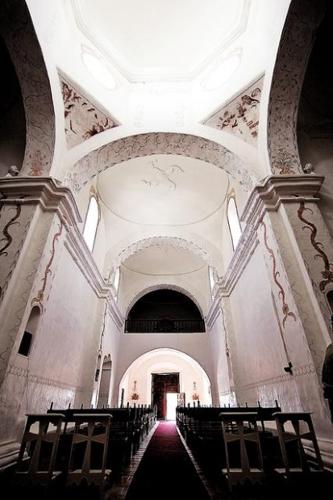
CABORCA, Sonora.- Tanto al amanecer como al atardecer, La Purísima Concepción de Nuestra Señora de Caborca luce radiante.
Esta iglesia, un modelo de la Misión San Xavier del Bac, y una de las misiones fundadas por el padre jesuita Eusebio Francisco Kino, recientemente se sometió a una renovación de 600 mil dólares.
Kino fundó las misiones en la Pimería Alta en lo que ahora se conoce como el Norte de México y el Sur de Arizona.
La Purísima Concepción de Nuestra Señora de Caborca fue construida por padres franciscanos aproximadamente un kilómetro al Este de donde el padre Kino fundó la misión original, la cual fue construida en octubre de 1694. La construcción de la iglesia actual dio inicio en 1803 y ésta fue dedicada el 8 de mayo de 1809.
Ubicada a unas tres horas al Suroeste de Nogales, la misión se encuentra en una ciudad de 75 mil habitantes que es conocida como "La Perla del Desierto" y cuenta con dos industrias principales, la agricultura y la ganadería.
People are also reading…
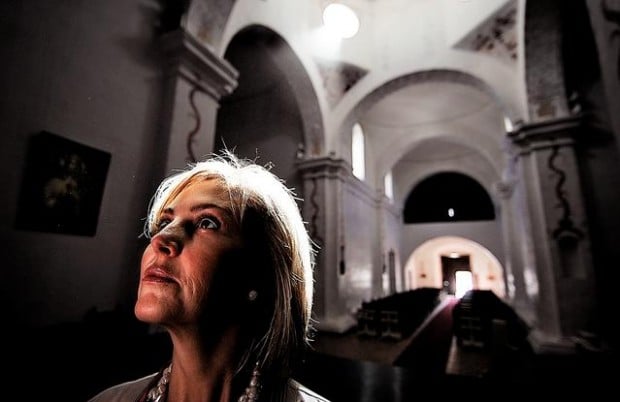
En esta renovación se reparó el techo, restauró la madera, cambió el piso, se hicieron instalaciones eléctricas y luces exteriores; también se restauraron las paredes interiores así como las exteriores, informó Gloria Elena Santini, de 46 años de edad y presidente del Patronato para la Restauración del Templo de la Purísima Concepción de Caborca.
El interés de Santini por la misión surgió después de que tanto amistades como familiares le preguntaban sobre la historia de la misión y ella no tenía las respuestas.
"Me dirigí a José Jesús Valenzuela, el historiador de la ciudad y él me dio unos libros y documentos para leerlos; también me abrió las puertas de la misión, yo entré y me quedé enamorada de ésta", rememoró Santini, graduada en 1985 de University of Arizona quien se licenció en desarrollo infantil y relaciones familiares.
"Creo que Gloria es la parte que se necesitaba para que la restauración siguiera adelante", opinó Valenzuela de 65 años de edad. "Ella es como la pila de un reloj; sin la pila el reloj no funciona", agregó.
"Yo he enseñado a otros sobre la historia porque yo nací aquí. Vi cómo, durante décadas, se fue destruyendo la misión con el paso de los años, pero la gente del pueblo todavía viene aquí.
La misión es mi identidad. Somos los hombres y las mujeres quienes vivimos en el desierto donde parece que no hay nada, pero en realidad, hay todo", continuó Valenzuela.
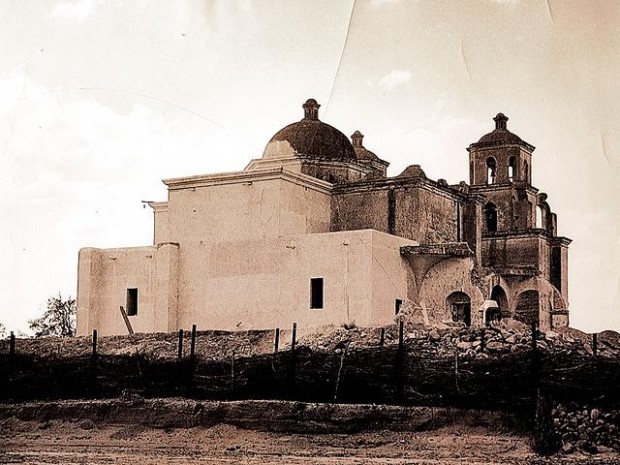
Una inundación de 1890 le hizo mucho daño a la misión, destruyó la parte de atrás de la iglesia y su convento, dijo Santini. Incluso comentó que otras inundaciones en 1899, 1915 y 1917 destruyeron grandes partes de la iglesia también.
En 1957 dio inicio la obra de restauración para reparar el santuario y el altar principal.
La misión dejó de ser una iglesia activa en los años treinta y en 1985 el gobierno federal la designó como un monumento nacional. El gobierno se la entregó a la Arquidiócesis de Hermosillo en 1997, y la misión está bajo Nuestra Señora de la Candelaria. Se celebra misa en la misión a las 6 p.m. los sábados; se puede solicitar para ocasiones especiales.
La labor de Santini y la del patronato para esta renovación incluyó ponerse en contacto con la organización Adopte Una Obra de Arte, la cual restaura monumentos por todo México. "Por cada peso que se recaude por parte de la comunidad, el estado, así como el gobierno federal, ponen otro peso. Esto nos ayudó muchísimo para la recaudación de fondos", explicó Santini.
Se percató que los esfuerzos del patronato también fueron reconocidos por el Fondo Mundial de Monumentos en el 2004 y en el 2006, declarando que la misión era digna de ser rescatada.
El patronato trabajó con arquitectos, ingenieros y expertos en restauración durante meses en andamios para reparar los daños y limpiar el interior de las paredes con el fin de obtener la capa original del arte.
"Las pinturas de helechos, flores y adornos con conchas fueron realizadas en 1811 por Gordiano Escalante, un talento local", informó Santini.
Las esculturas de cráneos en las paredes llaman la atención. "Esta obra de arte representa a Jesús conquistando la muerte y el bien sobre el mal", dijo.
Originalmente había 11 figuras religiosas en la misión, dijo Santini mientras señalaba las fotografías históricas del interior de la iglesia, que están en una exhibición en el museo de este sitio.
"Sólo quedan dos, la Purísima Concepción y el Niño Jesús", señaló Santini. Explicó que estas estatuas fueron salvadas ya que se encontraban en la casa de una costurera que estaba haciendo ropa para éstas cuando agentes federales entraron a la iglesia, agarraron las estatuas y las quemaron en frente de la misión. "Esto sucedió durante la persecución religiosa en 1933 bajo el gobierno del presidente Plutarco Elías Calles. Muchos sacerdotes fueron asesinados durante este periodo", indicó Santini.
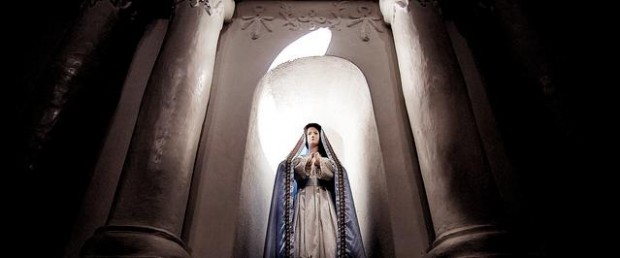
La Purísima Concepción original está puesta sobre el altar principal. Su restauración tuvo un costo de 4 mil dólares y fue realizada por la artista Mariana Straulino en la Ciudad de México en 1999.
"La virgen y la misión representan recuerdos de mi infancia", reveló Estela Burke Vanegas, de 81 años de edad quien hizo la donación para la restauración de la virgen.
Dentro de esas memorias está la de ella y sus amigas yendo a ofrecer flores a la virgen cada mes de mayo durante las celebraciones religiosas. "Yo ofrecí con gozo la restauración de la virgen para que pudiera volver a lucir tan hermosa como antes. El tiempo se la había acabado", comentó Vanegas, quien es suegra de Santini.
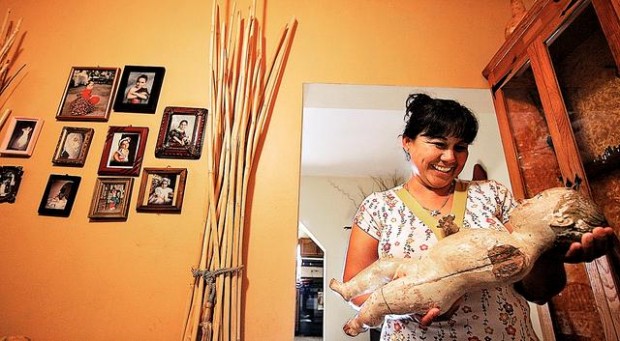
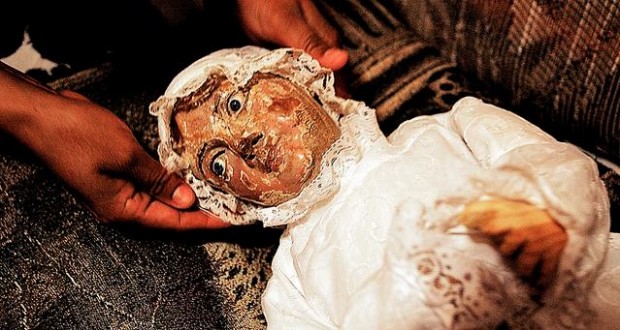
La otra imagen original, la del Niño Jesús, está en la casa de Amadeo Jiménez. Hace más o menos unos 30 años, Jiménez encontró la escultura en el río mientras cuidaba un ganado, informó su hija Leticia Jiménez de 36 años de edad.
"Mi padre creyó que era un muñeco. Encontró el cuerpo, pero le faltaba un brazo. Lo trajo a casa para nosotros", contó Leticia al recordar la historia. "Los vecinos, personas de 80 años de edad, cuando lo vieron dijeron que era el Niño Jesús de la misión", dijo ella.
Su padre llevó la estatua al párroco, pero el padre le dijo que como él la había encontrado que se la podía quedar, aclaró Leticia. Y eso fue lo que la familia hizo y no tiene planes de regresar al Niño Jesús a menos que éste les indique que lo lleven a la iglesia, expresó Leticia.
Su hermano, Raúl de 34 años de edad, hizo un brazo de madera de pino para la estatua hace unos dos años. El Niño Jesús le ha hecho milagros a la familia, aseguró Leticia. Uno sucedió hace dos años. El relato dice que al padre lo tumbó una vaca y sufrió un tobillo roto y varios dedos del pie necesitaron cirugía. Pero cuando Amadeo regresó dos días después al hospital, el doctor estaba sorprendido porque su padre había sanado.
"Sentimos que nuestra casa está bendita", dijo ella.
El patronato respalda un programa llamado Adopte un Santo, el cual solicita que la gente done fondos para pagar por la restauración de ocho íconos religiosos. El trabajo será realizado por el artista Agustín Parra de Guadalajara. Se colocará una placa con el nombre del donante o a nombre de un ser querido quien haya fallecido en el nicho donde el santo sea puesto, mencionó Santini.
Durante una visita a las instalaciones la semana pasada, Santini señaló un proyecto que el gobierno federal terminó que incluyó la re-canalización del Río Concepción, el cual corre directamente atrás de la iglesia.
"El lecho del río se amplió y se construyeron siete muros de contención para disminuir el flujo y la fuerza de la corriente", explicó Santini. "La última inundación sucedió en 1993 y no debería desbordarse otra vez. Eso es lo que esperamos", agregó.
El agua destruyó el convento y el santuario Norte, refirió al señalar las partes del trabajo de restauración al estar parada en el altar principal.
Antes de 1915, el altar principal fue de un estilo barroco antiguo, casi neoclásico con grandes columnas. En 1999, se renovó con el mismo estilo de la capilla del lado izquierdo de la misión.
En un ladrillo a lado del altar, hay un mensaje grabado de los trabajadores de la construcción, Doroteo Vásquez Flores, Arturo Contreras Escalante y Doroteo G. Contreras Lira, quienes comentaron que su trabajo en el altar, realizado del primero de mayo de 1999 al 4 de septiembre del mismo año, los dejó con recuerdos muy bonitos.
"Me conmovió mucho esto. Estos trabajadores realizaron su labor con mucho amor al igual que tanta gente del pueblo quienes han contribuido con dinero para los trabajos de restauración", advirtió Santini.
Ella miró hacia los jardines de la misión y a sus caminos de piedras y ladrillos. Las palmeras, ocotillos en flor, arbustos y plantas con flores de colores amarillos, rosas, rojos, morados y fucsias atraen a paseantes en las noches. Los niños andan en sus patinetas y bicicletas en la amplia plaza enfrente de la misión.
"La misión vuelve a atraer a familias una vez más", enfatizó Margarita Bórquez de 46 años y miembro del patronato. "Cuenta con una historia muy rica".
Durante mucho tiempo la iglesia fue abandonada, funcionó como escuela, granero y como cuartel general para los militares. En una época la gente del pueblo la usó como refugio contra los invasores estadounidenses.
"La gente ha sobrevivido condiciones horribles y también la misión. Ahora es tiempo de celebrar todo el arduo trabajo que la gente ha hecho y disfrutar la belleza de todo esto", finalizó Bórquez.
ENGLISH VERSION
CABORCA, Son. — At sunrise and sunset La Purísima Concepción de Nuestra Señora de Caborca is a glow.
This church, a model of Mission San Xavier del Bac, and among the 21 missions founded by 17th-century Jesuit Padre Eusebio Francisco Kino, recently underwent a $600,000 facelift.
Kino founded the missions in the Pimeria Alta, in what is now Northern Sonora and Southern Arizona.
La Purísima Concepción de Nuestra Señora de Caborca, was constructed under Franciscan priests about a kilometer east of where Kino founded the original mission, which was built after October 1694. Construction of the current church began in 1803 and was dedicated May 8, 1809.
This mission is located in a city of 75,000 that is known as the (favor de traducir como "La Perla del Desierto") "Pearl of the Sonoran Desert" and its main industries are agriculture and livestock. It is about three hours southwest of Nogales.
These latest renovations include roof repairs, wood restoration, floor replacement, electrical installation and outdoor lighting, restoration of the outter and interior walls and landscaping, said Gloria Elena Santini, 46, president of the Patronato for the Restoration of the Temple of the Immaculate Conception of Caborca.
Santini's interest in the mission came after friends and family asked her questions about its history, and she had no answers. "I went to José Jesús Valenzuela, the city's historian, and he gave me books and documents to read and he opened the mission's doors and I stepped inside it and fell in love," recalled Santini, a 1985 University of Arizona graduate who majored in child development and family relations.
"I think Gloria is the piece that was needed for the restoration to forge ahead," said Valenzuela, 65. "She is like the battery in a watch, and without the battery the watch does not function," he said.
"I have taught others about the history because I was born here. I saw the mission's destruction over decades, but the towns people still come here. The mission is my identity. We are the men and women who live in the desert where it seems like there is nothing, but in reality there is everything," Valenzuela said.
Flood waters dating back to 1890 caused damage to the mission, destroying the rear of the church and its convento, Santini recalled. She said other floods in 1899, 1915 and 1917 destroyed large portions of the church, too. In 1957, restoration work began again to repair the sanctuary and the main altar.
The mission stopped being an active church in the 1930s,and in 1985 the federal government designated it a national monument. The government released it to the Archdiocese of Hermosillo in 1997, and the mission is under Nuestra Señora de la Candelaria. Mass is celebrated at the mission at 6 p.m. on Saturdays and it can be requested for special occasions.
Santini and the patronato's work for the latest renovations included contacting Adopt A Work of Art, an organization that restores monuments throughout México. "For every peso raised by the community, the state and the federal government each pitched in one peso. This helped us tremendously in raising the money," said Santini.
She noted that the patronato's effort also was recognized by the World Monuments Fund in 2004 and 2006, stating that the mission was worthy to be saved.
The patronato worked with architects, engineers and restoration experts who spent months on scaffolding repairing damage and cleaning the interior walls to get to the original layer of artwork.
"The paintings of ferns, flowers and shell ornaments were done in 1811 by Gordiano Escalante, a local talent," Santini said.
Sculptures of skulls on the walls near the main entrance stands out. "This artwork represents Jesus conquering death, and good prevails upon evil," she said.
There were 11 original religious images in the mission, said Santini while pointing to historic photographs of the church's interior that are displayed in a museum at the site.
"Only two remain, the Immaculate Conception and the baby Jesus," said Santini. She explained that these statues were saved because they were at a house of a seamstress who was working on clothing for them when federal agents entered the church, grabbed the statues and burned them in front of the mission. "It was during a religious persecution in 1933 under President Plutarco Elías Calles. Many priests were killed during that time," Santini said.
The original Immaculate Conception is displayed above the main altar. She underwent a $4,000 restoration by artist Mariana Straulino in México City in 1999.
"The virgin and the mission represent childhood memories," said Estela Burke Vanegas, 81, who was the donor for the virgin's restoration. Those memories include her and friends offering flowers to the virgin every May during religious ceremonies. "I offered with joy to restore the virgin so she could again look beautiful like before. Time had worn her down," said Vanegas, who is Santini's mother-in-law.
The other original image, that of baby Jesus, is in the home of Amadeo Jiménez. About 30 years ago, Jiménez found the sculpture in the river while he was caring for grazing cattle, said his daughter Leticia Jiménez, 36.
"My dad thought it was a doll. He found the body but it was missing an arm. He brought it home for us," said Leticia, recalling the story. "Neighbors, people in their 80s who saw it, said it was the infant Jesus from the mission," she said.
Her father took the statue to a parish priest but the priest told him since he found it, he should keep it, she said. That is what the family did and does not plan on returning the baby Jesus unless he makes it known that he is to be taken to the church, said Leticia.
Her brother, Raúl, 34, carved an arm out of pinewood for the statue about two years ago. The Christ child has granted the family miracles, said Leticia. One happened two years ago. The story goes that their father was knocked down by a cow and suffered a broken right ankle and several toes, requiring an operation. But when Amadeo returned two days later to the hospital, said Leticia, the doctor was amazed because their father was healed.
"We feel our house is blessed," said Leticia.
The patronato is backing a program called Adopt A Saint, which asks people to donate funds to pay for the commissioned artwork of eight religious icons. The work will be done by artist Agustín Parra of Guadalajara. A plaque with the donor's name or in memory of a loved one who has passed will be displayed in the niche where the saint is to be placed, Santini said.
During a tour of the grounds last week, Santini pointed out a project completed by the federal government that included rechanneling of the Río Concepción, which runs directly behind the church.
"The river bed was widened and seven container walls were constructed to cut the flow and the strength of the current," explained Santini. "The last flood was in 1993 and it should not flood again. That is what we hope," Santini said. The waters destroyed the convento and north sacristy, she said pointing out portions of the restoration work while standing near the main altar.
Prior to 1915, the main altar was a late baroque-style, almost neoclassical with large columns. In 1999, it was renovated in the style of the mission's left chapel.
A message is carved into a brick on the side of the altar from construction workers who say their work on the altar from May 1, 1999 to Sept. 4, 1999 left beautiful memories for Doroteo Vásquez Flores, Arturo Contreras Escalante and Doroteo G. Contreras Lira.
"I was very touched by this. These workers did this with a lot of love, just like so many of the towns people who have contributed funds to the restoration work," Santini said.
She looked out to the gardens of the mission and its rock and brick pathways. Palm trees, blooming ocotillos, shrubs and plants with yellow, pink, red, purple and fuchsia colored flowers attract walkers in the evening. Children roller skate and ride their bikes in a spacious plaza in front of the mission.
"The mission attracts families once again," said Margarita Bórquez, 46, a member of the patronato. "It has a rich history. During times the church was abandoned, it served as a school, a granary and as headquarters for the military. At one time, towns people used it as a shelter against American invaders.
"People have survived horrible conditions, and so has the mission. Now it is time to celebrate all the hard work people have done, and enjoy the beauty of it all," Bórquez said.
3/4 La Purísima Concepción de Nuestra Señora de Caborca en Sonora recientemente se sometió a una remozada de 600 mil dólares para lucir magnífica en la celebración de su bicentenario este fin de semana.
3/4 Esta iglesia es una de las 21 misiones fundadas por el padre Eusebio Francisco Kino, jesuita del siglo XVII.
3/4 Se realizarán varias festividades durante el fin de semana en la misión.
3/4 Puede obtener más información sobre la misión visitando la página web: http://www.vivacaborca.com/activities/iglesia_pueblo_viejo.html
La Purísima Concepción de Nuestra Señora de Caborca in Sonora recently underwent a $600,000 facelift, and is celebrating its bicentennial this weekend. This church is among the 21 missions founded by Padre Eusebio Francisco Kino, a 17th-century Jesuit. Festivities are taking place this weekend at the mission.
You can visit http://www.vivacaborca.com/activities/iglesia_pueblo_viejo.html for information on the mission.


