

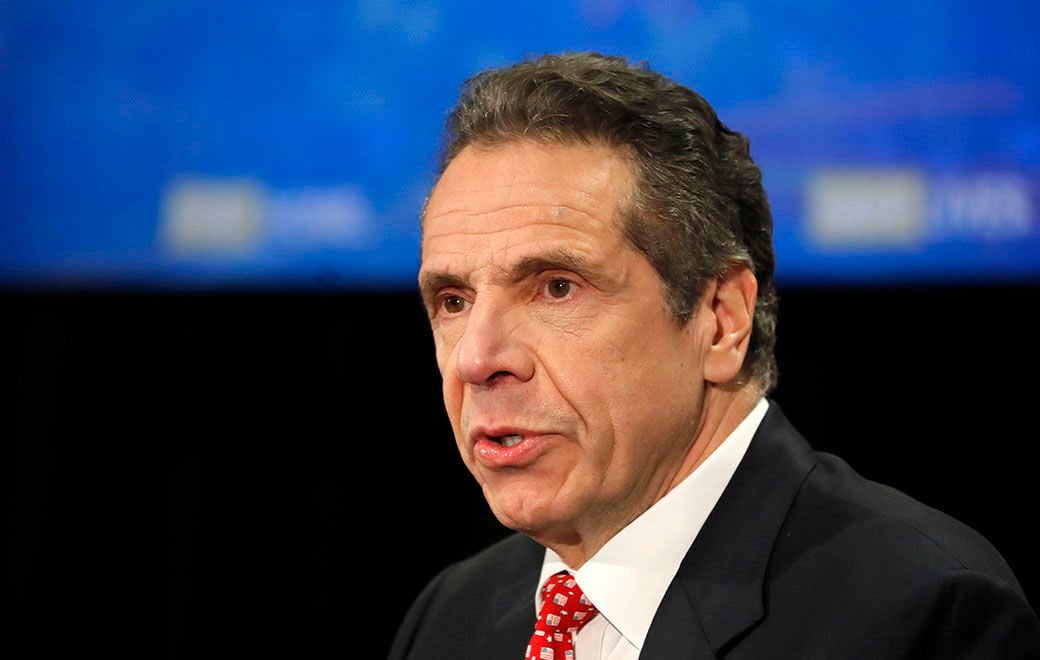
Gov. Andrew M. Cuomo said Friday the state will likely take a "microcluster response" to Western New York's high Covid-19 coronavirus rate.
"Western New York is a problem," said Cuomo, who called out Buffalo, Hamburg, Tonawanda and Orchard Park specifically.
In a conference call with reporters Friday morning, Cuomo said the average positive test rate for Western New York, which includes Erie, Niagara, Chautauqua, Cattaraugus and Allegany counties, has risen from 1.5% to 2.8%. That increase has happened over the last two weeks.
The governor said his team will review various coronavirus metrics and confer with local leaders this weekend. Cuomo said an announcement will come Monday "as to exactly what we are going to do."
The governor said Erie County has the highest average positive test rate in Western New York at 3.1%.
People are also reading…
"At these numbers in these areas, a microcluster response is appropriate," Cuomo said. "We tailor the microclusters to the particulars of that area."
The five counties of Western New York combined to report 336 coronavirus cases on Thursday, an all-time high of the pandemic, while the region is also experiencing its highest positive test rates since May.
The state has taken its "microcluster" approach to specific regions in the state for the past several weeks, often down to the ZIP code, as it has closed schools and limited gatherings in downstate counties of Rockland and Orange as well as New York City boroughs of Brooklyn and Queens.
The upstate counties of Broome, Chemung and Steuben were later added to the state's "focus zone areas," which can be color-coded as orange, yellow and red zones, depending on the severity of the virus' spread.
Cuomo said Friday that the downstate focus areas are now doing much better as he announced the easing of restrictions.
"In general, downstate New York is doing better than upstate New York," the governor said, describing the pandemic as a "disparate" situation across the state. "Which is a total reversal from the first phase of Covid, where it was primarily a downstate problem."
On Friday he said that in addition to Western New York, the Finger Lakes region (which includes Rochester and Monroe County) and Central New York (which includes Syracuse and Onondaga County) were seeing elevated levels of the virus. Cuomo mentioned Rochester and its suburbs of Fairport and Pittsford as well as Syracuse as other candidates for the "microcluster" approach.
The governor offered congratulations to many of the downstate areas that have been under microcluster guidelines.
"Southern Tier, good news," he said of the region east of Allegany County. "Most counties, good news. ... Erie, Monroe, Onondaga: Not good news."
"Relative to the nation," Cuomo noted," we're doing extraordinarily well."
New York has the fourth-lowest positive test rate in the nation, according to Johns Hopkins University.
Of Western New York, Rochester and Syracuse, Cuomo said: "When I say they're a problem, they're lower than states around us ... but relative to New York, they are the high spots in New York."
According to state data released Friday, the Western New York region's daily rate for Thursday's tests was 3.3%, the fourth straight day the region was over 3%.
Western New York's seven-day average rate, which has doubled in the last two weeks, is currently 2.9%. That is the highest among the state's 10 regions and well above the statewide average of 1.7%.
Cuomo said Thursday's statewide positive test rate was 1.86%, which included a 3.04% rate in the focus areas and 1.7% for the remainder of the state.
There were 2,997 positive cases statewide, the state's highest daily total since the first week of May. Statewide hospitalizations were at 1,277; there were 24 Covid fatalities Thursday.
The governor noted that all SUNY campuses will close for the semester when students go home for Thanksgiving later this month, and said private colleges should consider doing the same.
As for the rest of the college school year, he said: "We'll figure out next semester, next semester."
The governor also reiterated that the Buffalo Bills likely would not have fans in their stadium for the season. To do otherwise would be "reckless," he said.
Read the full story from News Staff Reporter Sandra Tan


