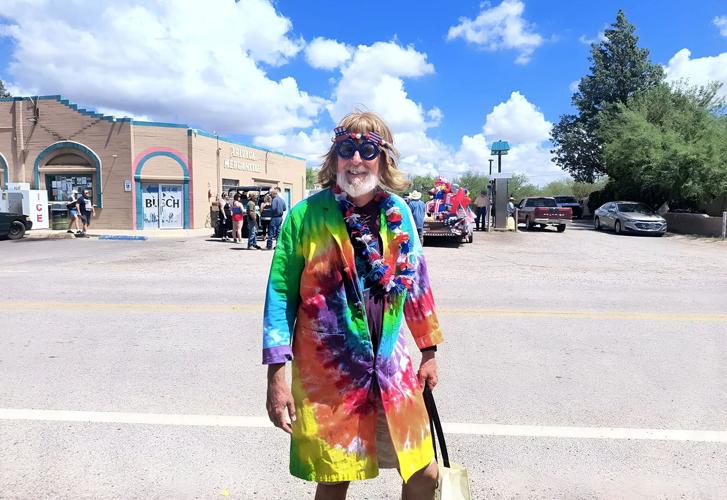
ARIVACA — Here, they call him Don or Doc. Sometimes he’s “otro abuelo” or his coveted and tie-dyed alter ego, “Dr. Feel Good.”
In Arivaca, a quiet, unincorporated community about 60 miles south of Tucson, he is the only doctor for miles, and has been for the past three decades.
Dr. Donald Smith, 67, has been trying to retire for just over a year, with a hard deadline set for Aug. 1.
He had hoped to be retired by now. However, the search for his replacement at the Arivaca clinic has been far from easy. United Community Health Center is its parent organization and operates several clinics in southern Arizona.
“It’s harder to find people who have that broad knowledge to go out into rural areas. And fewer doctors wanting to do it,” Smith said.
People are also reading…

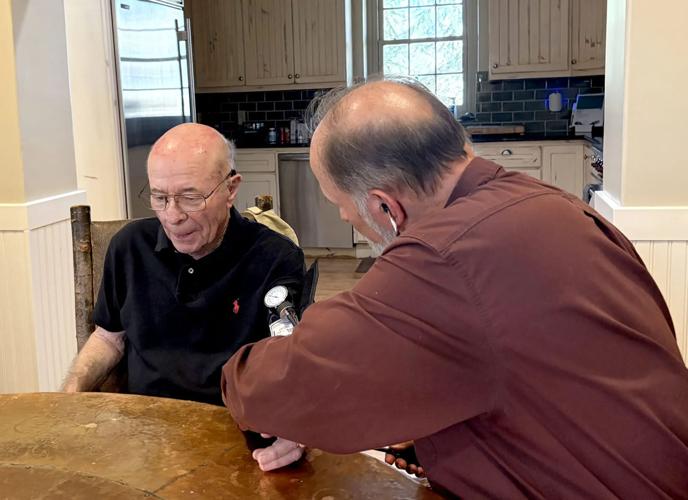
Dr. Donald Smith conducts an at-home visit with Jon Rowley, who has Parkinson’s disease. He often stops by Rowley's home in Arivaca on his way home to Tucson.
It’s the same story across the country.
The National Center for Health Workforce Analysis estimates an accelerating shortage of 70,610 primary care physicians across the country in 2038, with a particularly urgent need in rural communities.
Arizona has 852 health care professional shortage areas – the sixth most in the nation, according to the Health Resources and Services Administration. This is a federal designation that illustrates critical shortages of primary care, dental and mental health providers.
Inside ‘Casa Monongye’
The paved road narrows to a bumpy dirt path on the approach to Smith’s green-roofed Arivaca home, down the street from the local Baptist church, where the pastor is his lone neighbor. Poppies are just starting to bloom.
In the smaller of his two gardens, Smith is growing garlic and onions. In the summertime, it’s chiles and tomatoes.
The interior of his house is decorated with lizards — metal, plastic and a few live ones he lets in from outside, crawling on the walls. “They keep the bugs down,” he said, looking up at one that had settled on the blinds.
“Monongye” is the nickname Smith has carried with him since he worked on Hopi land during the first five years of his career, straight out of his residency in Ogden, Utah.
“We delivered lots of babies there. But it was very scary because we couldn’t do C-sections there – and you’re two hours from either Tuba City or Chinle, where they could,” he said.
During this time, one of his Hopi mentors looked at him while he was working bedside at a hospital on the reservation.
“He said, ‘I will pronounce you Monongye because you are like one of those changing lizards,’” Smith said. “So, that was my name.”
He’s even tried to fit the phrase on the license plate of his truck, which reads “MNONGY” for short, next to an “I heart Arivaca” bumper sticker.

Dr. Donald Smith in his tie dye lab coat in downtown Arivaca on the Fourth of July in 2025. Smith, the only doctor in Arivaca, is set to retire Aug. 1.
Working on the Hopi reservation was demanding, Smith said. “When you first start in practice, you don’t even know how to treat colic in babies because nobody teaches you such things in medical school. It’s just you and your colleagues out there, a couple hours away from any help,” he described, emphasizing the experience prepared him for somewhere like Arivaca.
His path to rural medicine was intentional, but unconventional.
Out of high school, he went to the University of Arizona, where he studied range management – the science of grasslands, grazing and sustainability. He stayed for medical school. Deep down, he said he always wanted to be a doctor in rural Arizona.
“I’m actually one of the rare people born here, in Arizona. My dad was born in Arizona. His parents came across a wood plank road across the sand dunes to move to Phoenix in 1924,” he said.
He’s also in charge of planning his 50-year high school reunion this year at his alma mater, Washington High School, located in the heart of Phoenix.
He didn’t mean to stay in Tucson or Arivaca, both over an hour apart. But, when the time came for his predecessor to retire, Smith was looked to as the next in line. He had been filling in across rural southern Arizona and had worked at the Arivaca clinic on a variety of occasions. “In 1995, I became a permanent employee and the medical director for United Community Health Center,” Smith said. “I’ve been here over 30 years now.”
A portrait of Arivaca
When Smith became Arivaca’s doctor, the town had about 1,000 full-time residents. Now, the number living in the community year-round is halved.
Back then, it was “old Hispanic families, ranchers, a few miners, artists,” he said. It remains a “mixture of single-wide trailers falling apart and million-dollar houses.”
The only health care facility used to be a little trailer downtown, run by a paramedic.
Now, Smith sees Arivacans at a one-story stucco with a small lobby and a few private examination rooms. The renovated clinic used to be “surrounded by a rusty chain link fence, the cows would come and go,” Smith said.
What was once dead grass and tall weeds is now a manicured landscape, where Smith calls himself the gardener-in-residence.
The waiting room has a picture book celebrating 30 years of Smith. The hallway has a joke board, filled with cartoons and comics. “It’s still this comfortable country home where people don’t feel like they’re going into a sterile, corporate environment,” Smith said. “This building’s part of the community.”
Over the years, he’s done less and less prenatal and pediatric care as the community’s population aged.
His next patient was Margie Tangye, who came into the clinic to address issues she’s been having with her heart – its “crazy beat,” as she called it. Her cardiologist is over an hour away.
“He wanted me to come in every time my heartbeat changed. I said, ‘You’re in Tucson, and I live in Arivaca,’” Tangye said. Without Smith and his clinic, she’d likely have to commute at least to nearby Green Valley, 45 minutes away, to see a doctor.
Tangye worked the front desk and referrals for the clinic for 20 years before she retired. She bookended the appointment with hugs from Smith.
“I have to have my hug,” she said. “I could not survive if I didn’t get my hug.”
An uncertain change
The search for Smith’s replacement is weighed down with an uncertainty that blankets Arivaca’s community.
Smith attributes the difficulties to generational discrepancies. He’s seen a trend where younger doctors don’t want to commit long-term to a life in rural Arizona.
But Smith is firm in his belief that there is someone out there – he just doesn’t know who that is quite yet.
“You know, I always say, I’m not the only one like me. There’s lots of docs like me. I’m just an example of what’s happening with this aging boomer doctor population,” he said, referring to the growing trend of aging physicians that are ready to retire, but can’t.
Smith’s Aug. 1 retirement deadline looms.
“I can’t extend it forever. It’s a movable goal post, but at this point, not that far,” Smith said, adding that United Community Health Center might need to lean on existing providers in the area for care.
Jon Reardon, the CEO of the organization, said the network is actively looking for Smith’s replacement: “We have yet to find a replacement, so he’s continued on with us for at least half a year, at least through summer.”
“I am not confident at all. I’m scared, I’m anxious that I won’t find a replacement,” Smith said. “It’s not because I don’t like the job. I love this place, I love Arivaca. This has been the best job that I could have had, I think, in my life.”
‘It’s a crisis, actually’
Smith isn’t alone in experiencing this bittersweet, prolonged passing of the torch.
Peggy and Jon Rowley live on a 23,000-acre ranch in Arivaca, with parts of their home built with adobe bricks about 200 years ago. Jon has Parkinson’s disease and has difficulty getting in and out of the car, so Smith stops by the house on his journey out of town and back toward his home in Tucson as needed.
Already, they’ve had to abandon some appointments and specialists that are just too inconvenient to get to.
“As he gets less mobile, it’s like, well, we don’t really need to go see that doctor. We don’t really need to go take care of that. And that’s what you start to do. You start not to go. And that’s bad for him,” Peggy added.
These home visits have been invaluable for the Rowleys, Peggy said. But the concern of working with a new doctor as Jon’s disease progresses weighs on her.
“What if it’s somebody that doesn’t like it down here? What if we just keep rotating people? You know, it’s hard to even find rural vets, let alone rural doctors. So it’s a crisis, actually. So we’re nervous, but we’re hopeful,” she said.
Three decades of this intimate and unique patient-doctor dynamic rooted itself around the table as Smith stuck to his routine, checking Jon’s blood pressure and asking questions about his health.
Smith knows the next doctor won’t be the same. That they’ll likely be able to navigate computers better. But they will still need “a heart for the community.”
Dale Williams is a resident of Arivaca, and like so many, also a patient of Smith’s.
“If you go to a big city, you’re just a number to most people. They don’t care about you. But he does. He cares about his patients and it’s going to be sad when he leaves. I’ll be sad,” Williams said.
Turning to Smith, he added, “You don’t need to leave.”