When Erie County Executive Mark Poloncarz toured the former Bethlehem Steel site on the shore of Lake Erie in the summer of 2017, he knew what few others did.
Amazon had come calling.
The county at the time was five months away from regaining control over a large chunk of the industrial Lackawanna brownfield. Heavy equipment was trucking away brush and debris. Companies, the county executive said, were already expressing interest.
“We’re not talking about mom-and-pop shops,” Poloncarz told The Buffalo News back then.
Months before a developer for Amazon proposed and then dropped a plan to build a 3.8 million-square-foot warehouse in Grand Island, another secret Amazon deal was in the works.
People are also reading…
Amazon representatives spent more than a year studying the Lackawanna steel site and drawing up plans addressing everything from the size and orientation to the traffic flow of a large logistics center. The company was so close to committing to the property in 2018 that developers had drafted a formal project application for the City of Lackawanna.
Instead, just a few days before an expected public announcement in early 2019, county leaders got another call: Amazon was giving up on Bethlehem Steel.
What sank the deal? Not friction over proposed tax breaks, local labor waivers, higher wages and public transparency – all sticking points in a yearlong negotiation that led to a broad, conceptual agreement on financial terms, according to those involved in the talks.
What dropped the site from contention was buried in the property itself.
Concerns about the time and cost associated with unseen obstacles underground could not be overcome, despite negotiations and agreements on other terms, according to sources with direct knowledge of the failed Amazon deals.
County leaders believe what they walked away knowing has better positioned them for redeveloping the long-dormant Bethlehem Steel site in the future.
“Even though this project didn’t work at the Bethlehem Steel site, the process confirmed for me that all the time and money Erie County has put into this property are worth it," said Deputy County Executive Maria Whyte, who was heavily involved in negotiations. "Erie County is worth it. This land, along with our geographic position on the Canadian border and our skilled, dedicated workforce, piqued the interest of one of the biggest companies in the world."

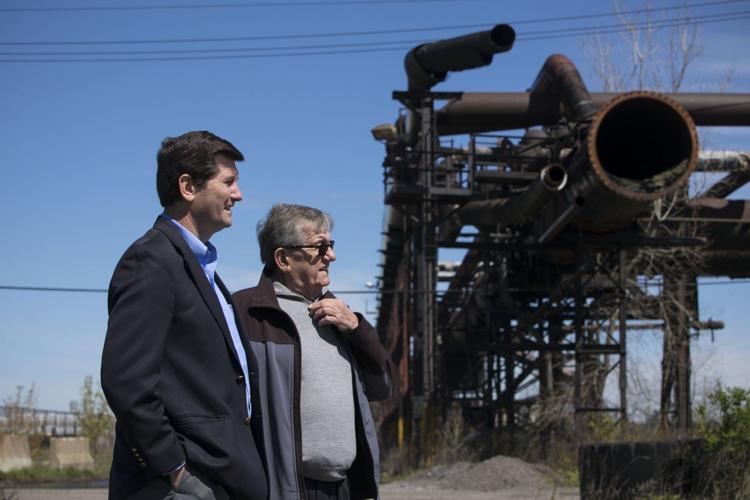
Erie County Executive Mark Poloncarz looks over the Bethlehem Steel site with his father, Charles Poloncarz, who worked at the Lackawanna plant for 38 years, during a tour of the property with The Buffalo News in May 2017.
'The perfect site'
As the son of a steelworker, Poloncarz understood not just the economic impact of redeveloping the land, but also the symbolism. The retail giant's interest in Lackawanna stirred hopes that a place that once employed more than 20,000 people could be reborn in the modern marketplace.
Amazon initially seemed like the ideal fit. The nation's second-largest corporation was looking for a place to build a football stadium-sized logistics center just as Erie County was poised to gain control over nearly 150 acres of industrial property with the infrastructure, workforce and transportation network needed to support such a facility.

Trace Amazon's steps as it attempts to find a spot for a new facility in Erie County.
"As we started to go through it, it became clear this was a once-in-a-generation kind of project," said Thomas Kucharski, executive director of Invest Buffalo Niagara, the nonprofit responsible for marketing the region's properties to outside companies.
Amazon headquarters offered no insights for this story regarding its decisions, except to say that it explores multiple locations simultaneously and adjusts its timetables based on the needs of its network. This account of what happened at the Bethlehem Steel site is based on interviews with nearly a dozen people with knowledge of the Amazon negotiations, some of whom said they could not speak publicly about the talks.
The negotiations began in late 2017 with Amazon representatives and developer Trammell Crow. The commercial real estate developer is one of the few companies that build and lease Amazon's largest facilities.
The Lackawanna land offered many benefits:
• Near the Canadian border, it was properly zoned and fell under the control of a single county-controlled agency, the Industrial Land Development Corp., so all negotiations would be with a single owner.
• The location in a city and major commercial corridor offered extensive utilities and infrastructure, strong transportation options by roadway, rail and water with an active port. It also offered easy access and public transportation options for the 1,000 workers needed to run the distribution operation.
• The parcel qualified for lucrative brownfield tax credits that are no longer available in New York State. Amazon would have essentially paid nothing in local property taxes until 2027 because the company would have been eligible for a reimbursement of all taxes paid, while not shortchanging any community.
Despite Amazon's preference for greenfield locations, the company still moved forward with environmental, traffic-related and geotechnical studies of the former steel factory site.
"At the time, they said it was the perfect site for the size they were looking for," Poloncarz said.

This is not the first time the Bethlehem Steel property has been reimagined. But this time, the plans are being backed with nearly $19 million in local, state and federal
A heavy lift
Amazon planned to build a 2.6-million-square-foot, four-story facility on 75 acres on the Bethlehem Steel site. The fulfillment center would have required heavy, reinforced concrete floor slabs to support the weight of inventory and equipment.
The goal was to begin construction April 2019 and have it opened around now. But the project was different from smaller projects in which a simple cap on the brownfield property would be enough to begin construction quickly.
In Amazon's case, a lot of investigation was necessary to determine what was under the ground and what kind of support would be needed to ensure the stability of the heavy structure.
County officials knew from old maps of the Bethlehem Steel site that the property hid underground foundations from demolished buildings, which it shared with Trammell Crow.
The results from the geotechnical studies commissioned by the developer determined that builders would have to drop deep pillars anchored in bedrock to support the building's weight. To get that deep, crews would need to remove or bust through pre-existing foundations to reach bedrock.
"They were drilling, and they were taking a look at it," Poloncarz said.
The county still saw a feasible project, but Amazon was not convinced.
The geotechnical findings could only tell the developer so much. That uncertainty marked the beginning of the end of consideration for Bethlehem Steel.
Doing the deal
Amazon represents its consideration of the former steel site as exploratory and informal, but on the ground, financial matters were secretly being discussed in concrete terms.
"It was one year that felt like it was eight years long," said former Lackawanna Mayor Geoffrey Szymanski of negotiations.
Among the matters negotiated was the required amount of local labor use for construction and requirements for initial payment of property taxes, Poloncarz said.
Amazon representatives also resisted the county's demands about the higher, living wages the county expected the retail giant to pay. That matter was resolved when Amazon announced in October 2018 that all workers would be paid a minimum of $15 an hour.
"We weren’t really interested in supporting a project that was supporting solely minimum wage," Poloncarz said.
Amazon's demands for complete secrecy regarding the project also frustrated for county leaders.
Nevertheless, Amazon's interest in Erie County remained a closely guarded secret for more than a year until May of 2019, when word eventually leaked that Amazon was exploring the possibility of placing a logistics facility on Grand Island.
By then, Amazon's interest in the Bethlehem site was over.

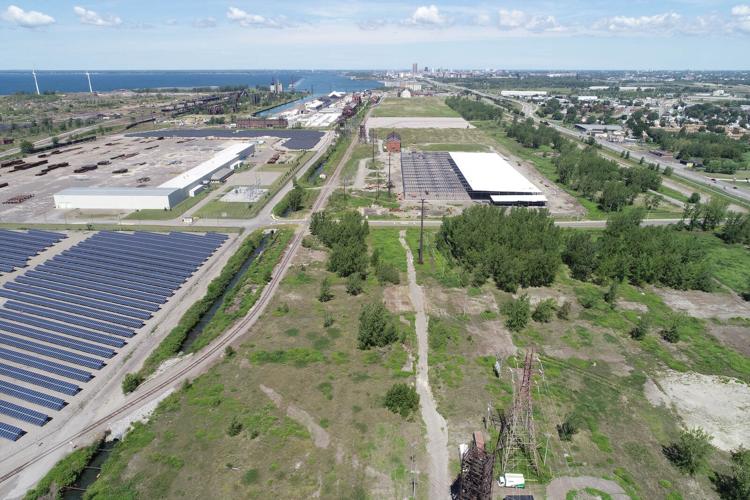
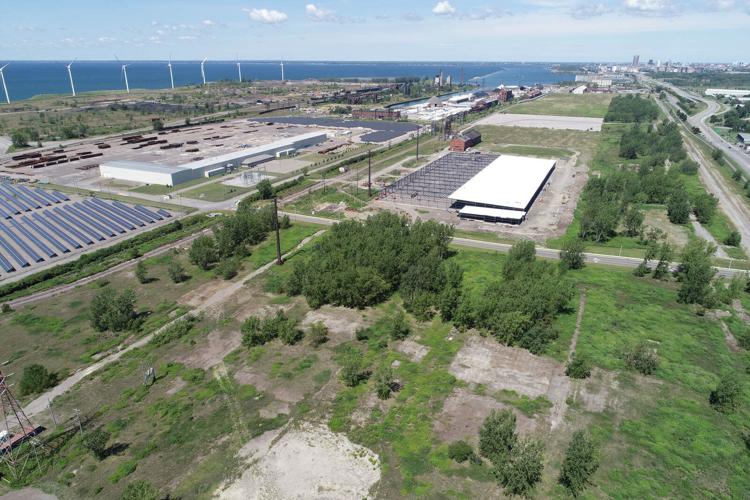
Overhead shot of the former Bethlehem Steel site on Route 5 in Lackawanna where a solar farm, windmills and other development now occupy some of the property.
'Nothing anybody could have done'
While Trammell Crow could easily calculate above-ground building costs on the Lackawanna site, the below-ground costs were another matter. Dozens of unexcavated foundations remained, and they weren't all known. The property had only recently reverted to county control, and the developer's own commissioned research provided less certainty than desired.
The developer couldn't be certain whether the construction costs to support such a heavy structure would be as low as $10 million or as high as $80 million. Those expenses would have been recouped from New York State through brownfield tax credits but the money would first have come from the developer.
Amazon had little desire to spend its brownfield credits to cover the additional underground construction costs, even though county leaders said that's what the credits were for, according to those directly involved in the project.
Even if cost wasn't an issue, the amount of time involved in excavating or penetrating below-ground foundations could put the entire construction effort behind schedule.
That posed major concerns for Amazon, which adheres to a rigid development time frame for all its construction projects across the country, said those involved. Projects that enter into the pipeline together and get the green light are expected to be completed together in time for the holiday season of a target year – in this case, fall 2020.
Given that strict schedule and the facts known at the time, Amazon took a negative view of the risks.
"There’s nothing anybody could have done," Kucharski said, in assessing the outcome and looking ahead to future Bethlehem Steel projects. "It’s remarkable we got as far as we had, and it bodes well as far as the path that we’re on right now. We learned from that experience, and everybody’s working hard together to make it a much better situation for the future."
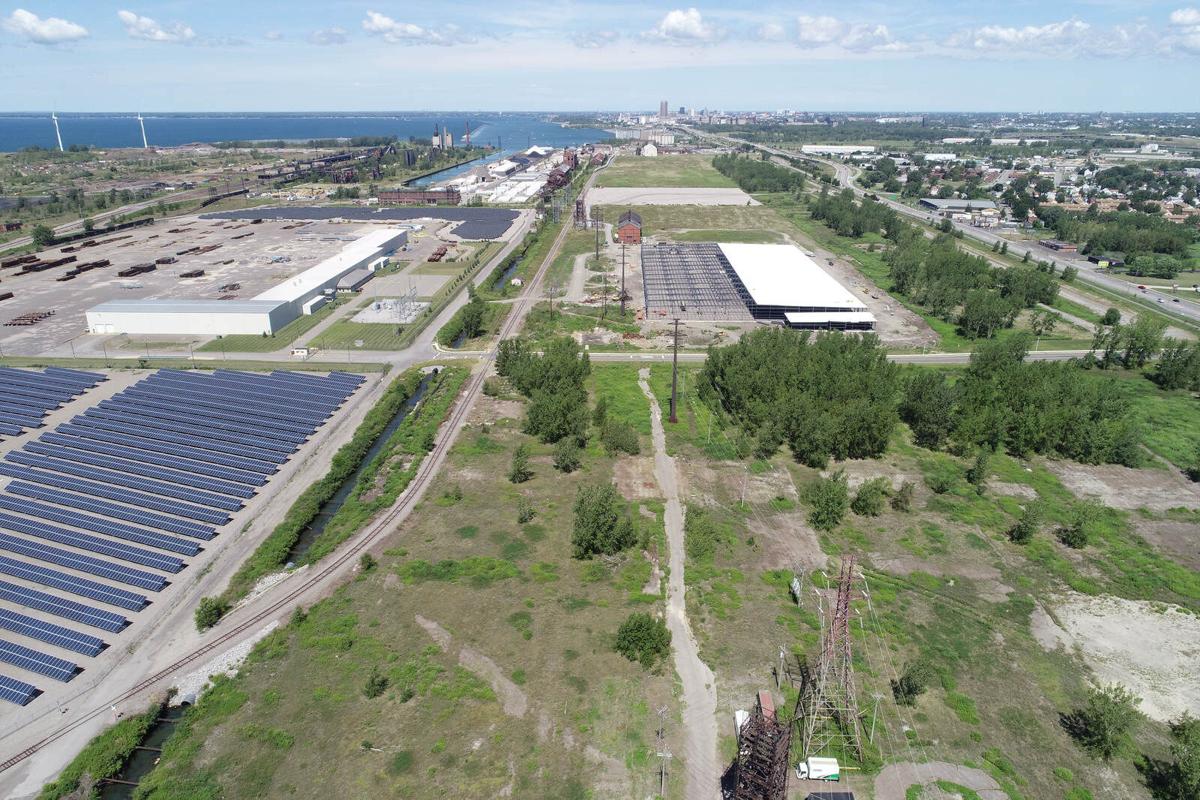
Overhead shot of the former Bethlehem Steel site on Route 5 in Lackawanna where a solar farm, windmills and other development now occupy some of the property.
County leaders contend Amazon made a mistake giving up on the Bethlehem site, especially since, unlike Grand Island, the community would eagerly embrace the Amazon facility there.
"I don't understand why they thought it was going to cost them more money to build on that site, just because it was a brownfield, when they weren't going to pay taxes on the site for seven years," Poloncarz said.
Even if Amazon had built underground factors into the construction costs and timeline, county officials believe the company would have paid less money and opened sooner than what was ultimately proposed for Grand Island.
"If they had moved forward in late December 2018 and 2019, that building would have been up and people hired," Poloncarz said. "I just think they’re skittish about building on brownfields."
'Confident about the future'
The decision by Amazon to abandon Bethlehem Steel was a major disappointment to county leaders, not just because Amazon left, but because Erie County was unable to market most of the property to other companies during the yearlong negotiations.
The clock is still ticking on the exceptional brownfield tax credits, which expire in 2027.
But Poloncarz and other community leaders point out that the property is still one of the largest, marketable pieces of industrially zoned land in the state.
Much of the geotechnical research done by Trammell Crow now provides the county with more information that can better position the county to attract future suitors for the parcel. That will benefit the local task force that regularly meets to discuss future opportunities for the site.
Challenges exist to building a facility like the one Amazon considered on the Bethlehem site, but local leaders agree that other projects would be easier fits.
"The average win is something like 38 employees and $11 million," Kucharski said. "Those types of facilities, you can do those all day long there."
While a retail company like Amazon might be reluctant to build on a brownfield, those who facilitate development projects say manufacturing companies tend to have a greater comfort level with industrial legacy sites, so the possibility of landing another big fish still exists.

The company that makes the Mr. Clean Magic Eraser for Procter & Gamble is helping to erase some of the blight along the former Bethlehem Steel complex in
That's why the Erie County Industrial Development Agency master plan for the Bethlehem Steel site would still save 70 acres in the middle of the county-controlled land for future occupation by a single, large tenant.
The Poloncarz administration has already had some success redeveloping the land. Beyond windmills and solar farms, the Canadian company Welded Tube located to the site in 2013. More recently, TMP Technologies – manufacturers of the Magic Eraser – completed the construction of the steel frame for a $22.7 million, 290,000-square-foot factory just off the newly extended Dona Street.
Now, county and Industrial Development Agency officials are in the process of settling on a company to construct a speculative building for the site.
"There was interest before, and there is still interest now," Poloncarz said. "We’ve run into a few issues no one would have foreseen, like a global pandemic and the delay associated with Amazon. But I feel very confident about the future of this site."
Next: Why the Amazon deal on Grand Island unraveled and lessons learned.