

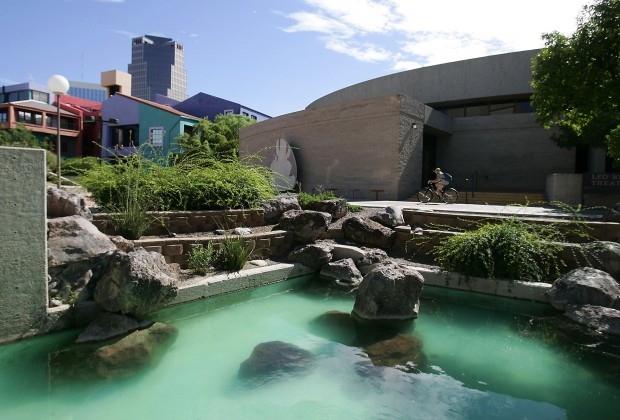
The rock-filled fountains east of the Music Hall in the city's convention center complex are a maintenance nightmare and a legal liability.
They are also Tucson's only example of the work of Garrett Eckbo, "the most important landscape architect of the 20th century," according to art historian Anne-Marie Russell.
"Thank God I was educated because I would have had it filled by now," said Tommy Obermaier, deputy director of the Tucson Convention Center. He's the man in charge of plans to "repurpose" the plaza that links the Music Hall, the Leo Rich Theater and the convention center itself.
At one point, Obermaier said, the city had planned to fill the fountains with sand and turn them into xeriscape gardens.
All plans are on hold for now, Obermaier said, partly because the city has been made aware of the importance of the plaza's landscaping, but mostly because it doesn't have the money to do much about it.
People are also reading…
Meanwhile, maintenance of the fountains costs the city $86,900 yearly, and the collapsing water pipes and leaky pools need $91,000 in repairs, Obermaier said.
Preservationists point to Eckbo's reputation and the plaza's design as reasons to rehabilitate and preserve the fountains, part of a sprawling landscape that includes terraced concrete steps, concrete planters and groves of drought-tolerant pine, towering palms and shady African sumac trees.
The series of cascading pools with large rocks was meant to mirror the surrounding mountain watershed, said Emily Yetman, who is pursuing her master's in landscape architecture at the University of Arizona. Eckbo conceived the project, which opened in 1971, as an accessible place for people to splash and wade in an urban setting, she said.
Though his practice included designing gardens for wealthy Californians such as Gary Cooper and Louis B. Mayer, Eckbo was "really interested in landscape being something for the common people," said Yetman. There are steps into the pools on the south end, she noted.
The city, worried about liability, never allowed wading in the pools. It added bright colors to the project as warnings, she said.
The fountain pools are now painted aqua. There are red lines along some of the canals. Metal benches, in lilac and bronze, form barriers at some of the pool edges. Even the broad concrete steps of the plaza, now crumbling in parts, have yellow lines painted on them.
Art installed on the plaza over time expresses a contrasting aesthetic. Rusted metal arches with solar-powered illumination now bookend one of the pools.
It's not the kind of thing you would do to an architecturally significant building, landscape architects say.
"In my mind, Eckbo is to the profession of landscape architecture what Frank Lloyd Wright was to architecture at that period of time," Yetman said.
Yetman recently wrote a piece about Eckbo's Tucson design for the Washington, D.C.-based Cultural Landscape Foundation, which has included it on its website list of designed landscapes that are threatened by neglect or development.
Russell, executive director and chief curator of the Museum of Contemporary Art, said Eckbo is well known for his "social justice ethic and aesthetic."
The landscape he created is "basically Sabino Canyon and the pools in the Catalinas," she said.
"He was inspired by the path of the water down the mountain. His social justice goal was to bring that experience to those Tucsonans stuck down in the flatlands in the hottest part of summer with no urban swimming hole. Obviously, the lawyers all freaked out," she said.
The Modern Architecture Preservation Project, which advocates for threatened buildings from the modern era, has not been "as vigilant about landscapes," said architectural historian Anne M. Nequette, the group's president.
The group has not taken a stand on preserving Eckbo's design, said architect Chris Evans, vice president of the group.
It's a tough call, he said. The space is broken up and much of its concrete expanse is unshaded. "I've never thought of it as a successful space," he said.
"It's not functional. It would be hard to adaptively reuse it like you would a building," he said.
"It's a tragedy," said Lauri Johnson, director of the UA's School of Landscape Architecture and Planning, "and I really see the city's point of view in terms of the utility expense. On the other hand, it is such an important part of our heritage. Garrett Eckbo was one of the pioneers of modern landscape architecture."
Eckbo was leader of a movement known as the "Harvard revolt," which rejected classical design and favored "responding to regional and site conditions," Johnson said.
Eckbo, who trained and taught at the University of California-Berkeley and also at USC, designed civic plazas throughout California and the landscaping for the General Motors "World of Tomorrow" pavilion at the 1939 New York World's Fair.
His firm created a master plan for open space for the entire state of California.
In the early '70s, he was part of a team assembled to explore improving the aesthetics of the American Falls portion of Niagara Falls.
At the least, Johnson said, the city needs to make an architectural assessment of the landscape at the Tucson Convention Center before it does anything.
Her UA colleague Ron Stoltz suggested a compromise - spend the money to fix the fountains, but turn them on only for events and special occasions.
Obermaier said the city is open to suggestions but won't have the budget to work on them unless private money is raised, something Russell and others are exploring.
He's also worried that future water shortages will trigger Tucson Water's drought plan which, he said, will force shutdown of public fountains.
Contact reporter Tom Beal at tbeal@azstarnet.com or 573-4158.


