

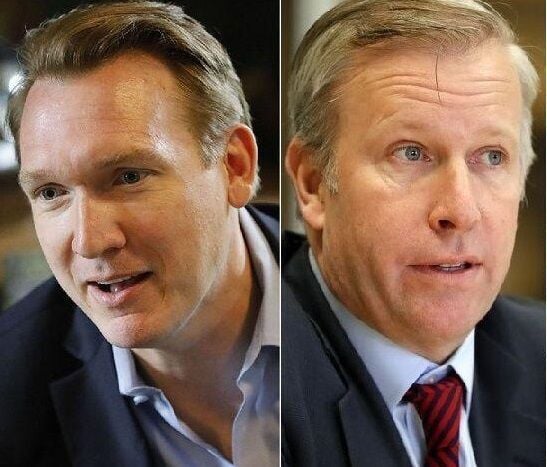

In August 2018, when local Republicans were scrambling to find a candidate to replace the newly indicted Rep. Chris Collins, then-State Sen. Chris Jacobs’ phone rang.
"My cousin called me and said: 'I think you should look at this,' " Jacobs, a Republican real estate developer who first explored a race for Congress a decade earlier, said Friday.
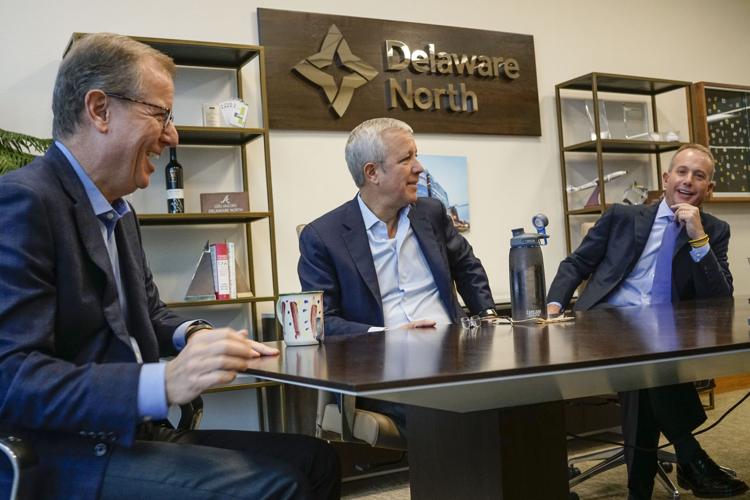
That cousin was Lou Jacobs, a top executive at Buffalo’s Delaware North Cos. who thought it might be time for the politician in the family to move up in the ranks.
Collins stayed on the ballot and won reelection that year, only to resign and plead guilty 11 months later. And while Chris Jacobs never worked for Delaware North and has no ownership stake in the company, he got help from the family firm as he ran in a special election to replace Collins this June, defeating Democrat Nate McMurray.
People are also reading…
McMurray, a corporate lawyer for Delaware North until his acrimonious departure in February, received the opposite of help. A company lobbyist, former Rep. Thomas M. Reynolds, even tried to talk McMurray out of running for the seat Jacobs eventually won – and into running for the State Senate seat Jacobs would vacate instead.
"I left the room kind of shook a little bit," McMurray said regarding that meeting.
He might have been shaken, but he should not have been shocked. Delaware North, the concessions, hospitality and gaming company run by the Jacobs family for more than a century, does business with governments and public agencies all the time. The company says that's why it is an active political player.
Reynolds is just one member of Delaware North's big, bipartisan government affairs team, which includes a Democrat who wrote a memo outlining how McMurray should begin a campaign for Jacobs’ Senate seat.
And the company's executives and its political action committee are big and bipartisan political donors who invested heavily in, among others, Chris Jacobs.
All this serves as a backdrop for McMurray's Twitter assault against his former employer, as well as fodder for McMurray's allegation that "Chris Jacobs is going to be Delaware North's congressman."
Jacobs said nothing could be farther from the truth.
"I've been in elected office – local office, county office, state office, now federal office – for 16 years now, and never in the entirety of time have my relatives ever asked me for anything," Jacobs said.
Meeting with Reynolds
Who is this guy?
That was what McMurray recalls thinking when his bosses summoned him to that meeting with Reynolds and Jack McNeill, Delaware North's senior vice president of government and external affairs, at the company's Buffalo headquarters in late 2018.
McMurray, who was living in California and Asia when Reynolds served in Congress from 1999 to 2009, didn't recognize Reynolds. But McMurray soon sensed he was meeting with a tough political pro.
"This man is like basically telling me that I am wasting my political future by looking at NY-27, that I need to look elsewhere," McMurray recalled.
McMurray said Reynolds never told him Jacobs wanted to run for Congress, but said: "You could do good things in the 60th Senate District," which Jacobs represented at the time.
"Listen to him, Nate," McNeill added, according to McMurray.
Asked about the meeting, Reynolds said: "It was really kind of a discussion for him to kind of get his bearings post that election. And, you know, I consider it a private conversation … I was invited to have a conversation with him. And I did it in the offices of Delaware North, of which I do work for. And he was an employee of the company at the time."
Reynolds, who went on to be an informal adviser to Jacobs’ congressional campaign, declined to offer any details of the conversation. But he added: "There's no scheme, no plan, no long-range visions of anything at that time, other than trying to see a guy heal those wounds from being defeated by an indicted felon."
Not long after that meeting, McMurray said, he started getting more pressure to run for the State Senate. The pressure never came from Delaware North’s chairman, Jeremy M. Jacobs Sr., nor the co-chief executive officers, Jacobs' sons Jeremy Jr. and Lou, but from others, including his supervisor, McMurray said.
A State Senate bid?
Amid the pressure, McMurray started to consider running for Jacobs' State Senate seat. To help him, Shannon Patch – Delaware North's new director of government affairs – wrote him a memo in February 2019, gaming out whom he should call to start building support.
That memo, which McMurray shared with The Buffalo News, urged him to call Buffalo Mayor Byron Brown, State Sen. Tim Kennedy, developer Nick Sinatra and Delaware North lobbyist Jack O'Donnell.
"You should say: 'That district is heavily Democratic, and Buffalo would benefit from having another Democratic, majority member in the Senate,' " Patch wrote.
Patch seemed to be trying to reshape McMurray – one of the region's most progressive politicians – into a candidate who would run to the right of Assemblyman Sean Ryan, another Democrat who was eyeing and is now running for that Senate seat.
In a conversation with Sinatra, "your overall message is you are a business-minded candidate," wrote Patch, a former aide to Kennedy and Senate Minority Leader Charles E. Schumer and a Democratic Council member in the Town of Tonawanda.
Also in that talk with Sinatra – a Republican – "you want to become his buddy and the guy he likes for this seat," Patch wrote, in italics. "Sean and he have been at odds over the Children’s Redevelopment Project, but don’t mention that."
Patch said no one at Delaware North spoke to her about writing the memo, an undated Microsoft Word document with no letterhead. She said she had known McMurray for years and thought she was advising him privately.
"It has nothing to do with the company," she said. "And it was written by me as a person, as a Democrat, on my personal time.”
The memo didn't sway McMurray, who announced another bid for Congress in August 2019 – a race Jacobs entered three months earlier after rejecting a chance to run for Erie County executive.
Ryan, after seeing Patch’s memo, suggested it was connected to his opposition to government subsidies for Delaware North's downtown headquarters in 2013.
"This is what happens when you stand between a billionaire and the taxpayer dollars," Ryan said.
A bipartisan behemoth
It might seem odd that Delaware North keeps a former Republican congressman on retainer and a well-connected Democratic politico on staff, but Reynolds and Patch are just two of the company's influential hires.
In April, the company signed a lobbying contract with Brian Ballard, whom Politico last year called "the most powerful lobbyist in Trump's Washington." The coronavirus shutdowns have devastated Delaware North’s businesses, and the lobbyist registration showed that Ballard would be seeking government loans to help the company.
On Delaware North's Democratic side, there is O'Donnell, a well-known Albany lobbyist. William J. Hochul Jr. – a former U.S. attorney and the husband of Democratic Lt. Gov. Kathy Hochul – serves as the company's senior vice president and general counsel, but he is not a lobbyist.
The company declined to offer any interviews with executives other than Patch, instead offering a statement from Glen White, director of corporate communications.
“Delaware North is active in the political process with both the Democratic and Republican parties based on having a variety of business interests involving various levels of government and the need to stay informed about evolving legislation that affects our industry sectors," White said. "These sectors include our significant business in regulated environments such as airports, national parks and casino gaming."
Delaware North's website illustrates White's point. Nearly every one of the company's business lines – from its airport concessions contracts to its lodging offerings in Grand Canyon and Shenandoah national parks to the casinos it manages – depends on contracts with local authorities or the federal or state governments.
So lobbying is how Delaware North competes in an industry where it's actually a relatively small player.
The company reported $3.7 billion in revenues in 2019. One of its competitors, Aramark Corp., pulled in more than four times as much money. Delaware North lost the concession rights at Yosemite National Park to Aramark in 2015.
Competing against Aramark and Sodexo – which is nearly six times as big – the Buffalo-based company has built a political presence that nearly equals and in some ways surpasses its rivals.
Delaware North has spent $3.5 million lobbying Washington since 2011, federal lobbyist registrations show. Sodexo spent about $3.6 million, and Aramark spent only $1.6 million.
In campaign donations, Delaware North and its executives give to both parties. For example, in 2016, Delaware North's political action committee gave $80,000 to two Hillary Clinton fundraising committees. Meanwhile, Jeremy Jacobs Sr. gave $100,000 to the Trump Victory Committee, a joint fundraising committee that Ballard chaired.
Delaware North's PAC has given federal candidates and committees $316,100 since 2014, including $5,000 to the Jacobs campaign a month after he entered the congressional race. In contrast, Aramark's PAC has spent $126,800 since 2012, while Sodexo's has spent only $70,000.
"Our level of legislative and regulatory activity and political contributions is comparable to the levels of other companies operating in these specific sectors,” White said.
The NY-27 race
Given McMurray's experiences and Delaware North's public presence, the Democratic candidate argues voters should be wary of Jacobs.
"His loyalties are going to lie with Delaware North," McMurray said. "There's a reason why they worked this hard to get him elected."
That work extended to campaign donations from company executives. Campaign records show that Delaware North employees contributed $72,314 to federal candidates for this year's election as of June 30 – and $35,100 of it, or 48.5%, went to Chris Jacobs. Most of those contributions came from Jacobs family members.
Otherwise, $28,725 of the donations from Delaware North employees went to the company's PAC, with the rest split among candidates of both parties.
The donations Jacobs got from Delaware North employees should be viewed in the larger context of a congressional campaign in which he will raise $2 million, Jacobs said. Jacobs also noted that he has given more than $500,000 to his own campaign.
Jacobs said he never knew about Reynolds' efforts to get McMurray out of the congressional race, or Patch's effort to help McMurray run for Jacobs' old Senate seat.
"I would have been upset because Nate McMurray was the candidate I wanted to run against," given that the Democrat's left-leaning politics is so out of tune with the conservative 27th District, Jacobs said.
Jacobs is facing McMurray again this fall, amid the Democrat's charges about Jacobs' connections to the family company.
Which raises the question: As congressman, will Jacobs recuse himself from any federal issue involving Delaware North?
"I will follow the letter of the law in regards to everything I do, as I have at every level of government," Jacobs responded. "But again, I have no ownership in Delaware North; I don't work there. So I have no conflict directly with them. But I know the ethics directives at the federal level say that you will give no preferential treatment to anyone, but you will treat every constituent in the district equally. That is exactly how I've operated as a county clerk, as a state senator, and I'll do exact thing at the federal level.”


