
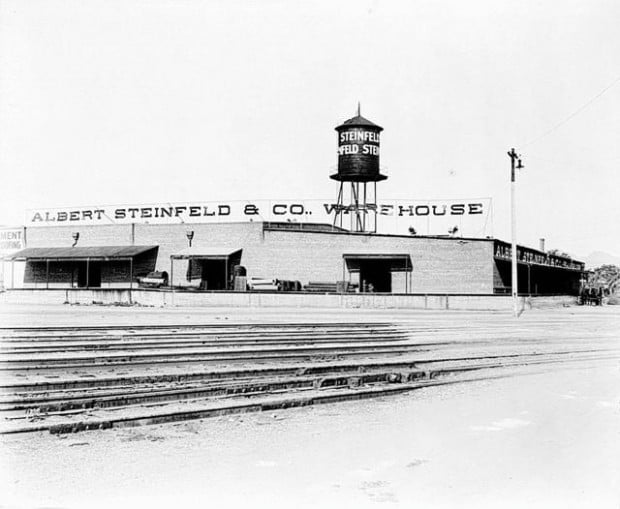
Look at the picture of the old brick building. Albert Steinfeld and Co. Warehouse, blares the large sign above the building facing east. His name faces the north and is stenciled in white, block letters on the water tank above.
There was no question who the building belonged to in the 1920s when the photograph, now at the Arizona Historical Society library, was taken. (See the photo on Page B7.)
It belonged to Albert Steinfeld — a German-born Tucsonan whose name and Downtown businesses once dominated Tucson, and whose mining and banking enterprises made this Jewish pioneer one of the most successful and important Territorial figures.
His Tucson realm occupied the four corners of Stone Avenue and Pennington Street where Tucsonans shopped for the latest fashions from New York City and Europe, and where upper-crust visitors stayed in the once majestic Pioneer Hotel.
People are also reading…
While the Steinfeld businesses anchored the four corners, it was the warehouse, a few blocks north, that held the businesses together. It was the warehouse where the goods arrived by train, were unloaded within its four walls and basement, and then distributed to the Steinfeld's stores.
Other than the Steinfeld Mansion on North Main Avenue in Snob Hollow, only the warehouse holds out as a vestige of Steinfeld's presence.
The Pioneer building at the northeast corner of North Stone and East Pennington Street was a Steinfeld building, but its facade has changed enough since the disastrous December 1970 Pioneer Hotel fire — which killed Steinfeld's son and daughter-in-law and 26 others — there is no resemblance of the hotel's regal past.
The warehouse, at least 100 years old, dilapidated and owned by the state, remains as a visible and honest physical memory of an important part of Tucson's history.
The City Council Tuesday will decide the fate of the Steinfeld warehouse at West Sixth Street and North Ninth Avenue. The state Department of Transportation owns the warehouse, which for more than 20 years has housed artists and anchored the arts district.
The council will consider a financing plan to stabilize the building and rehabilitate it for possible use by artists.
It's not just any only building. It's a territorial-era building, one of the first brick structures, and had Tucson's first indoor sprinkler system, relying on gravity to draw water from the large tank, said Lee Davis, the last executive of the Steinfeld company. He worked in the warehouse as a kid in the 1940s.
Davis was the nephew of Margaret Davis Steinfeld, who was married to Harold Steinfeld, son of Albert Steinfeld.
Margaret and Harold Steinfeld perished in the Pioneer fire four days before Christmas.
"We used the warehouse extensively," said Davis, who served as Steinfeld's president after his uncle died. Davis' brother, James Harold Davis, was executive vice president of the company.
The warehouse was the hub of the Steinfeld stores, which finally closed in 1984, but whose roots stretched 130 years to New Mexico.
The mercantile business began in 1854 in Santa Fe when Aaron Zeckendorf, Albert Steinfeld's uncle, opened a general merchandise store in Santa Fe. In 1868, Zeckendorf and his two brothers, Louis and William, opened a small store in Tucson at Pennington and Pearl, a street now gone.
Albert Steinfeld arrived in Tucson in 1872 and within a few years was store manager. He eventually bought the business and in 1905 built the first Steinfeld department store on the southwest corner of Stone and Pennington.
He opened a grocery store across Pennington, which gave way to the U.S. Post Office. On that corner, the present site of the Joel D. Valdez Downtown Library Plaza, the visionary Steinfeld built two buildings in the early 1950s to house his competitors — Jácome's and J.C. Penney department stores.
His Downtown holdings would include a wholesale hardware store, the immigration building, the Pioneer Hotel and garage, and the Montgomery Ward building at the southeast corner.
None of the Steinfeld's commercial buildings have survived intact. "I can't think of another commercial building still around that is as old as the warehouse," Davis said.
That's something for the council to keep in mind on Tuesday.