

Sweat and water mingled in dripping beads, caressing the cheeks of muddied soldiers in a land rotting with war.
It was early in the morning; the world was still black with a sleeping sun. In anticipation, U.S. Army Pvt. Tony Gargano, in Fox Company, waited to launch a secret attack on the German soldiers' front line.
Not all were willing to fight, for some the war had taken its toll on their minds and bodies, leading to acts of desperation to get out of battle.
"One of the guys shot himself in the foot, he didn't want to go," Gargano said.
The man with a fresh limp was taken off to medical while everyone buzzed with emotions for the approaching battle.
They started to move forward as the U.S. Army Air Corps dropped flares to expose the enemy's front line. Hollywood-style spot lights pointed toward the German troops in hopes of blinding them in combat.
People are also reading…
"The Germans knew we were there, they put artillery on us," Gargano said. "Boy they were really accurate. The first aid man, Willy, a good friend of mine said, 'Tony you got to help me, these guys are bad.' One guy had his hip off, another was dead."
The mêlée roared on around Gargano as he helped identify the living from the dead.
Up ahead the battle pressed forward, in the disarray of artillery, explosions sounded.
The company's leader, Capt. Earl E. Swanson stepped on a landmine. Lt. Robert W. Rankin went after his comrade and suffered the same fate, leaving Fox Company without an officer in charge in the midst of combat.
The sun rose over the horizon blessing Gargano with light to see. He stepped in foot prints like stepping stones leading him across a meadow of death.
"Now it was my turn to walk across the mine field," Gargano said. "I could see the foot prints of the guy in front of me; I would step in his prints and stop. Any minute I was ready for an explosion."
For Gargano, the explosion never came, but machine gun fire opened up, forcing him to hit the ground and crawl the remainder of the field to a church encircled by a stone wall.
Through the crawl Gargano reached back for his grenades. His hands pressed against his garments in search for what was not there. He had lost them in the pandemonium.
"I reached back and they were gone, I lost them crawling. I hoped I didn't pull the pins." Gargano said with a smile, recounting his mistake.
The church was in a small village with only one street; inside Gargano, a handful of other soldiers and German prisoners found shelter from the rain of bullets.
But the fight had turned, and Gargano and the other soldiers were enclosed by Germans. The Germans fired, raining copper and steal ammunition on the church.
The soldiers attempted to send a sign of surrender, "We sent one German prisoner out with a white flag. They shot him." Gargano said.
They attempted to escape by running.
"I don't know if it was a tank or artillery, but we turned to go downhill away from it. As we made our way, there were the Germans with a four-barrel machine gun, the kind they used to shoot low flying aircraft," Gargano said. "We were running so fast down that hill as they were coming up. We couldn't have turned around to head back up without them shooting the hell out of us. We'd be dead. So we gave up."
"I was surprised at how many of our guys were captured," Gargano recalled softly. "It was disappointing."
Living conditions were harsh. Lice crawled in forests of hair and over plains of skin of the captured soldiers. Food was presented once a day and consisted of potato peels mingled and floated with meager vegetables, paired with a piece of bread.
"We marched for thirty days," Gargano said. "On the way we had to beg for food."
While Gargano was lined up along the roadside for a head count with other POWs, a horse-drawn wagon bumped and jostled past. In the back was a mountain of potatoes.
"As soon as the wagon came by me," Gargano said, raising his voice in excitement over the memory, "I jumped on that wagon and I grabbed potatoes, stuffed them in my shirt. I still remember how many I got to this day: 21 potatoes. I ate well for two or three days."
They marched on through German fields tilled by artillery and explosives, through leveled villages and towns.
Pushed into a large barn, the soldiers waited for their German captors to give direction, but they never came. A lone soldier came into the barn announcing the Germans wanted to kill their hostages, earning him a beating from one of the prisoners. They walked out expecting to see the Germans prepared and waiting. They were nowhere to be seen, the captured men were abandoned.
"There was a road running alongside the barn and here comes our guys, recon outfit, in two armored vehicles and a jeep with a machine gun," Gargano said. "They knew about us and I think they were purposefully breaking through the German lines to get at us."
The freedom washed over the men in a wave of pure relief.
"I couldn't believe it. I couldn't believe it. I felt free, like a big stone was lifted off my chest."
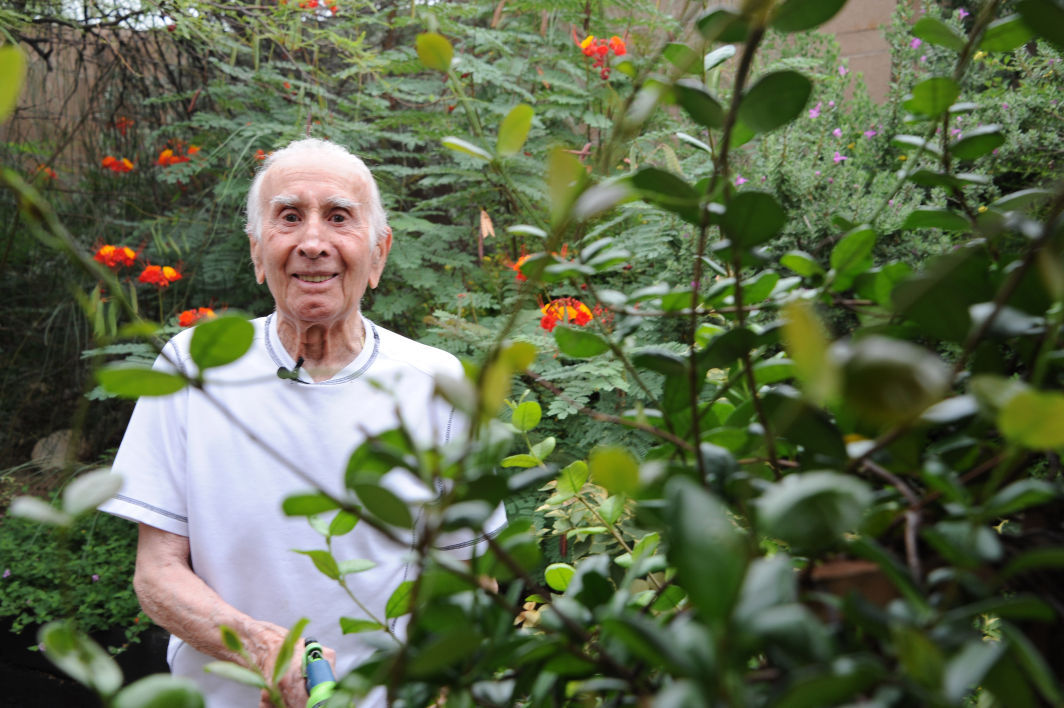
Gargano, 90, now lives in Tucson.
Airman 1st Class Ashley N. Steffen is with the 355th Fighter Wing Public Affairs, Davis-Monthan Air Force Base.


