

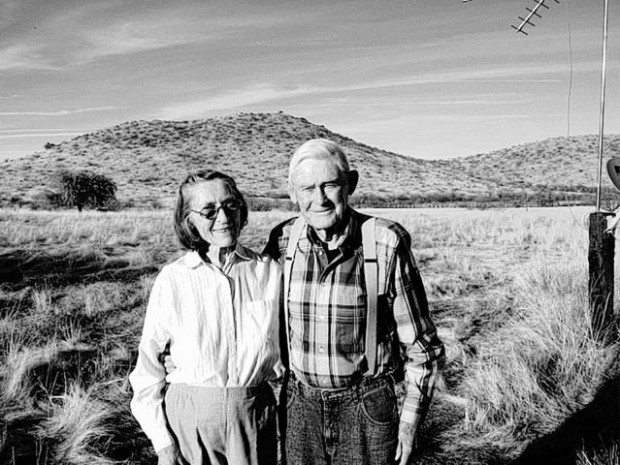
Rancher Mary Burnett Magoffin was a gal with too much gumption — and Southern Arizona is the better for it.
A plaque on a Pearce School District building dedicated to Magoffin in March sums up her contribution to Cochise County. The inscription calls her a respected community activist, dedicated historian, humanitarian and animal advocate.
As a testament to the respect she earned during her 79 years living in Southeastern Arizona, nearly 400 people attended her memorial service May 19 in the Pearce School gymnasium.
Magoffin had colon cancer and died April 30 at her home in Cochise Stronghold, east of Benson.
Mary Magoffin was born in Douglas and grew up on her grandfather's ranch at the Stronghold. She was a third-generation rancher, though, if not for the Great Depression, she might have been a second-generation potato-chip maker.
People are also reading…
In the 1920s, her father invested in a Douglas potato chip factory, "just in time to lose everything in the Depression," she wrote in a personal history that accompanied a 39-page book she wrote in 2001 for the Cochise County Historical Society.
After the chip factory went bust, the Burnetts moved to their family ranch north of Elfrida. It was while she attended school in nearby Pearce that Magoffin was accused of having "too much gumption."
"Somebody had scrawled a note to somebody at school," her daughter, Meg Gilmore said. "There were some girls who thought mom was too lively to be ladylike. That would have been in the '30s when girls were supposed to behave like girls and my mom had an opinion about everything."
After she graduated from high school, Magoffin took some university classes but decided ranching was her vocation. She went to work for a widowed cattle rancher in Elfrida.
"I got a job with Mattie Pressey where I cowboyed and helped her in general, which was a great experience," she wrote in her 2001 bio.
Around the same time Mary was working for Pressey, John Magoffin was working as a hand on a neighboring ranch. A cowboy at heart, Magoffin was born in Buffalo, N.Y., and did a stint in the military before majoring in agriculture at Cornell University and making his way west.
Mary and John were introduced by some of the area's female ranchers. Within a year, they married and bought their own ranch in Cochise Stronghold, where they raised four children.
"I wanted a girl from the golden West," said John Magoffin of his wife of 57 years.
It was from that ranch that Magoffin became a community activist. She volunteered at the local animal shelter, historical societies, schools and ranching groups. And she did it all, for a good number of years, without a telephone or electricity.
In 1966, at Mary's insistence, the Magoffins sold their ranch and bought one in Guadalupe Canyon on the Arizona-Mexico border east of Douglas.
"My mom had always wanted to live there," Gilmore said. "She'd heard about it all her life. It's a very unusual place. It's a canyon with a creek that runs through it. There are a lot of birds you don't see elsewhere. That interested her."
During her 20 years on the ranch, Magoffin became an expert on area birds, bugs and geology by talking to researchers who visited the canyon.
"My mom loved nature. She was constantly amazed by nature — clouds and sunsets and plants and bugs and birds," said daughter Molly Magoffin-Hunt.
It was Magoffin's inquisitive nature that led her to record local history.
"She liked people and she liked to visit with them," her husband said. "She always wanted to know about who lived there and the old-timers, what happened to them. She looked into everything."
It was a neighbor, Diana Hadley, who nurtured Magoffin's interest in history.
"She gave me the gift of bird-watching and because I was so excited about the history of the area, she became more interested," said Hadley, a historian at Arizona State Museum.
Magoffin dedicated hundreds of hours to recording the oral histories of pioneer families, researching historic locations and writing about them for area publications. Her research became even more fervent in the late 1980s, when she and her husband semi-retired to a ranch at Cochise Stronghold owned by their daughter and son-in-law.
"She was an excellent interviewer. She knew exactly what questions to ask and she got all the significant information," Hadley said. "These are tape recordings that can never be duplicated."
Historian Jim Turner met Magoffin six years ago and read a booklet she wrote about a site significant to cavalry troops during the Chiricahua Apache campaign of the late 1800s.
"I was impressed by what a scholarly job Mary did with the article," Turner said. "Mary used the standard sources, quoted leading historians, but also ferreted out obscure school district records, memoirs and newspapers. Mary interviewed old-timers, and left no stone unturned to present as full and clear a picture of local history as humanly possible. Mary could have been a professional historian, and the caliber of her work was Ph.D. quality."
Magoffin and her husband were instrumental in creating a monument at the site she wrote about, Soldiers Hole.
"Mary was a hero for so many of us and for so many reasons," said Rebecca Orozco, director of the Center for Southwest Studies at Cochise College in Douglas. "She single-handedly did so much for preserving history in Cochise County."
Magoffin was the organizer, too, of the annual Pearce School Old Timers Rendezvous, a reunion of students who attended the school. She put together her last reunion in March, just weeks before her death.
"Mary was one of the living legends we have here in the county," said Christine Rhodes, Cochise County recorder and an Arizona native. "Her family has so much to be proud of."
Find a photo gallery of this Life Story at azstarnet.com/slideshows


 Air adventure park to open in Tucson with ziplines and more


