

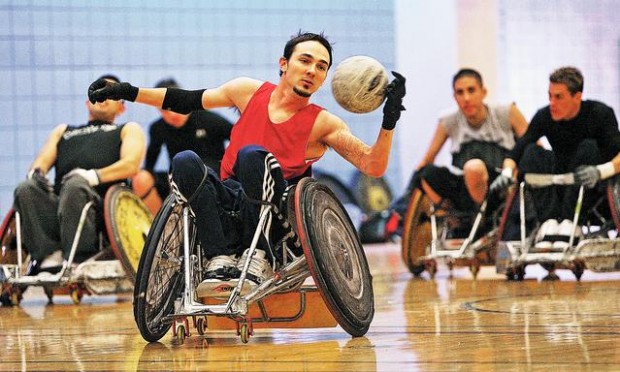
He's fast, he's smart and for the past two years he's done everything he can to become one of the top athletes in his sport.
For that, Chad Cohn — a quadriplegic since snapping his neck in a motocross accident eight summers ago — is only one cut away from being named to the U.S. Olympics wheelchair rugby team.
"I am amazed. I'm overwhelmed, really," said Cohn, 23. The 2001 Canyon del Oro graduate is one of 19 players who qualified last Sunday in Birmingham, Ala., for the U.S. Paralympic wheelchair rugby national team.
Cohn will find out in June whether he gets to be part of the 2008 summer Olympics in Beijing.
U.S. head coach James Gumbert, a quadriplegic like all his players, met Cohn shortly after he began playing "quad" rugby with the University of Arizona in fall 2004.
People are also reading…
"It's just been a very steady rise for him," Gumbert said last week. "He's now at the beginning stages of his international career."
Bryan Barten, head coach of the UA wheelchair rugby team, calls Cohn "a superstar."
Barten, 33, has been playing and coaching wheelchair sports since a car accident left him quadriplegic 10 years ago.
"Chad is one of the best athletes I've ever been around," Barten said during a practice session Thursday at the UA Campus Recreation Center. "He came here two years ago and was just kind of timid, and I looked right past him. I didn't really see much. But what he's done in the past two years is just unreal."
Cohn doesn't just show up for practice, Barten explained. He works out regularly on his own. He reads about the game. And when he goes to tournaments, he spends every minute when he isn't playing watching other teams, studying other players' moves.
"When he's at practice, he's totally intense, just fired up about the game," Barten said. "As his coach I really gotta be on top of things 'cause if the action slows down, he gets angry. He just doesn't stop."
And he's a nice guy, Barten noted during Thursday's practice.
"Look at that smile," Barten said. "Chad just told that other player what a good job he's doing. Chad not only wants to be as good as he can be, he wants to help others be as good as they can be."
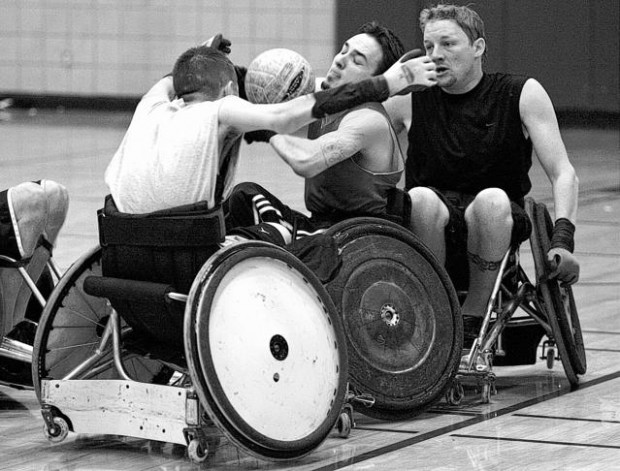
Wheelchair rugby is rowdy, fast-paced and hair-raising to watch. Players slam into each other with such force that their chairs bounce off the floor.
"When you see it for the first time you think, 'Oh my God, they're going to kill each other,'" Gumbert said. "It's just so in-your-face as opposed to the usual wheelchair scene."
Players are rated according to their injury level. The most severely injured are rated .5, followed by 1, 1.5 and on up to the least disabled, who are rated 3.5.
Barten, for example, is a 3. He has the best arm and hand function of anyone on his team.
Cohn's injury rates him a 1. His left arm is strong and muscular, but his right arm remains weak. Still, he is one of the fastest players on his team, Barten said.
"From the first year, I've just kind of busted my butt," Cohn said before Thursday's practice. "I knew I had a shot at something big. People would say to me, 'Hey, you're doing really well. How long you been playing — three or four years?'
"And I would say, 'No, this is my first year.' And they'd say 'Well, you're something special.' "
Cohn's competitive spirit is not new. Before his accident, he was a trophy-winning BMX cyclist.
"I've always been motivated," he said. But that became especially true in July 1998.
Cohn was practicing for a motocross competition when he hit a bump on the dirt track. He bounced into the air, then fell on his front tire before landing head first in the dirt.
Doctors at University Medical Center told his parents that night that he would never use his arms or legs again.
Cohn wasn't willing to hear that. "Whenever anyone told me I couldn't do something, I'd think, 'I'm gonna do it.' "
Eight months after his accident, he started working out. Two years later, at his high school graduation, he "walked" to the stage to get his diploma, using a walker and braces on his legs to propel himself forward.
Cohn worked for a few years after graduating, mostly at the fitness club where he worked out. During those years, he came to fully accept his injury — despite the fervent wishes of family and friends who kept telling him, "Keep trying. Someday you'll walk again."
But Cohn is happy with his life, he said. "I'm not going to spend the rest of my life trying to get out of this wheelchair. What I have is what I have. Even if someday they come up with some stem-cell cure, who says I'm going to want to change?"
Cohn was taking classes at Pima Community College when his sister Stephanie introduced him to one of her classmates at the UA: Gabe Nyrkkanen, a quadriplegic and assistant coach of the UA team.
That was the spring 2004 semester. By October, Cohn was a quad rugby player, fully committed to the sport.
With his first game, Cohn said, "I had a blast, but I didn't think too much of it." That changed within a few months.
Cohn was one of 13 UA players at the practice scrimmage Thursday. They ranged in age from 18 to 50, and they include Katie Samson, 27, one of only about eight women playing quad rugby in the country.
"I was an athlete before I was injured seven years ago," Samson said. "I still have that competitive streak. We all do. We just can't sit still for long."
Some quadriplegics give in to their injury, said Dr. Robert Dzioba, one of the UMC surgeons who operated on Cohn after his accident. Cohn was not one of those, Dzioba said.
"He's one of those who says, 'I have an opportunity that I never wished for but it's an opportunity that's been thrust upon me, and I'm going to see what I can do with what I have.' There's no denial. He's made peace with himself and moved on. I think it's wonderful."
The Wildcats hosted the Phoenix Heat — the top-ranked quad rugby team in the country — in a scrimmage Saturday at the UA. The Heat's head coach is Scott Hogsett, a 2004 Paralympian featured in the award-winning 2005 documentary film "Murderball."
Although they compete, Hogsett also has mentored Cohn over the past two years.
"He's getting to be so good, they want to work with him and take him to the next level," Hogsett said of Cohn's appointment to the national team.
Cohn and his coaches hope that will happen in time for Beijing next year.
Either way, Cohn said, he's hooked.
"With everything I've learned from the other players and the coaches, all the places I've gone, it's been one of the best times of my life," he said. "This is going to be with me forever."
On StarNet: View an audio slide show about Cohn and his push to make the Olympics wheelchair rugby team at azstarnet.com/slideshows


