
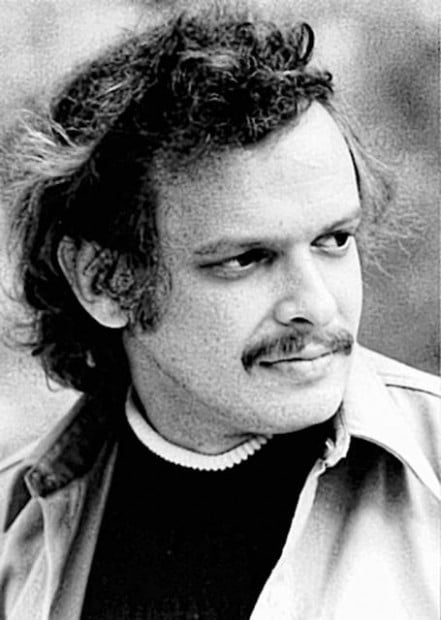
Jon Anderson, a celebrated lyric poet and longtime professor of English at the University of Arizona, died Saturday in Tucson. He was 67.
Anderson published six critically acclaimed collections of poetry and won several national awards, including a Guggenheim Fellowship and the Shelley Memorial Award for Career Achievement from the Poetry Society of America. He had achieved most of his fame before he came to Tucson to teach at the university in 1977.
He did not publish a book between 1982 and 2001.
Anderson was tough on himself when he did write, said longtime friend, colleague and poet Steve Orlen. "He would closet himself in his office for three or four days without sleeping or eating until he finished a poem," Orlen said.
"He was also the kind of poet who sits with a first line and doesn't go on to the second line until he had perfected, in his own way, the rhythm of that line, the music."
People are also reading…
The music of his poetry stood out, said poet Michael Collier, who called his former teacher "one of the most gifted poets of his generation."
"He had a kind of beautiful and graceful lyric voice," said Collier, associate professor of English at the University of Maryland-College Park, and director of the Bread Loaf Writers' Conference.
"His ear was flawless; he was really the best of his generation. He was writing the poems that I didn't know I needed until I encountered them,"
Another Anderson student, poet David Rivard, said Anderson once told him, "The first line of a poem establishes its values, and you should write a line you can live up to."
Rivard, who is poetry editor at the Harvard Review and teaches at Tufts University and the Vermont College M.F.A. in Writing Program, said Anderson wasn't the kind of teacher to go over your poems line by line.
"He was one of those people who had like six or seven really big things to teach you about the process of writing poems.
"He wouldn't fix up your poems, but he would tell you that writing poetry had a purpose — that somehow it made you larger as a person in spirit and important in that sense."
Rivard said Anderson's poetry was one of the reasons he came to the UA for graduate school after deciding in the middle of his graduate work in anthropology at Princeton that he wanted to pursue poetry.
"I didn't know a lot about poetry, and I looked at an anthology, and Jon's poems were in there, and I liked them quite a bit. They seemed quirky and serious at the same time. They had an elegance about them and at the same time seemed quite intimate."
Rivard said it would be "hard to overestimate how influential Jon was in the late '70s and early '80s. It was more than having a reputation. People felt the power of his poetry."
Longtime friend Orlen said Anderson "had begun sounding like an old man" by the time he published his third book, still in his 30s — "very wise and non-judgmental and forgiving, and that's what Jon was like."
"His poems had a real generosity about being human," Rivard said. "It made him a good teacher. Jon could be challenging, but he was a tremendously supportive teacher."
There were several reasons for Anderson's long layoff from writing, Orlen said.
"He stopped writing poetry because it was too hard for him, he said, and because he had an alcohol problem. Once, he said, 'I've had ambitions and I've met them and why should I keep going.' "
Rivard said there was "a point where I felt sad he wasn't writing, as if he owed the world more than he had already given it."
Former student Collier said it's always been a mystery how some writers can write and change and improve all their lives, while others, like Anderson, seem to use it all up in a "lyric burst."
"Maybe he thought he could never, ever again sing the way he had, so he fell silent," Collier said.
Anderson is survived by a son, Bodi Orlen Anderson, and his wife Ayaka, of Flagstaff; his former wife, Barbara Anderson, of Flagstaff; and a sister Vicki Cahalane, of Osterville, Mass. No services are planned, but the UA Poetry Center will host a tribute in the spring.
Online tribute
• Steve Orlen's tribute to his friend, including a long listing of friends and students Jon Anderson inspired and his poem "In Sepia," are online at the UA Poetry Center Web site: http://poetrycenter. arizona.edu/memorial.shtml