Every kid who collected baseball cards learned to flip them over. The front had the picture. The back had the numbers: batting average, home runs, RBIs, season by season.
It was a scorecard for comparing one player with another, and it came in handy when you needed to convince your brother that the card in your hand was worth two of his.
Ricardo Valerdi was one of those kids.

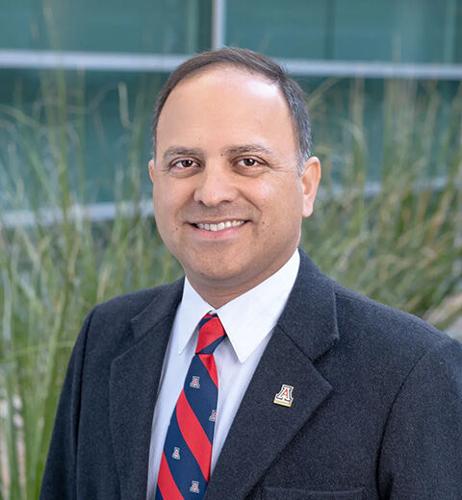
Valerdi
Today he is an engineering professor at the University of Arizona, as well as a sports scientist, author and social entrepreneur. He told me plainly that he's a numbers guy, and that his love of baseball started on the back of the card.
That love eventually met a book. In 2003, "Moneyball" by Michael Lewis told the story of how the Oakland A's used statistics to rethink the way teams value players, an approach rooted in the work of baseball writer Bill James.
People are also reading…
For Valerdi, the lightbulb came on. If numbers could change how baseball is played, baseball could change how kids feel about numbers.

University of Arizona professor Ricardo Valerdi’s nonprofit Science of Sport uses baseball and other sports to teach STEM to schoolchildren.
He founded Science of Sport, a nonprofit, and built its first program, The Science of Baseball. The belief behind everything the organization does is simple: STEM (science, technology, engineering and math) becomes engaging, relevant and accessible to every learner when it's taught in the universal language of sport.
Take the strike zone, the space above home plate that a pitch must pass through to be called a strike. In the program, each student calculates his or her own. They measure their height, then use two formulas Dr. Valerdi developed to work out the height of their strike zone, along with its perimeter and area. Suddenly geometry has a batter standing in it.
The lessons go well beyond home plate. Students study how a batter's launch angle affects how far the ball travels and how a pitcher's stride affects accuracy. They even measure fielding accuracy, working in three-person teams and dropping baseball cards.
Like any good scientist, Valerdi had to take his idea out of the lab and into the real world. He tested it at Mansfeld Middle School, right here in Tucson, starting with fourth- and fifth-graders. The response was so strong that the program expanded through eighth grade.
That left one big question: who pays for it? School budgets are stretched thin, and you can't send the bill to a 10-year-old.
Enter Major League Baseball. Valerdi approached the Arizona Diamondbacks, and they loved the idea. Team President Derrick Hall calls it a win-win. The program makes math interesting for kids, it supports the Arizona Diamondbacks Foundation's mission of helping children, and it turns those kids into baseball fans for life.
From there, the partnership with MLB grew quickly. The league funds programs at its Youth Academies for young players, and individual teams sponsor their own. One example is the Arizona Diamondbacks Science of Baseball Program, presented by Resolution Copper. The Angels, Padres, Cubs, Dodgers, Braves, Rangers, Nationals, Mets, Rockies, Athletics and Phillies are just a few of the teams with programs of their own.
Science of Sport has also moved well beyond baseball, with programs tied to the NBA, NFL, NHL, MLS, NWSL, FIFA, and the Olympics.

In this March 2018 file photo, D. Baxter the Bobcat helps demonstrate the preferred launch angle for a home run during an Arizona Diamondbacks Field Trip Day at Hi Corbett Field.
Thirteen years in, more than 750,000 students have gone through Science of Sport programs.
Valerdi's goal is to pass 1 million by the organization's 15th anniversary.
Hearing all this, it's easy to see why the program works. But in the early days, Valerdi wasn't entirely sure it would. The proof came from a sixth grader in Los Angeles. After one session, the student walked up, thanked him for such a good program, and offered the highest praise a sixth grader can give:
"You got me out of math class."
That student had just spent the entire class doing math. That's the whole idea.