

Police have only so many places to take someone who appears to be suffering from a mental health issue.
There's jail or the psychiatric emergency room.
If the person wants help in Buffalo, options are few. But after Monday's shooting of a man on Hertel Avenue by Buffalo police officers, another option is getting some attention: the crisis stabilization center, a 24-hour operation that provides a comprehensive array of services that take a holistic approach to helping a person in need. A visitor would have access to a doctor who could prescribe medication, detox care, crisis counseling, as well as housing services, peer support, social skill development and employment assistance.
People are also reading…

Buffalo police on Wednesday released a 3 minute 44 second video from a body-worn cameras of one of the police officers who shot a man armed with a knife who was having a mental health crisis early Monday morning.
"The community, the City of Buffalo needs more resources that officers can utilize to get individuals the help that they need," said Buffalo Police Capt. Amber Beyer. "There needs to be a crisis stabilization center, where we can use that as a drop-off when people aren’t appropriate for the emergency room, but they also need more than an outpatient clinic."
Right now, no such facility exists in Western New York. The state has plans to fund some of these facilities starting later this year.
A crisis stabilization center would offer services for children and adults suffering from a mental health issue. Someone receiving services at a center would not be permitted to stay longer than 24 hours.
Police would be able to take people to the center. Having this type of facility would help alleviate the overburdened psychiatric emergency facility at ECMC, Beyer said.
Sometimes, police encounter people who don't meet the criteria for an involuntary transport to Erie County Medical Center's psychiatric emergency facility, the Comprehensive Psychiatric Emergency Program, also known as CPEP. They would have to be considered an imminent threat to themselves or others for that to happen.
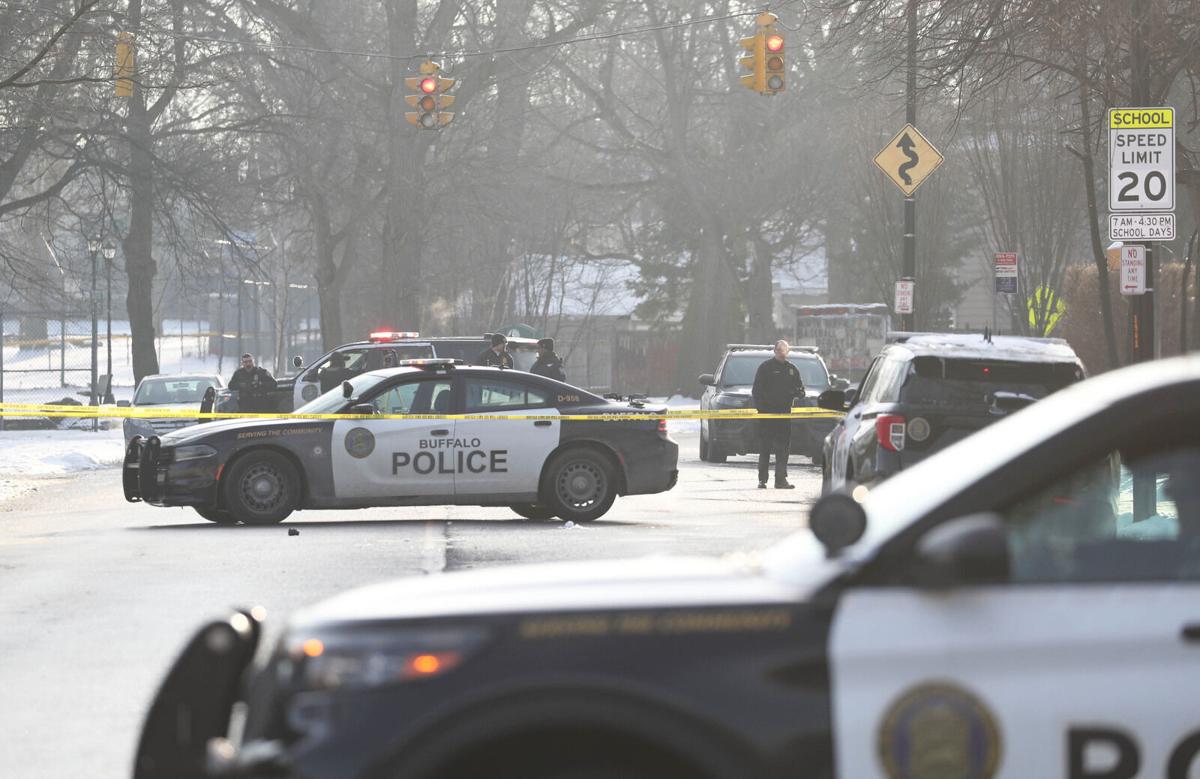
Police can take someone there who volunteers to go, like they did with Dominique Thomas earlier this month. On Monday morning, less than a week after that trip to the ER, the 30-year-old called police again. In the darkness outside his Hertel Avenue apartment building, two police officers shot him after he charged at them with a knife.
Police were called to 1945 Hertel, near Shoshone St., about 4:36 a.m., according to archived police radio transmissions.
Police had other interactions with Thomas before the two this month. He remains hospitalized after being shot multiple times.
A crisis stabilization center would be most useful when a person is not considered an imminent danger at the moment but is demonstrating the need for more intervention or is asking for more help than can be provided in an emergency setting, said Beyer, who also coordinates crisis intervention training for the department.
After police shot Thomas, Police Commissioner Joseph Gramaglia said there is a "resource problem" when it comes to dealing with those suffering from mental health issues.
Buffalo police's Behavioral Health Team pairs specially trained officers with mental health clinicians. Since the team was created in October 2020, more than 800 people who previously would have been arrested or taken to the Comprehensive Psychiatric Emergency Program, known as CPEP, at ECMC were referred to other services.
In about half of these instances, called "diversions," people are left at home or at a scene where they encountered police and are given information about available help, Beyer said.
In the other half, officers take people to a place that offers services, she said. Those include Spectrum Health and Human Services' urgent care clinic on Main Street, the Restoration Society's Empowerment Academy on Elm Street and the Help Center on the ECMC campus.
ECMC's Help Center offers services similar to what would be offered at a crisis stabilization center, according to a spokesperson. It's open to walk-ins from 8 a.m. to 10:30 p.m. daily.
While the police department's Behavioral Health Team's normal hours are 8 a.m. to 6 p.m. on weekdays, Beyer has recently been scheduling the team to work occasional nights and weekends, Beyer said.
Mental health services are offered on a continuum and patients have different needs, so it's important to meet them where they are in order to provide what help, said Elizabeth L. Mauro, CEO of Endeavor Health Services, a local nonprofit that provides mental and behavioral health services, including alongside city police.
While crisis stabilization centers will be able to treat people in the middle of a crisis, they are geared towards being more preventative in nature, Mauro said.
The centers are distinct from what exists now; they would offer all a variety of services, marrying different components under one roof, she said.
"Different services resonate with different people," she said.
Earlier this year, the state issued a request for proposals for 12 "intensive crisis stabilization centers" – three in New York City and one in each of the nine economic development regions outside the city, including Buffalo. Proposals are due in June.
The facilities will be licensed by the state Office of Mental Health and the Office of Addiction Services and Supports.
Earlier this year, Gov. Kathy Hochul announced the state would allocate $100 million of federal block grant funding over five years for the development of this type of crisis center. The state also plans to develop similar facilities known as "supportive crisis stabilization centers."
Momentum is building nationwide to create facilities for people to get immediate care for mental health crises and connect them to services, said Alexis Piquero, a University of Miami criminologist who serves on the Violent Crime Working Group of the Council on Criminal Justice, a nonpartisan think tank.
Piquero pointed to a new project in Miami where a facility geared toward people with mental illness who are repeatedly arrested for minor offenses is set to open soon. Part of the Miami-Dade Criminal Mental Health Project, it's designed to be a one-stop shop that provides psychiatric services, job training and up to a year of housing.
Such efforts can be helpful, but they're not panaceas, Piquero said.
"We live in a world where we have people who need help and have access to things where they can hurt themselves," he said. "...It's like the homeless situation. Nobody wakes up and says: You know, I want to be homeless or I want to have a mental health problem."
News Staff Reporter Maki Becker contributed to this report.
Reach Aaron at abesecker[at]buffnews.com or 716-849-4602.


