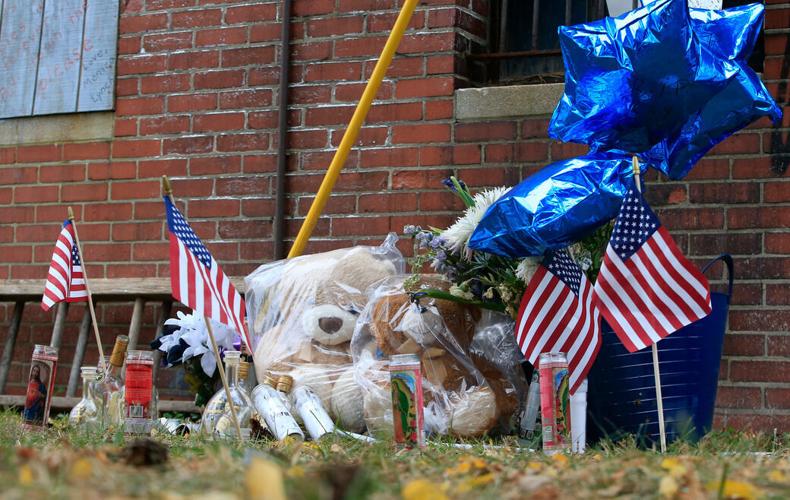
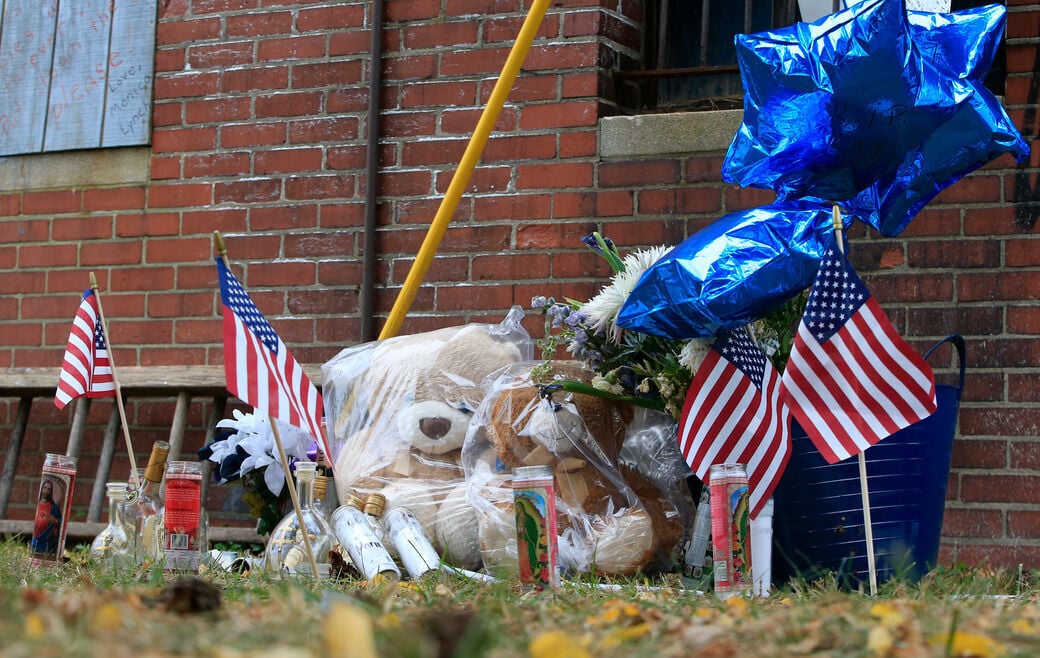
Behind a boarded-up brick building on the corner of Jefferson and Glenwood avenues, blue balloons, purple flowers and stuffed teddy bears carry the memory of a young mother of three killed a week after her 23rd birthday.
Messages of love scrawled in blue, red and black marker hang on pieces of poster board. On a nearby sidewalk, 37 tealight candles spell out "Ray."
On Sept. 19, Rayshionna Johnson was killed and four others were shot near that intersection, in the second quintuple shooting of the year in Buffalo. All five victims were Black.
Gun violence in Buffalo continues to disproportionately affect people of color. So far this year, more than eight of every 10 shooting victims were Black.
Poverty in these neighborhoods is key factor, community activists say. So is access to handguns, often trafficked illegally from other states, they say. Buffalo Police Commissioner Byron Lockwood and activists both agree that more needs to be done to steer young people away from resorting to violence. Many of the shootings involve neighborhood gangs and are done in retaliation for previous shootings.
People are also reading…
The shootings in Buffalo mirror what's happening in other major cities across America and criminologists are still trying to parse out the role of the Covid-19 pandemic in the surge in violence. They also are happening as the Black Lives Matter movement has forced questions about race, racism and the U.S. criminal justice system.
The shooting at Jefferson and Glenwood was Buffalo's second quintuple shooting in less than a month.
Lockwood said police investigations often find one individual responsible for three or four shootings.
"It's a very small number of people causing this havoc on the East Side," Lockwood said. "The vast majority of people are law abiding citizens."
Through the end of August, 217 people have either been injured or killed in a shooting in the city, according Buffalo Police Department data. That's 82% higher than over the same period in 2019, according to a Buffalo News analysis of the data. It's also about 35% higher than the average over that eight-month period from 2015 through last year, according to The News' analysis.
For three straight months, the number of people shot each month exceeded 40 – in June, 41; then 48 in July; and 49 in August. Before 2020, the last time 40 people were shot in one month in Buffalo was July 2011, according to police data.
Through early August, the number of shooting victims in the city already eclipsed the total number of people shot last year.
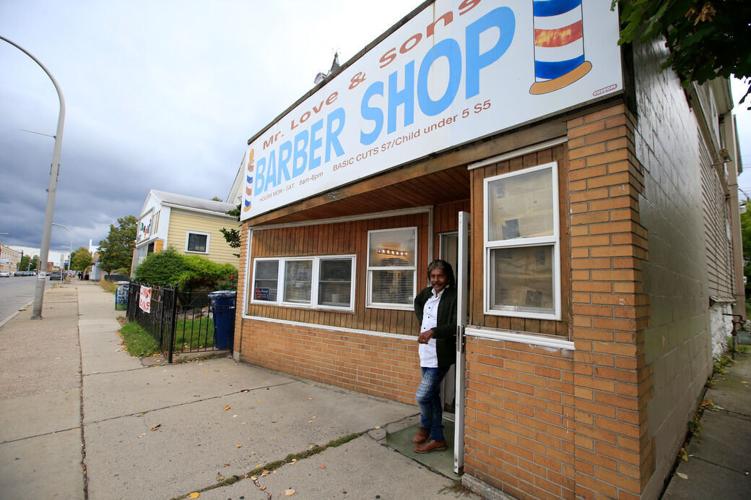
"Young people, they don’t really have anywhere to go," said Leroy Love, who runs a barbershop around the corner. "So when they meet up – it’s hundreds of them, usually – they’ll pick a block or something, have a party. Or if there happens to be a party, they’ll show up there, and something seems to go wrong."
Buffalo in line with national trends
Buffalo is not alone in experiencing a rise in shootings. Nearly every major city in America has reported an increase in shootings and homicides.
In Chicago, both shootings and homicides are up 50% this year compared to 2019, according to the Chicago Sun-Times. Fatal shootings in Boston were up 34% through August, while shootings overall were up 29%, according to the Boston Herald.
Buffalo crime statistics also align with other national crime trends. In 2019, the rate of both violent and property crimes went down across the country, according to FBI statistics released Sept. 28.
The amount of poverty in a community is correlated with its levels of crime. A wide range of economic indicators show Buffalo's Black neighborhoods have not seen conditions improve for decades.
The overall violent crime rate in Buffalo last year dropped to 991 violent crimes per 100,000 residents, according to the FBI data. That’s down from a rate of 1,043 per 100,000 in 2018. The violent crime rate encompasses homicide, rape, robbery and aggravated assault.
The property crime rate also dropped in Buffalo. In 2019, there were 3,245 property crimes reported for every 100,000 people. That’s down from 3,815 per 100,000 in 2018, according to the statistics published by the FBI. The property crime rate is composed of burglaries, larcenies, motor vehicle thefts and arsons.
During the first half of 2019, the number of people shot dropped to at least a nine-year low, according to Buffalo police statistics provided to The News.
The toll on Black communities
As the number of shootings in the city this year has risen dramatically compared to last year, Black residents have been disproportionately impacted by gun violence.
At least 85% of people shot so far this year in Buffalo were Black, according to the latest data released by the Buffalo Police Department.
About 37% of Buffalo's population is Black, according to Census Bureau estimates.
"When we look at that rate ... that is horrendous, but it's also not surprising, because again the tie between poverty and crime is so tight knit," said De'Jon Hall, an activist with Black Love Resists in the Rust and a member of the Buffalo Police Advisory Board. "It's almost as if one is a causal of the other, and until you address the underlying cause you'll continue to get the same results."
Those who live in communities hit hard by gun violence, along with those who work to combat it, have long known that victims are overwhelmingly young, Black men.
It's also established that a disproportionate percentage of people arrested are Black, both locally and nationally.
According to 2019 Census Bureau estimates, Erie County's population is 79.3% white and 14% Black. During that same year, 46% of those arrested in the county were white and 43% were Black, according to statistics compiled by the New York State Division of Criminal Justice Services. For felonies, 34% of people arrested were white, 54% Black. Broken down to violent felonies, 23% were white and 64% Black.
Buffalo police in July began including some data on the race of shooting victims in documents released to The Buffalo News.
Residents who live in some areas of the city face disproportionate levels of gun violence. A 2016 News analysis of shooting data showed the entire East Side, which accounts for only a third of the city’s population, accounted for about three-quarters of all shootings in the city from 2011 through 2016.
Gunfire nearly every night
At the memorial to Rayshionna Johnson, some of the candles carry messages including "Rest in peace, RayRay," and "Love you, CrayCray." On a board covering a window on the back wall of the building, a message written in red marker reads "Life is precious people; this is not a joke! Ray is gone & 3 babies will feel the pain forever... Put down the guns, please!"
Buffalo police have said the Sept. 19 quintuple shooting happened at one of the latest of what the department describes as "pop-up parties," which the department says have been occurring in the city during the Covid-19 pandemic. These street parties spring up across the city get dispersed by police and then people reassemble at another location, according to the department.
Police said the large group who assembled Sept. 19 had gathered at two prior locations that night.

Leroy Love has run his barbershop on Jefferson Avenue for about 30 years. "I think everybody got a gun now," Love said.
Walter Jackson was born and raised in the neighborhood surrounding the shooting scene.
Jackson still lives there. He said he hears gunfire almost every night.
It used to be that anytime there was gunfire, regardless of whether anyone was shot, police would show up, said Jackson, 45.
But things are different today, he said.
"It's so bad around here, if ain't nobody hit, people not even going to call the police," he said.
Love, the barber who has run Mr. Love & Sons Barbershop for 30 years, said he believes most of the shootings here happen in spur of the moment disputes or encounters. Some occur when individuals run into someone with whom they've had a past dispute, he said.
"I think everybody got a gun now, so when you piss 'em off, you’re bound to get shot," he said. "Ain't no more negotiating or talking to 'em about it. And they don’t use their fists no more."
The biggest problem in his neighborhood, Love said, is easy access to guns.
The role of illegal handguns
As part of efforts to deal with the rise in shootings, some are pushing for law enforcement to crack down on gun traffickers, while also calling for additional investment in Buffalo neighborhoods.
"I think that the challenge is that we’re looking at the fruit and not the root. The root of this is illegal guns," said Bishop Michael Badger of Bethesda World Harvest International Church in Buffalo.
Many of the guns used in shootings here come from outside the city, said Neal Dobbins, who runs a parents group called Most Valuable Parents. Buffalo has a handgun problem, Dobbins said, and there are too many guns in the hands of what he described as reckless young people.
"The bottom damn line is Buffalo is filled with handguns. It's flooded with handguns," he said.
Buffalo Police Commissioner Byron Lockwood agrees with Dobbins that one key to curbing the bloodshed is to stop the flow of illegal handguns into the city's streets.
"I would say 95 percent of these shootings are connected to handguns," Lockwood said.
He and Mayor Byron Brown met with Dobbins and Pastor James Giles of the Back to Basics Ministries to talk about raising awareness about handguns, especially those that are being trafficked from other states.
And Lockwood also believes there needs to be more investment – of time and money – into Buffalo's Black neighborhoods.
"I know people are talking about defunding the police. There are other ways of getting money that should be channeled into these communities," Lockwood said.
He pointed to efforts by the Buffalo Bills to reach out to area youth.
"That's all and good. But what we need is people to go out," he said.
Lockwood is a strong supporter of community policing and has expanded programs such as the police department's "custom notifications" effort, where police officers team up with members of the Peacemakers to work one-on-one with young people deemed at risk of getting into trouble.
He said police should be part of community efforts to stop the bloodshed, and not just through patrolling and arrests.
"As a Black police commissioner I want to work with my community," Lockwood said. "I want to work to help put a stop to this crime – of young black men killing other black men."