For more than six years, FBI agents and federal prosecutors have investigated people, businesses and political organizations closely associated with Buffalo Mayor Byron W. Brown.
Federal agents raided one of his administration’s City Hall offices, seized thousands of City Hall documents, questioned dozens of people, including city employees and contractors who did business with the city, and persuaded Brown’s former deputy mayor to become an informant.
But Brown has never been charged with a crime.
And two former U.S. attorneys, witnesses interviewed by the FBI, and a veteran defense lawyer familiar with the probes told The Buffalo News they don't expect any charges to be filed against Brown before the Nov. 2 mayoral election.
Some of them think Brown will never be charged.
People are also reading…
“After six years, it seems to me that if the FBI was going to charge the mayor, they would have done it long ago,” said Buffalo attorney Dennis C. Vacco, who supervised dozens of political prosecutions as the U.S. attorney in Buffalo and as New York state attorney general.
It would be extremely unusual for the FBI and Justice Department – and against their usual policies – to file criminal charges against Brown or any other candidate so close to an election, according to Vacco, former Acting U.S. Attorney Kathleen Mehltretter and others familiar with federal law enforcement practices.
U.S. Attorney James P. Kennedy did not respond to requests for comment. The FBI in Buffalo declined to answer questions about its City Hall investigations, saying it does not confirm or deny the existence of investigations.
Through his campaign, Brown declined to be interviewed by The News.
“The mayor has never been contacted and told that he is the subject of any investigation by anyone,” Brown campaign spokesman Conor Hurley said.

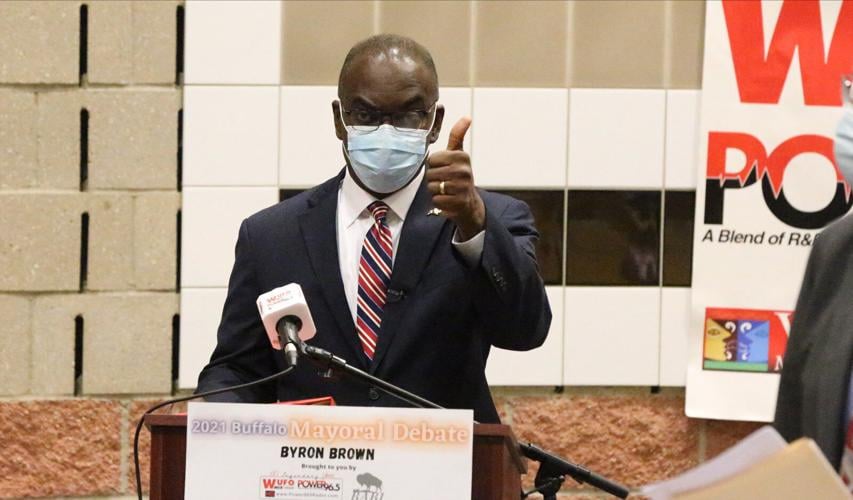
Byron Brown gives a thumbs up at the start of the debate.
In recent weeks, reporters for The Buffalo News have spoken to 11 sources who have knowledge of the federal probes focused on City Hall. Those sources include five witnesses who were questioned by the FBI about the mayor and his administration. Every one of those sources agreed that any prosecution of Brown before the election is highly unlikely.
Clarence Lott, an East Side political activist, said he was questioned by the FBI about how Brown’s campaign handled political contributions, but he hasn't heard from federal authorities in more than a year.
Lott is a former president of Grassroots, the East Side political group that helped put the mayor in office and was the base of his political support for decades. He used to support Brown, but now he is backing Brown's opponent, India Walton.
“That’s what I’m hearing … no charges against the mayor,” said Lott.
If the investigations have turned up evidence against Brown or his administration that voters should know, Kennedy and the FBI should make the information public, said Lott.
“You’ve got to assume, with all these investigations, the FBI was looking into something. You’d like to think they weren’t just fishing,” Lott said. “If they did find something and they’re going to just sit on it until after the election, that’s a disservice to the taxpayers and the voters. … Voters should have the information.”
Walton, a first-time candidate who upset Brown in the Democratic primary, has also come under scrutiny during the mayoral campaign. The News has reported that Buffalo police charged her with harassment in 2014 after she was accused of threatening to break a co-worker’s legs. The News also reported that Buffalo police investigated if a friend of Walton was dealing drugs out of Walton's home in 2018. Walton has denied she threatened a fellow registered nurse at Children's Hospital or allowed drugs to be sold from her home.
In contrast, the FBI investigation of Brown’s administration appears to be aimed at uncovering public corruption.
The investigations
• In May 2015, agents raided the homes and offices of three political operatives in the Buffalo area, including political consultant G. Steven Pigeon and former Deputy Mayor Steven M. Casey, who was intimately familiar with City Hall operations and the mayor’s political campaigns.

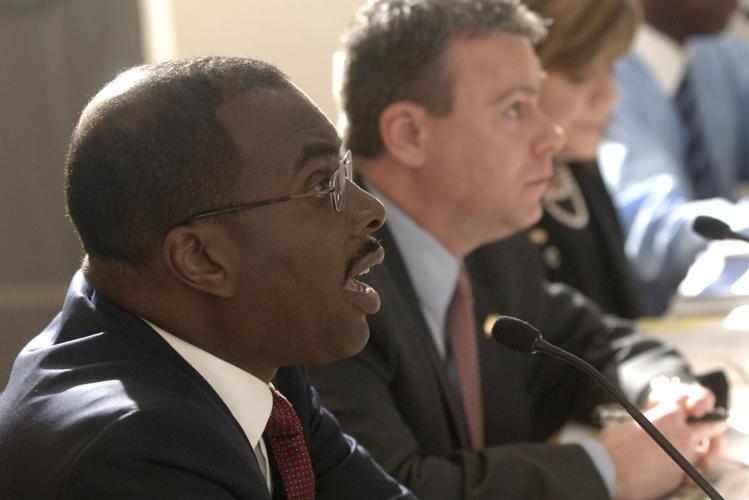
Buffalo Mayor Byron W. Brown and then-First Deputy Mayor Steven Casey at City Hall on Friday, June 16, 2006.
• In June 2017, agents raided the home and offices of Maurice Garner, a political confidante of Brown, and two political organizations closely associated with Garner and the mayor.
• A month later, agents showed up at City Hall with a court order and took thousands of pages of documents related to the Brown administration’s dealings with Modern Corp., a waste disposal company from Niagara County, and six other companies that did business with the city.
• In early 2019, the FBI began investigating Community Action Organization, an anti-poverty nonprofit closely associated with City Hall that spends about $50 million a year in Erie and Niagara counties. Over the years, CAO has worked with the Buffalo Urban Renewal Agency to obtain government funding for community centers and low-income housing projects in the city. Brown is the chairman of BURA’s board.
• In November 2019, federal agents searched the offices of the Buffalo Urban Renewal Agency in City Hall, again seizing documents.

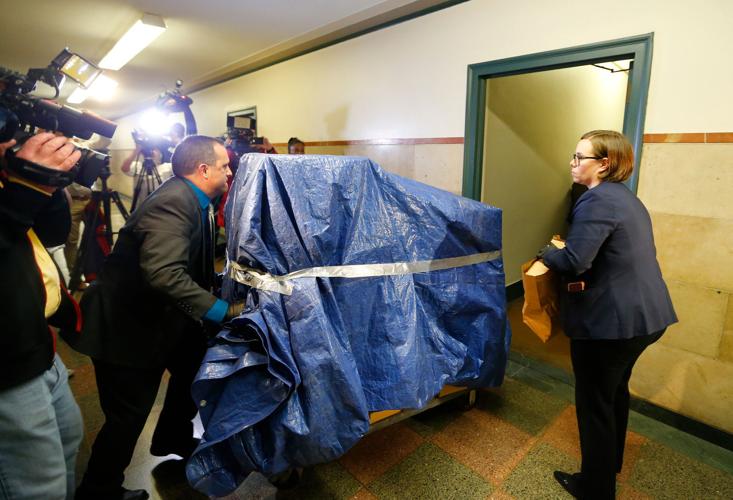
Federal agents executing a search warrant remove evidence from Buffalo Urban Renewal Agency in Buffalo City Hall in 2019.
• Over the years, FBI agents have interviewed several close aides to the mayor, including individuals involved in political fundraising for Brown, sources told The News. Brendan R. Mehaffy, executive director of the city office of strategic planning and vice chairman of the Buffalo Urban Renewal Agency, confirmed he was also questioned.
• Last November, Niagara County businessman Gary E. Smith told The News he was questioned by FBI agents and grilled before a federal grand jury about political donations made to the mayor by the company he formerly ran, Modern Corp., which received more than $60 million in city contracts.
• Also last November, a federal grand jury heard testimony about the Brown administration’s dealings with NRP Group, a Cleveland company that tried to develop a housing project in the city. NRP sued city officials, saying the mayor’s office orchestrated a “pay to play” scheme and killed the project when the developer did not hire a local minister as a consultant. Brown denied the allegations and a federal appeals court dismissed the case, though the court stated that there was “substantial evidence” to support the claim.
• Casey, the former deputy mayor, became an FBI informant in 2016. Pigeon, who worked as a $25,000-a-month consultant for Modern Corp. in its dealings with the Brown administration, has been cooperating with federal authorities since at least early 2019.
So far, none of those inquiries have resulted in charges against Brown or anyone in his administration.
Walton's campaign says the Brown administration has a corruption problem.
"For a man who depicts himself as a staunch proponent of law and order, Byron Brown certainly has close ties to an impressive number of indicted criminals. His disgraced associates Steve Casey, Steve Pigeon, and Louis Ciminelli all testify to the opaqueness and corruption of the Brown administration, and the desperate need Buffalo voters have for transparent, accountable leadership," said Walton campaign spokesman Jesse Myerson.
Questioned about donations to Brown
According to Vacco, Mehltretter and two other former prosecutors who spoke to The News, federal law enforcement officials try to avoid taking public actions that could influence the outcome of elections.
“As a matter of policy, they wouldn’t do it unless the criminal conduct was so egregious that the individual involved is deemed unfit to hold office,” Vacco said.
Any prosecution of a high-profile elected official would have to be approved by the Justice Department’s Public Integrity Section in Washington, the two former prosecutors said.
Vacco, who contributed to Brown’s campaign committee in 2017, said he would be shocked if the mayor was charged with any federal crime, either before or after the election.
Lott said FBI agents questioned him more than a year ago about Grassroots and how Brown’s campaign handled money that came in from political donors. He said he has several friends who were questioned about similar issues by federal agents.
“They don’t tell you what they are looking for, but it was clear they were interested in what happened to political donations … how money from the campaign was spent on the street,” Lott said. “When the FBI raids City Hall, Grassroots and Maurice Garner’s home, you know they are looking for something.”
With all that said, Lott said he has no firsthand evidence of criminal activity by Brown or anyone close to him.

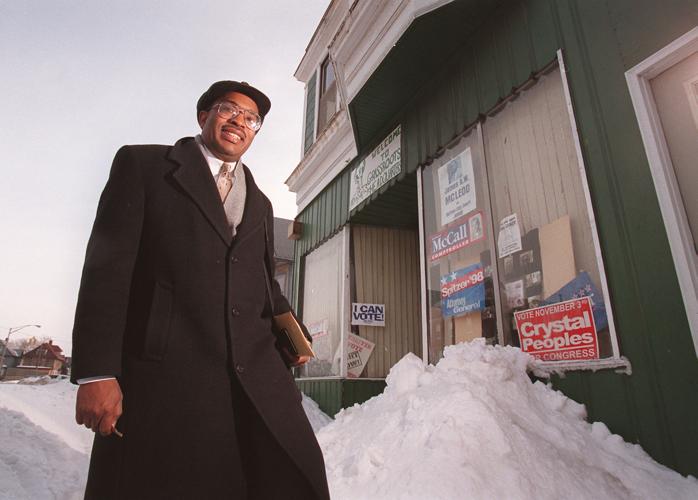
Maurice Garner, a longtime ally of Buffalo Mayor Byron Brown, poses outside of the Grassroots political club's office in 1999.
Garner, a political consultant who has been a close friend and adviser to the mayor for decades, has been questioned by the FBI but never charged.
“Maurice has not been charged with anything,” said Patrick J. Brown, Garner’s attorney. “And I don’t know of anything that he should be charged with.”
Former Modern exec expects no charges
Gary Smith, former chief operating officer of Modern Corp., said he knows of no reason why Brown should face criminal charges.
“I don’t see them charging the mayor with anything, certainly not based on anything I told them,” Smith told The News earlier this month.
Smith said he was interviewed three times by federal agents and that he also testified before a federal grand jury investigating City Hall. He said the agents were investigating the Brown administration and its dealings with Modern, Maurice Garner and Pigeon.
The News reported last November that Modern and its associated companies have received more than $60 million in revenue since 2005 for handling Buffalo’s trash or recycling materials.
In 2015, Pigeon worked for Modern as a $25,000-a-month lobbyist, and one of Pigeon’s duties was trying to convince Brown and other city officials to give Modern a no-bid extension on its contract to dispose of city garbage. The contract was then worth about $5.5 million a year.
Smith said Pigeon asked Modern to pay him an additional $5,000 a month for Garner’s help in convincing the mayor to approve the contract extension without competitive bidding. He said Modern agreed to pay Garner $2,500 a month.
Smith said he does not know whether Pigeon actually gave any money to Garner. “I don’t know what discussions there were, if any, between the mayor, Steve Pigeon and Maurice Garner,” Smith told The News.
The Brown administration decided to put the garbage contract out to bid in May 2015, after FBI agents and State Police raided Pigeon’s downtown office.
A News examination of state Elections Board records by showed that Modern, Smith and companies associated with Modern donated a total of $67,560 to Brown’s campaign organization between 2005 and 2019.
“I have not heard from the FBI in more than a year,” Smith said in a Sept. 2 interview.
He said he believes federal authorities have concluded that no crime was committed.
Retired HUD official questioned
Stephen T. Banko III, who served as the Buffalo field office director for the U.S. Department of Housing and Urban Development until Brown’s second term, said the FBI approached him roughly one year ago, but it was hard to discern what its investigation focused on.
Agents asked Banko, who retired in 2010, about multiple development projects undertaken by the city, including one on the East Side valued at more than $1 million, he said.
“The money was gone and there was no paper trail of where it went. And that’s when the FBI went in,” he said. “The FBI said, ‘The record-keeping was so bad that we couldn’t figure it out either.’ ”
Without something more solid to probe – and without the necessary paper trail to make a case – Banko said investigators may be stymied.
“I would be very surprised if any criminality is discovered out of all of this … but it does bear some watching,” he said.
Pigeon gave feds nothing on Brown
Meanwhile, a source familiar with Pigeon’s dealings with the FBI said Pigeon “gave them nothing that could be used to charge Mayor Brown with a crime.”
In 2018, Pigeon pleaded guilty to arranging an illegal donation to the campaign of former Gov. Andrew M. Cuomo. He is scheduled to be sentenced on Dec. 14. Pigeon also pleaded guilty to bribing a State Supreme Court judge, John Michalek, and is awaiting sentencing for that.

Political operative G. Steven Pigeon, whose sentencing has been delayed since he pleaded guilty three years ago to conspiring to arrange an illegal campaign contribution, is now scheduled to be sentenced Dec. 14, 2021.
In July, a consulting company run by Casey pleaded guilty to defrauding a local political candidate. The company, LSA Strategies, is scheduled to be sentenced on Dec. 1.
The News asked Rodney O. Personius, Casey’s attorney, whether Casey gave the feds any evidence of criminal activity by Brown.
“Whenever he was questioned, Steve gave candid and forthright answers,” Personius said. “I’m not at liberty to discuss any of the details.”
Neither of the guilty pleas taken by Casey and Pigeon have any connection to Brown or City Hall.
The fact that sentencing dates have been scheduled for Pigeon and Casey’s consulting firm is seen by local defense attorneys, including Terrence M. Connors, as a sign that both men are nearing the completion of their cooperation as federal witnesses.
Connors has dealt with federal prosecutors and agents for more than 40 years as a defense lawyer.
He agreed with others who have told The News they do not expect to see any criminal charges against Byron Brown. Connors has represented the mayor on some other matters but has not represented him in connection with any of the federal investigations.
“It is not uncommon for law enforcement to pursue rumors, speculation, even innuendo, especially when it involves public officials. That’s their job,” Connors said. “But these efforts do not always evolve into a full investigation. The consensus of opinion is that since the debriefing of Steve Casey and Steve Pigeon have concluded without charges, all that is left are rumors and speculation. That’s not enough to support a real investigation.”