

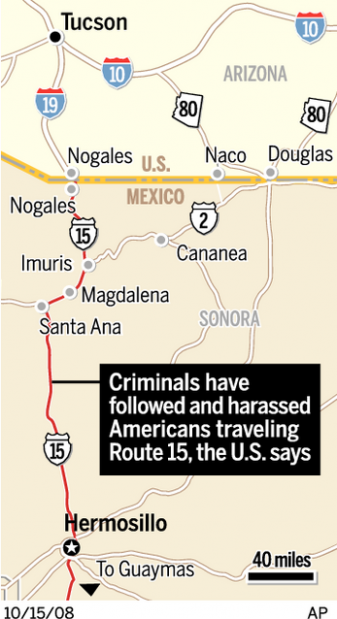
Unprecedented levels of drug-related violence in Nogales, Sonora, have landed the border city on the U.S. State Department's "travel alert" list alongside notoriously dangerous cities such as Ciudad Juarez, Tijuana and Nuevo Laredo.
Previous alerts instructed U.S. citizens to take precautions when traveling in all parts of Mexico along the U.S. border region but did not single out any Sonoran city.
The new alert mentions Nogales as one of the cities that "recently experienced public shootouts during daylight hours in shopping centers and other public venues."
It also highlights Route 15 between Nogales and Hermosillo, Sonora, as a road where "criminals have followed and harassed U.S. citizens traveling in their vehicles."
The alert stops short of telling U.S. citizens to avoid traveling in Mexico but urges them to be aware of the increase in violence related to drug cartels.
People are also reading…
"Criminals are armed with a wide array of sophisticated weapons," the State Department says. "In some cases, assailants have worn full or partial police or military uniforms and have used vehicles that resemble police vehicles. While most of the crime victims are Mexican citizens, the uncertain security situation poses risks for U.S. citizens as well."
A Tucson business owner who is familiar with Sonoran tourism predicted the alert could be devastating for the Mexican state.
"Most Americans that have never been to Mexico already are afraid to go to Mexico," said Mike Huhn, owner of Desert Divers, which leads scuba-diving and snorkeling excursions to San Carlos, Sonora, every other week year-round. "This certainly will be a setback, and unfortunately, it comes at a time when business is off both here and Mexico."
The new alert comes on the heels of a Sunday midnight attack on the U.S. Consulate in Monterrey, in the state of Nuevo Leon, where shots were fired and a grenade thrown at the building. No one was injured.
Travel alerts are issued in regard to short-term or changing conditions that pose risks to U.S. citizens, the State Department said. They are updated every six months.
Travel alerts are less serious than travel warnings, which describe long-term conditions that make a country dangerous or unstable.
The reasons
The alert says the increased violence along the border is attributed to an ongoing battle between drug cartels for control of trafficking routes in an apparent response to a crackdown by Mexico.
That explanation falls in line with the U.S. Drug Enforcement Administration's view of the bloodshed in Nogales, Sonora.
The Sinaloa and Gulf cartels are fighting for control of the Sonoran-Arizona corridor, Anthony Coulson, assistant special agent in charge of the DEA's Tucson District Office, said last month.
The Mexican government's campaign to weaken the cartels by putting the army along known drug-smuggling routes and trying to snuff out corruption has added fuel to the fire, Coulson said.
From January through September, there were 76 premeditated homicides in Nogales, Sonora, most of them drug-related. The deadly 2008 tally has already surpassed the 2007 total, 52, and more than doubled the 2006 total, 35.
The violence in the border city of more than 200,000 has included beheadings, execution-style killings, bodies found wrapped in duct tape with messages for rival drug traffickers, and shootouts in such public places as bus stops and restaurant parking lots.
Through September, Nogales accounted for more than a quarter of the 269 killings registered in Sonora and had more than any other city in the state, including Hermosillo, which had tallied the most killings in each of the previous two years.
Sonora had 252 killings at that time last year.
Reactions
Huhn and a hotel employee in San Carlos called the inclusion of Nogales and Route 15 between Nogales and Hermosillo in the new travel alert unnecessary. The route continues south to the seacoast areas of Guaymas and San Carlos.
"I don't agree with calling that a violent route," said Georgina Orantes, of the Hotel Fiesta Real in San Carlos, speaking in Spanish. "I would say they are exaggerating a bit in the alert."
Huhn called it a bit drastic to list Route 15 as a dangerous one for U.S. citizens. Desert Divers has offices in Tucson and San Carlos, and Huhn drives between the two sites at least twice a month. He's never had any problems during trips, and said he believes the violence is isolated to people involved in the drug trade.
"Obviously, somebody could be in the wrong place at the wrong time by accident. Those kinds of thing happen, but nobody is seeking out Americans to harass them or bother them," Huhn said.
"For those of us for whom San Carlos is our playground, I don't think you are going to see many people change their travel plans," added Huhn, who was run Desert Divers for 30 years.
Orantes doesn't think travel to San Carlos will slow, even though the most direct route is on Route 15. "In Guaymas and San Carlos there haven't been any shootouts," Orantes said. "It's still a peaceful place."
more online
Find the U.S. State Department's updated travel alert here.


