

A new task force is charged with making Tucson streets safer for pedestrians.
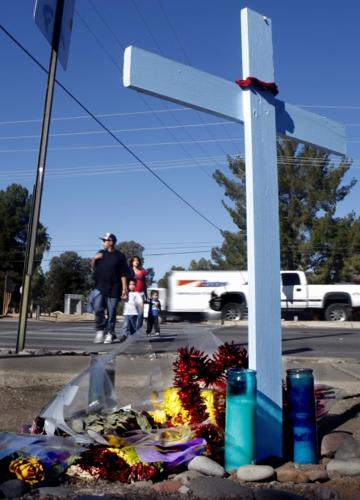
It was created just over two weeks after a 13-year-old boy became the 17th pedestrian killed in 2011. Representatives from the police, fire, parks and recreation, and transportation departments have been told by City Manager Richard Miranda to help improve safety education, law enforcement and pedestrian transportation by adding new pedestrian-activated crosswalk signals.
"At this time, I feel it is paramount that we evaluate our pedestrian safety efforts to ensure that we are programming our available resources as effectively as possible to provide for the safety of pedestrians within the city," City Manager Richard Miranda said in a news release.
The task force was created based on the response after 13-year-old Nicholas Celaya's death, looking at statistics and concerns from City Council members, said Mike Graham, a spokesman for the city. There were 13 pedestrian fatalities in 2010 and 10 in 2009, according to the Tucson Police Department.
People are also reading…
Celaya was struck by a car when he was trying to cross East 22nd Street near Reid Park, safely making it across three lanes of traffic but failing to wait at a median before darting across the next three lanes of traffic. After Celaya's death, Ward 6 City Councilman Steve Kozachik said he went to the area and measured the distance between crosswalk signals on 22nd Street. He sent several emails to the Tucson Department of Transportation and the City Manager's Office advocating for the installation of a pedestrian-activated signal across East 22nd Street. Because the park is on the north side of East 22nd Street and a McDonald's is on the south side, the area seems likely to attract a lot of pedestrian traffic, Kozachik said.
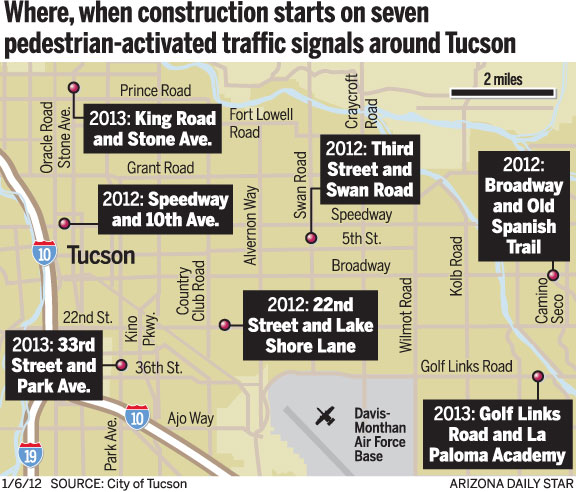
In 2010, the Regional Transportation Authority allocated funding for nine new High Intensity Activated Crosswalk, or HAWK, signals at $125,000 each and installed two that same year. Work will begin on four of those this year and on the other three in 2013.
A signal on East 22nd Street at Lake Shore Lane, in the area where Celaya was struck, is one of the locations on the list for 2012.
"We all cringed when we heard about the accident there," said Jim DeGrood, the transportation services director at RTA who said that location has been on the list to receive a HAWK signal for at least six months.
Pedestrian demand, accident statistics and proximity to places like parks, schools and bike paths that have a lot of pedestrian traffic are some of the things taken into consideration when deciding where to install a HAWK signal, DeGrood said.
The city has identified more than 50 other locations where HAWK signals would be installed when money allows.
The HAWK signals that flash yellow and turn to a solid yellow light before changing to a solid red light give pedestrians a better chance at safely crossing the road, DeGrood said.
"By law if somebody has put their foot into a crosswalk, the cars are supposed to stop, but they don't," DeGrood said. "What this does, by adding a HAWK signal, is it reinforces the traffic rules that already exist. It serves to give advance warning so that people can responsibly slow down."
Pedestrians are often at fault in accidents, said Sgt. Maria Hawke, a Tucson Police Department spokeswoman.
"More often than not, they were jaywalking," Hawke said. "They were in areas of town that were not well-lit, wearing dark clothes."
Of the 25 serious or fatal pedestrian accidents in 2011, 14 of those were due to jaywalking.
Over the next few months, presentations by the Fire Department and the Kidco staff will teach students about pedestrian safety. The city will also update educational materials distributed through various programs to include information about pedestrian safety. Channel 12, the city's TV station, will produce a pedestrian-safety video and public-safety announcement.
The task force also will review accident statistics to see if additional enforcement efforts are needed in certain areas.
Did you know?
In 2010, the University of Arizona installed a solar- powered, lighted crosswalk on the campus, with lights embedded in the asphalt to draw drivers' attention to the high-traffic crossing on North Mountain Avenue at East First Street.
Source: Star news archives
Safety tips for pedestrians
• Always cross at a marked or unmarked crosswalk.
• Be aware of traffic. Make sure drivers see you and they have enough time to stop, and you have enough time to get across the road.
• Always wear light or bright clothing so that you're visible to drivers.
• Don't be distracted. Don't talk or text on the phone or listen to headphones while crossing the road.
Source: Tucson Police Department
Contact reporter Veronica Cruz at vcruz@azstarnet.com or 573-4224.


