

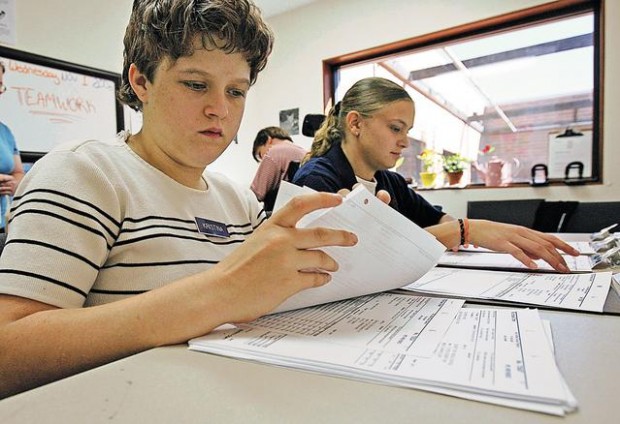
Special-needs students at Cienega High School will have an advantage over fellow students looking to enter the job market upon graduation.
They already will have on-the-job experience, a professional résumé and money-management skills through the Vail School District Youth Transition Program.
"Students in special education often learn best when they're able to have the practical hands-on (experience) to help them make the transition from high school to the work world outside," said Youth Transition Program coordinator Kathleen McNaboe.
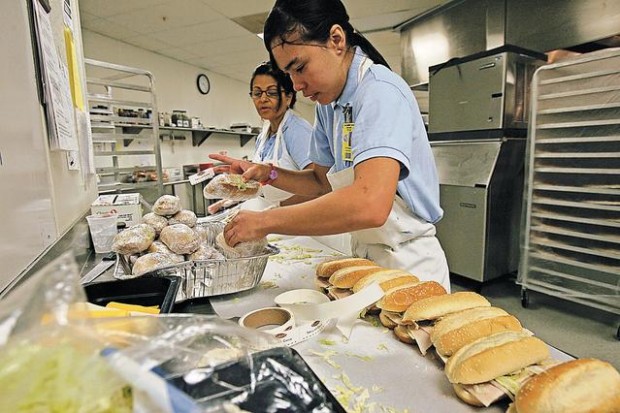
The program was started in 2004. Currently, 27 special-needs students are working on six job crews. They work in the school's cafeteria, clean up the campus as custodians, perform clerical tasks in the district office, do yardwork for businesses and residents and grow plants on land the Rincon Valley Farmer's Market set aside for a student nursery.
People are also reading…
"When we started," McNaboe said, "we looked at the first group of students who needed this service and we thought, 'What would they be good at? What are their strengths? What are their preferences? How will they be able to best show their talents?' "
Finding their strengths
Students rotate from crew to crew, but if they find a job they enjoy and in which they excel, the students will stick with that job.
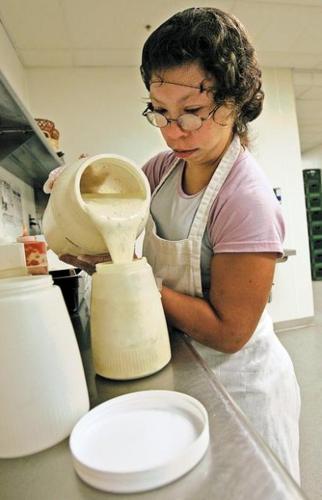
That's how Kevin Witz, 20, found his niche on the cafeteria crew stocking milk and ice for Cienega's food-service provider, Sodexho.
When he ages out of the district work program at 22, there is a chance he will be hired full time by Sodexho.
Witz worked on the car-wash and yard crews before landing in the cafeteria. He said he likes working on the cafeteria crew because the pay is better. Witz is considering a career in cafeteria work.
"He really seems to be happy with that," said his mother, Cheryll Witz. "I'm very pleased that they've integrated him into working like this."
Colette DeBoer works for Sodexho and supervises Witz and the other special-needs students on the cafeteria crew.
"I love my special-needs kids," she said. "They are very hard workers, conscientious, always on time."
Witz, she said, "is one of my best workers."
"All of the kids really enjoy their jobs, especially Kevin. He's really flourished," said Cienega inclusion specialist Christina Hernandez
Sheryl Winkel, 20, also works in the cafeteria, and her brother, Matt, 18, works on the yard crew.
"One thing I like is doing the sandwiches," Winkel said. "Once I'm finished, I'm going to clean this mess up and get the broom and sweep."
Kristen Aerts, 18, is in charge of condiments.
"I like to interact with the people," Aerts said. "We're a team, and it takes teamwork to do what we do. We have to feed a lot of people."
Gaining self-confidence
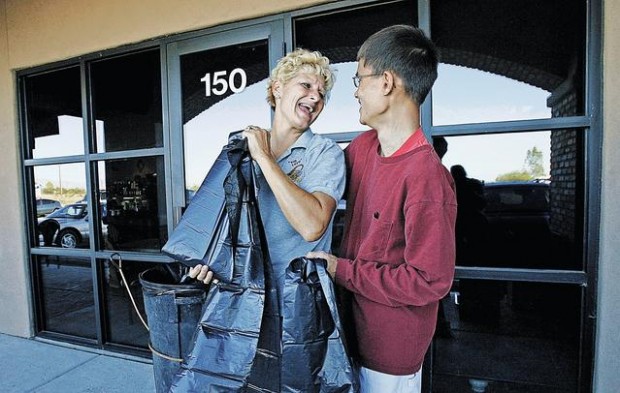
The yard crew has more clients than it can handle, said crew chief Jim Youngquist. In addition to homeowners who request their services, yard-crew customers include Quik Mart, Ace Hardware, Old Vail Station and the Vail Post Office.
St. Rita in the Desert Church was the first to hire the crew, in 2004.
"The yard has never looked better and the parishioners say the same thing," said the Rev. Bob Wicht of St. Rita.
Several members of the yard crew are also parishioners at St. Rita and have become more outgoing since entering the work program, Wicht said.
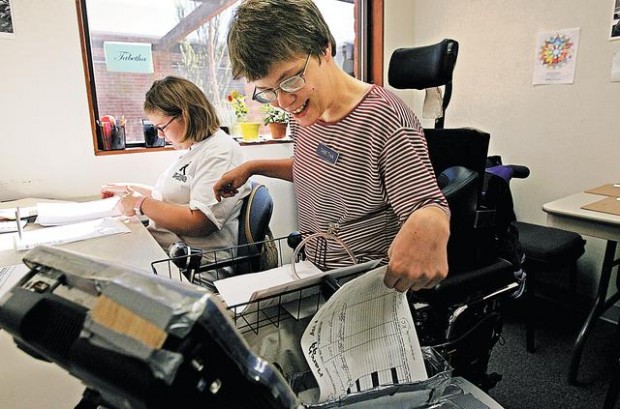
At the Vail School District office, students fax, copy, collate and shred documents, organize purchase orders and file.
Tabetha Conley, 20, speaking with the assistance of a computerized communication device that composes sentences from previously programmed information, said: "I go to all the offices and get work for the day."
Last week Conley was busy shredding documents while classmate Kristina Wiczynski, 18, sorted purchase orders.
Wiczynski hopes to find an office job when she leaves school.
"It's hard for me to stand up doing something, so it's easier doing a sitting-down kind of job," she said.
Irma Truman's daughter, Valerie, 21, works in the office, too.
Valerie has been in the jobs program for two years, and "she's just happy to do what she likes to do — clerical work," said her mother. "I've been seeing a lot of changes, a lot of self-confidence, a lot of self-organization."
Ready for the job market
The program is a partnership between the Vail district and the state Rehabilitation Services Administration. The partnership allows the district to use federal funding to support the job training. Students earn stipends that vary in amount.
According to the Youth Transition Program brochure, "students are learning how to work and make the connection between earning money and purchasing the things they want in life."
"The kids all earn paychecks, and we make biweekly trips to the bank to deposit them," Hernandez said.
"We're teaching them how to keep track of their money," said inclusion specialist Rhonda Warren.
Next year, McNaboe said, the jobs program will expand to include students at Empire High School.
Currently, all of the Cienega special-needs students who are old enough and want to have a job are working, McNaboe said.
"The goal is, they leave Cienega and have a skill set that's valuable and a way to use that skill set and contribute and make some money; things all the rest of us want in life," Mc-Naboe said.


