

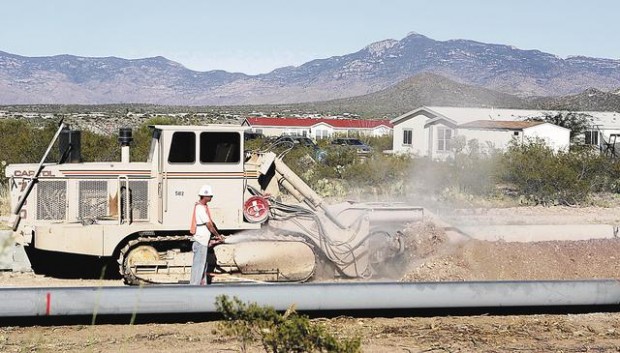
Work is nearly done on a project to replace portions of an old pipeline that carried gasoline and other petroleum products from refineries around El Paso, officials said.
Crews that have been working their way westward along Interstate 10 since May laid pipe last weekend at the end of the line — the Tucson Terminal, the big tank farm at East Ajo Way and South Dodge Boulevard.
"We're over 90 percent done," said Jim Ruhwedel, project manager for the Rockford Corp., the pipeline-construction company contracted by line owner Kinder Morgan Energy Partners.
Ruhwedel said that for the next six weeks or so, Rockford crews will be working along the pipeline route, which runs just north of Interstate 10 to around Marsh Station Road, then veers to the northwest, crossing under the south set of Union Pacific Railroad tracks on to the terminal just west of Davis-Monthan Air Force Base.
People are also reading…
After Rockford finishes laying the new 16-inch pipeline, Kinder Morgan will hire another contractor "to come in and pretty up the right-of-way," he said.
That's good news to Barry and Jacque Fotheringham, who live in Vail.
The Fotheringhams and other residents in the Fast Horse Ranch subdivision say that for months they've had to put up with dust, noise, traffic delays and other nuisances caused by the pipeline work.
Jacque said that at first, she didn't know what was going on, because nobody in her subdivision received any notice that the crews would be working their way through the area.
"We were told that more than 800 letters were sent by Kinder Morgan advising people about pipeline work. But none were sent to our subdivision," she said.
She said she and her husband knew about the old pipeline south of the railroad tracks, but didn't know that the new pipeline would be between the two sets of tracks — near her home.
So they were surprised, and distressed, when crews showed up a few weeks ago to begin work through Vail.
Jacque said the work sometimes delayed access to and from the subdivision.
In addition, "The dust is excessive," she said. "It's terrible. We've complained to the county. We're concerned about valley fever."
The respiratory disease, which is common in this area, is caused by a soil fungus that can be kicked up around construction sites and other areas where soil is disturbed.
Barry Fotheringham said the trains that run near his house are louder now that the vegetation has been removed — and with it, the acoustic barrier it created.
"The noise is twice as bad as it was," he said. "Before, you'd hear the engine, but you wouldn't hear the cars. Now you can hear the cars as the train passes by."
Emily Mir Thompson, a spokeswoman for Houston-based Kinder Morgan, said the company is working on a contract to revegetate, but could not say when that project would begin.
Jacque said she'd like to see watering trucks running along the pipeline route to hold down the dust.
Barry said Kinder Morgan should plant taller vegetation, like palo verde bushes and mesquite trees.
"We would like to at least get them to put it back the way it was — to restore the desert," he said.
Pipeline project details
Kinder Morgan Energy Partners in May began replacing 140 miles of a 300-mile pipeline that runs from El Paso to Tucson, a company official said.
The $130 million project includes replacing the old 8-inch line with 16-inch pipe, which boosts the pipeline's capacity to 200,000 barrels per day, said Emily Mir Thompson, a Kinder Morgan spokeswoman.
The project includes reconnecting portions of a second 12-inch pipeline that runs parallel to the 16-inch line, Thompson said.
The old pipeline will be drained, cleaned and filled with inert nitrogen gas and left in the ground, she said.
In June 2006, Houston-based Kinder Morgan replaced an older 8-inch pipeline that ran from Tucson to Phoenix. In July 2003, a portion of the old pipeline burst in a Tucson West Side area, spraying 52,000 gallons of gasoline on several homes under construction.
The company shut down the pipeline for several weeks until interim repairs were made, which aggravated a shortage of gasoline in Phoenix and sent the cost of fuel soaring.
The company spent $210 million to replace that line and build a 490,000-barrel tank farm near El Paso. The money also paid for upgrades to stations and terminals along the pipeline. The project boosted the capacity of the pipeline — which carries different fuels, including gasoline, jet fuel and diesel — to 53,000 barrels per day, Thompson said. As part of an agreement with federal pipeline-safety regulators, company officials also agreed to improve inspections and invest in a new electronic monitoring system.
— Tim Ellis


