

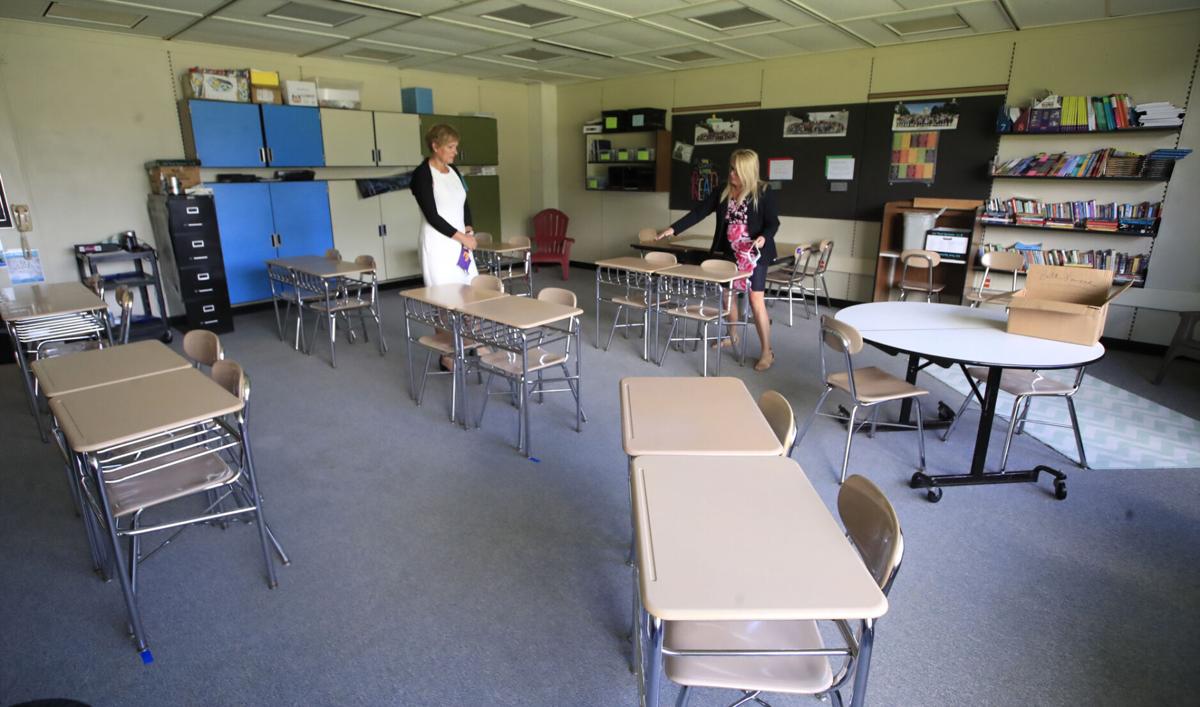
She worked all summer on plans to reopen school, and it has been the proverbial moving target for Springville-Griffith Institute Superintendent Kimberly Moritz.
"I think the hardest thing was knowing that no matter how well we planned, likely no one was going to be happy with it," she said.
This summer, "We'll figure it out" has become the mantra for Moritz and her district.
Consider remote learning. The district was not going to offer an all-remote learning plan for those who do not want to send their children to school. Nine families had asked for it. But after talking with a fellow superintendent who asked her what she would do with students who might have to be quarantined for 14 days because of exposure to Covid-19, Moritz decided to revisit the issue.
"We turned around within 24 hours, this new option of full remote," she said.
People are also reading…
By Wednesday, parents of 107 students had opted for all-virtual learning. What will it look like? Moritz said they'll figure it out.
So far, Springville-Griffith Institute is like the little district that could, one that doesn't have its teachers union threatening to sue over reopening plans or its parents demanding the superintendent's resignation.
It might be easier for Springville to pivot quickly because it is a smaller district, with about 1,700 students. It also doesn't confront as much poverty as Buffalo Public Schools, where 83% of the 30,000 students are economically disadvantaged. In Springville, 36% of the students are.
The district spreads over 140 square miles in all or parts of nine towns and one village in two counties, with wide open land and farms from Zoar Valley to Kissing Bridge.
Despite the geographic size of the district, there's a small-town feel. Individual banners featuring each senior in the class of 2020 line Main Street in Springville, and football games are a draw for the community.
Remote vs. in-person
For the majority choosing in-person learning, about 1,500 students, the district plans to bring half into its four school buildings for classes Mondays and Tuesdays, and the other half there Thursdays and Fridays.
The district had planned to have teachers in schools on Wednesdays, when all students learn remotely, but it shifted its stance after hearing from teachers.
Springville Teachers Association President Joseph Karb said the union asked for teachers to work at home on Wednesdays because many had childcare issues.
"We problem-solved this with the district and developed guidelines that ensure that student needs and teacher responsibilities were being met while allowing teachers to work from home on Wednesdays," he said.
Still, Moritz has misgivings about remote learning. Part of it comes from her childhood, where school was a cherished avenue to learn about the world.
A native of Pittsburgh, Pa., her father was a coal miner who dropped out of school in the eighth grade and her mother was a secretary, and later an office manager. Moritz is the first in her family to attend college, but she didn't go to Gannon University to become a teacher. She graduated with a degree in business communication and managed a CVS pharmacy and a 7-11 store.
It wasn't until she had a child that she decided to get a teaching degree. Moritz, 56, taught in the Pine Valley Central School District, where her daughter is now the superintendent. She was a principal at Randolph and Gowanda school districts and was the superintendent at Randolph before joining Springville four years ago in the top job.
"Philosophically, I've worked in districts my entire career that serve the neediest students," she said.
She sees remote learning as an issue of equity. Many families don't have the means to keep children home because of parents working outside the home. Some families, less than 10 percent, do not have access to the internet or cell service.
"We’ve done the best we can with remote learning but I do not believe, based on my experience, it is as good as in-person learning," Moritz said.
Students want to go back
Marin Lehr, 17, who is entering her senior year, said it's a lot easier to get an education when you're in the same room with your teacher.
"Our teachers are very one-on-one with kids," she said. "I do feel like they're trying to do the best they can. I think our school is definitely working really hard to make sure all aspects of the student life and school is going to be somewhat normal."
But seniors know those traditions they look forward to, such as football games and homecoming week, may not be the same, if they occur at all.
Finn Martin, 15, starts his sophomore year next month. While he is worried about the emotional well-being of his classmates, he's looking forward to going back.
"It was really hard on a lot of us," he said of the closing in March.
Students are used to seeing the same kids on a five-day schedule, but starting this year, half the student body will attend for two days each week. The groups are named for the school's colors, purple and gold.
"I think its going to be a little weird because you're missing half the students. It's going to make it like a ghost town," Finn said.
He was so concerned about how things would go that he emailed his principal, James E. Bialasik, and then talked to him in a video chat. Bialasik said when he was talking with Finn, he realized he should have a forum for all students before school starts, and he is planning that.
A parent's views
Springville schools will be less full because about 6% of the district student population will be learning with the full remote model. Parents of another 59 students said they will home school this year.
Melissa Huber, a mother of six, with four still in Springville schools, said she knows of several families who decided against sending their children to school in person or remotely. A lot of parents are angry with the whole situation and with the superintendent, she said.
"It's not her fault. She's doing the best she can with what she can do," Huber said.
Huber is not happy with everything in the plan, particularly that children will eat lunch at individual desks in the cafeteria, spaced six feet apart.
"They miss their friends. I know school is not all about socializing," she said. "The lunch issue is going to be a problem for me, that’s when they get to chit-chat and be kids."
But it's not so big an issue that she would keep her children home, she said.
Building the plan
School districts waited half the summer for New York State to issue guidance on reopening. Then when it was released the week of July 13, they had a little more than two weeks to complete their plans. It was a scramble.
But before the guidance was released, Springville was using a playbook developed by members of Erie 2 Cattaraugus Chautauqua BOCES that helped to organize the approach to the plan.
A 30-member district committee was set up that included 10 teachers, three parents, a School Board member and administrators. For about two weeks, they divided into subcommittees and worked on a shared Google Doc that all members could access to make changes. They looked at guidance from the state health and education departments as well as the federal Centers for Disease Control and Prevention.
"It's certainly better when so many people can contribute like that," said Moritz, who typed the shell of the plan that committees fleshed out.
"I was proud of the group, how everybody just came together and we were able to do our separate pieces," said Amy Wnuk, the nurse at Springville Elementary. "We would meet in individual groups and then once in a while we would be back as a large group through the Zoom."
It was intense, with principals and administrators working in school. None of them had done anything like this before.
"I couldn’t sleep. I thought about this all the time. I was at my desk at 6 a.m. because you’d start thinking about it," Moritz said.
And when she got there, inevitably one or more of her staff would be working, too.
The group produced a 30-page plan several days before the July 31 deadline, and the district continues to update it.
The district is requiring face coverings, but there will be mask breaks. Attendance will be taken every day, even on remote days. Assignments will be graded. Teachers may need help from other teachers to connect with students on their remote days.
Uncertainty remains
Despite all the planning, there still are some unknowns. One of them is money.
"While we have all these things we need to do, we also have to figure out how to pay for all of that with reduced revenues," said Business Administrator Maureen Lee.
The district cut about $800,000 in July, which is about 1.9% of its total budget.
"Now we’re worried that we didn’t cut enough," Moritz said.
She said teachers have not had enough training to improve the remote option, but there is not enough money for professional development.
And no one knows what will happen with the virus, whether infections will go up, whether someone in school will test positive.
"I think, unfortunately, it’s a hard lesson for kids to learn that this is as good as it’s going to get for now, and it’s certainly not ideal – not what any of us wants," Moritz said.
"We very much want all of our kids with us in school full time. We’re managing a health crisis, a worldwide health crisis and trying to do our little piece of that to the best of our ability."


