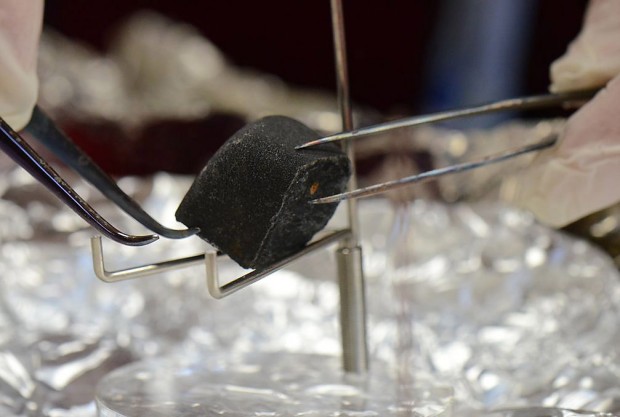
A trio of rock hunters donated samples of the meteor that blazed across Nevada and California last month to the UA Lunar and Planetary Lab.
The lab, which is currently working on OSIRIS-REx, a NASA mission to bring back pristine samples of an asteroid, values these "fresh" samples because they are less contaminated than space rocks found years after impact. They also appear to be a match for the asteroid OSIRIS-REx will be visiting in 2019.
Meteorite hunter Robert Ward of Prescott found the first meteorite the day after people reported a fireball that flashed across the skies of Nevada and California on the morning of April 22. He donated a 1-gram sample from one of his rocks.
Ward said he keeps "bags packed for various climates," something a veteran "fireball chaser" learns to do. When he heard reports of the California meteor, he consulted Doppler radar records of its entry, jumped in his truck and drove to its entry path.
People are also reading…
Michael Farmer of Tucson and Greg Hupe of Florida arrived a few hours after Ward but didn't find any meteorites. They began buying up rocks that had been found by residents and treasure hunters who had flocked to the foothills of California's Sierra in the vicinity of Sutter's Mill, where a gold discovery sparked the California Gold Rush in 1849.
Farmer said he and Hupe decided to double their donation to 2 grams after learning more about the planetary lab's space mission.
The donation benefits both parties, said Farmer. The OSIRIS-REx team will gain scientific knowledge and his rocks will gain value. "My specimen is more valuable the more interesting science comes out of it," he said.
About 400 grams of material has been found so far, and some is for sale for about $2,000 a gram.
The lab will use its two specimens to learn more about the targeted asteroid and to refine techniques for analyzing samples to be brought back in 2023, planetary lab scientist Dante Lauretta said.
The first step will be taking the spectral signature of the rocks and comparing it to data gathered from ground and space telescopes about near-Earth asteroid RQ36, the mission's target.
Lauretta said he knows by just looking at the rock that it is carbonaceous. It might contain organic materials, but that won't be known until analysis is done.
Scientists hypothesize that the building blocks of life may have been delivered to Earth in meteorites.
Lauretta is principal investigator for OSIRIS-REx, the NASA mission set for launch in 2016. The UA mission team, now numbering about 63 faculty, staff and students, is working at the Michael J. Drake Building, the planetary lab's off-campus center for space operations, which was also used for the Phoenix Mars Lander mission.
NASA scientists also joined the meteorite hunt last month, using a helium-filled airship to look for rocks over a 300-square-mile area.
A horse rancher in the area donated rocks he found to NASA Ames Research Center.
Greg Schmidt, deputy director of the NASA Lunar Science Institute, said in a statement:
"It's like asking, 'How did life on Earth begin?' and then having a fossil fall right in your backyard. This is exciting stuff - who knows what's inside?
"The Sutter's Mill Meteorite could be the most profound sample collected in over 40 years." Schmidt said.
The meteor that plunged through the Earth's atmosphere is believed to have been the size of a minivan, but it exploded into fragments.
So far, the biggest fragment, weighing 44 grams, was found by Ward, who has hunted meteorites all over the world.
"This eclipses any find I've ever made in just the scientific value of the stone," he said.
What is OSIRIS-REx?
OSIRIS-REx is a NASA mission that will send a robotic spacecraft to rendezvous with a nearby asteroid, study it and grab samples that will be returned to Earth.
It was proposed and will be run by the University of Arizona's Lunar and Planetary Laboratory.
Mission timeline
• December 2009: OSIRIS-REx chosen as one of three finalists for NASA's next New Frontiers mission.
• May 2011: University of Arizona awarded contract for OSIRIS-REx mission.
• 2016: OSIRIS-REx spacecraft launches.
• 2019: Spacecraft approaches asteroid 1999 RQ36.
• 2023: Sample of asteroid returns to Earth in capsule at Utah's Test and Training Range.
Contact reporter Tom Beal at tbeal@azstarnet.com or 573-4158.