

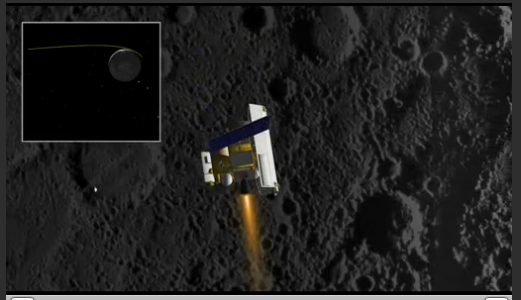
Scientists in Tucson and across the world will be waiting nervously this evening as a tiny spacecraft fires its thrusters, decelerating by 1,929 miles per hour to allow itself to be captured in orbit around Mercury.
If all goes well, NASA's Messenger and its seven scientific instruments will become the first spacecraft ever to orbit Mercury, the smallest planet and also the closest to the sun.
That proximity to the sun is the reason Mercury has not yet received a close-up visit.
From a mere 36 million miles away, the sun shines 11 times brighter on Mercury than it does on Earth, heating parts of it to a pizza-oven temperature of 800 degrees Fahrenheit.
The 6-foot spacecraft will be protected from the sun by a ceramic shield 20 feet across, and will also be shielded underneath from the heat radiating from the planet.
People are also reading…
"It's bringing along a sunshade, somewhat like a parasol," said William Boynton of the University of Arizona's Lunar and Planetary Laboratory.
The need for exact orientation complicates an already tricky procedure, Boynton said. "There are always problems when you try to go into orbit."
Boynton, a member of the mission's science team, said he is "excited and very interested in what's going on."
"Unfortunately we're not going to get any data back right away, but we're working very hard to make sure we're ready to investigate it."
NASA's Discovery class mission to Mercury is headed up by the Applied Physics Laboratory at Johns Hopkins University.
Tucson-area planetary scientists are well-represented on the 48-member science team, which incudes Boynton and two UA colleagues, Ann Sprague and Robert Strom.
Five members of the science team are affiliated with Tucson-based Planetary Science Institute - Deborah Domingue Lorin, William Feldman, Robert Gaskell, Catherine Johnson and Faith Vilas.
Feldman, who designed and helped build the neutron spectrometer onboard Messenger starting 10 years ago, said the scientific payoff has "been a long time coming."
Messenger was launched on Aug. 3, 2004, and will have orbited the sun 15.2 times, traveling 4.9 billion miles to reach Mercury orbit. On the way, it slingshotted off the gravity of Earth once and Venus twice, reaching speeds of 3,000 miles per hour.
It has has made three flybys of Mercury, but orbit will bring it to within 125 miles of Mercury's surface.
The neutron spectrometer is especially sensitive to hydrogen, and it may allow scientists to discover whether the signals it received from Earth and during flyby originate from sulfur or from frozen water ice in permanently shadowed craters near Mercury's poles, said Feldman.
Mercury is a planet of extremes. It heats to 800 degrees and cools to 300 below zero. With just a wisp of an atmosphere, it doesn't hold its heat.
Places where the sun never shines might harbor ice, Feldman said.
Ice is a big target, said Feldman and Boynton, but there is much more to be learned about the planet.
The other instruments Boynton is monitoring, gamma ray and X-ray spectrometers, will allow scientists to map the "elemental composition of the surface of Mercury," he said.
Ann Sprague, who has worked on Mercury as a ground-based observer and theorist since 1985, said she is most interested in a scanning spectrometer that will analyze the ions in the thin atmosphere of Mercury. "They will give us the best clues to the composition," she said.
Sprague said Messenger is "fully outfitted" and will provide "an excellent picture" of the planet.
In addition to the array of spectrometers, it will capture color and monochromatic images, map topography with an altimeter and use radio waves to measure the distribution of Mercury's mass.
"We're going to have imaged the entire surface," said Sprague. "We'll be able to very thoroughly look at the dynamics of the surface - the cracking, the faulting, the scarping, the cratering - and create a chronology of expansion and shrinkage of the planet.
"We'll know the shape of the planet very well, the thickness of its inner core, the radial depth of it, the primary rock types. If everything works right, we'll know its magnetic field better than we know the Earth's," said Sprague.
Faith Vilas of the Planetary Science Institute has been studying Mercury since her undergraduate days.
She has written and edited books about it that she now says "I'm sure will have to be totally rewritten."
Ground-based observation is limited by Mercury's closeness to the sun, she said. It is visible only at dawn and twilight. "I've stood on the tops of ladders with telescopes pointed at the horizon," she said.
"This 'going into orbit' is going to be one of the highlights of my professional career," she said.
There will be a new story of Mercury's origin and composition when this mission is completed, said Vilas.
Contact reporter Tom Beal at tbeal@azstarnet.com or 573-4158.


