Mariam Rana’s parents were told when she was very young that she wouldn’t live long, after a brain condition led her to being in the hospital for two months.
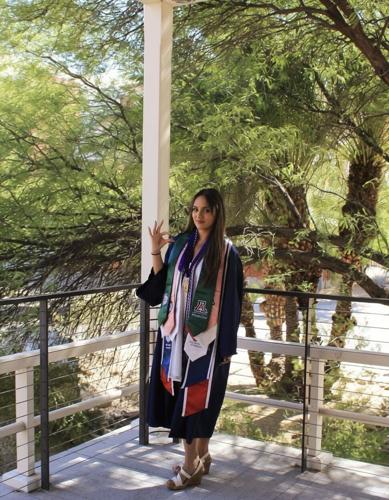
Today, as a first-generation college student of immigrant parents, she’s graduating from the University of Arizona with a major in physiology and medical sciences and a second one in public health.
She wants to pursue medicine to treat and support others like herself.
Rana was diagnosed as a child with bacterial meningitis, which is caused by inflammation of the protective membranes surrounding the brain and spinal cord due to a bacterial infection. In addition, she also had to deal with complications of a heart condition that runs in her family.
“Because of what I went through, it’s actually a main reason of why I want to pursue medicine,” Rana explained. “Because I don’t remember much about the individual visits at the hospital just because I was younger, or I don’t remember exactly what the doctors (said), but I do remember how the doctors made me feel and I remember them just being so supportive.”
People are also reading…
Rana, whose parents moved here from Pakistan, intends to pursue a master’s in public health after graduating this week from UA’s W. A. Franke Honors College and Mel and Enid Zuckerman College of Public Health. After that, she is seriously considering medical school. She’s already been accepted to the UA for a master’s in public health, but said she’s deciding between that and a few schools on the East Coast.
UA’s 2026 Commencement Ceremony is at 7:30 p.m. Friday at Casino Del Sol Stadium, formerly known as Arizona Stadium, where about 10,000 degrees will be conferred. The ceremony will last about an hour and a half and will have approximately 30,000 guests in attendance. It will be streamed live on YouTube as well. The stadium’s 3, 4, 6 and 7 gates will be open to guests starting at 6 p.m., and the UA will be observing game day practices, including its clear bag policy.

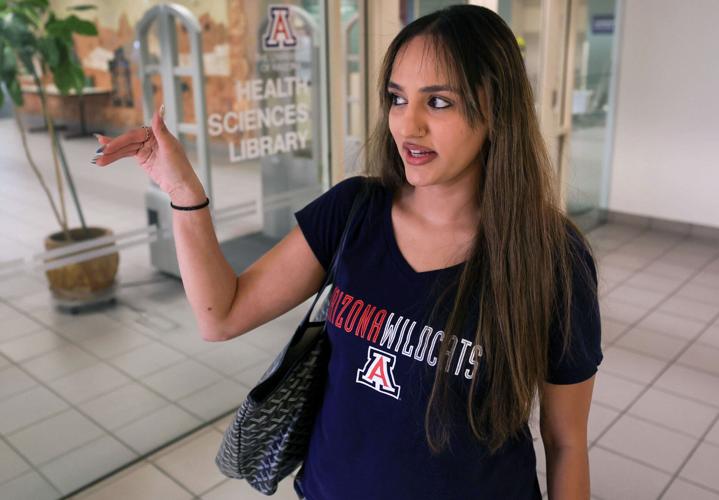
Mariam Rana, shown reminiscing about her study times in the University of Arizona Health Sciences Library, is a senior graduating this week with dual degrees in physiology, medical sciences and public health. Having overcome health challenges, Rana wants to pursue a career in medicine to treat and support others like herself. Her degrees will be among about 10,000 conferred to UA graduates at the university's commencement ceremony Friday night.
“From a very young age, since my parents really regretted not getting higher education, that’s something that they engraved in our brains — college is important, we would really like you to at least get a bachelor’s degree,” Rana said, explaining that her dad had to drop out of school in eighth grade, and her mom in high school, because they had to support their families.
Rana said she was able to recover from her medical conditions through a lot of treatments, but since there tend to be lingering symptoms for many people, including hearing loss and vision difficulties, she has had to keep up with doctor’s appointments to make sure everything was working fine.
Due to the heart condition that runs in her family, she said she had a bicuspid aortic valve, which means her aortic valve has only two leaflets instead of the usual three. This meant that when she would exercise, and when she had COVID during the pandemic, it was a little bit harder for her to breathe through the coughing.
During all the treatments she had to get, Rana said the doctors were really patient, kind and understanding with her mom, since she didn’t speak a lot of English, and would never make her feel dumb for asking certain questions. The nurses would come in with toys and lollipops and these were the little moments that made an impact on her.
“I wanted to be that for somebody else in the future,” said Rana, who will be the first woman in her family to graduate from college.
Rana, who is a second-generation immigrant and a Tucson native, said she initially decided on the UA because it was the most convenient and closest option, but now looking back, she would choose the UA every time.
“The community here is really amazing,” she said. “I feel like looking back at it now, I wouldn’t be able to do anything that I did at the university if it wasn’t for the friends that I made, the teachers that I met, the professors that had my back. I work on two on-campus jobs, and their support (mattered). It really is the peers and the people you surround yourself with that give you the motivation to keep going, especially when it gets really hard.”
Rana took part in the BIO5 Institute’s KEYS Research Internship, a UA training program for high school students that introduces them to advanced biomedical research and mentorship before college. It’s a seven-week summer research program where interns work on immersive, real-world projects under the mentorship of UA scientists.
She went to Salpointe Catholic High School, where her biology teacher’s classes in her junior year also struck a passion for science within her. This teacher was the one who recommended the KEYS internship to her, encouraged her to apply and wrote her letter of recommendation.
That was the start of her interest in research and the strong impact it has on people’s lives, Rana said.
“The research that I was doing during the KEYs internship was on Ehlers-Danlos syndrome, and there’s really not much information about it, except that it’s a genetic condition that kind of affects the connective tissue in your body,” she said. “I remember learning about this (and thinking), ‘oh, this sounds cool,’ really seeing the impact that research truly has. My whole project in the KEYS internship was doing qualitative coding for the symptoms, and since there’s no treatment out there yet, we would qualitatively code what people are saying helps them.”

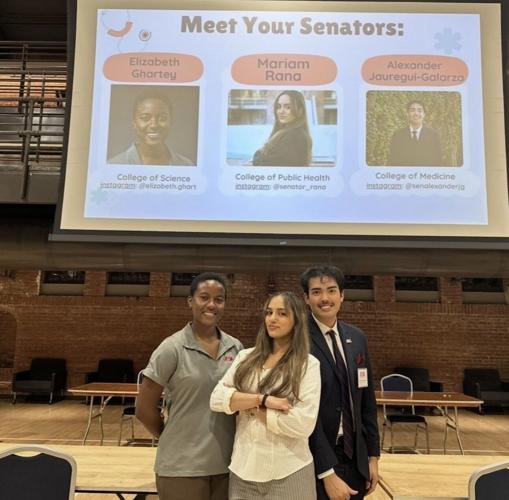
Mariam Rana, a first-generation college student, is an Associated Students of the University of Arizona student senator representing UA’s Mel and Enid Zuckerman College of Public Health.
In addition to pursuing medical education and research at the UA, Rana also held several leadership positions on campus, including as an Associated Students of the University of Arizona student senator for the Mel and Enid Zuckerman College of Public Health; a lead undergraduate research ambassador and a physiology and medical sciences peer mentor; and the founding vice president of recruitment for Phi Delta Epsilon pre-medical fraternity.
She was selected for PRIMUS and SPURS — the UA’s freshman and sophomore honorary service organizations — while also serving through Clinica Amistad, a student-run free health clinic and on the Wildcat Events Board.
She’s volunteered with Banner University Medical Center, worked as a researcher in ARID labs in the Division of Pediatric Cardiology at the UA, and been a part of the university’s Blue Chip Leadership Program.
Beyond the UA, she’s also left a mark in the community through her work as an intern and mentor in the HealthCorps’ Teens Make Health Happen program, and a physical therapy technician position with Bodycentral Physical Therapy & Sports Medicine. She was also named 2022 Young Scholar by the American College of Cardiology, and continues to do work in community medicine and women’s health through the RENEW Lab that was previously housed at the UA.
The research at RENEW focused on women who had been on opioids but found their motivation, through pregnancy, to quit drugs and change their lives, Rana said.
“It was really amazing because these women who come in, they’re obviously very vulnerable, they’re telling us their story. I would transcribe the interviews that were being conducted ... and see what these moms and women are going through, and how the support that their family’s given them, and now having a baby’s given them, has helped them quit.”

Mariam Rana
Rana said she’s still deciding which branch of medicine she wants to pursue in the long run; obstetrics and gynecology and children’s medicine are among her interests. Her double major in physiology and public health really tied her education together, she said.
“Physiology teaches you the overall system of the body and the knowledge about anatomy and how all that works, but none of that knowledge means anything if you don’t have access to it, and that’s where public health comes in,” she said.
“Because it kind of asks the question that, ‘Okay, you have all this knowledge out there, you have all this information, but why is it important?’” she continued. “I love the overlap between both.”
Wherever she ends up, she thinks she will eventually come back to Arizona and serve the community here.
Her family’s excitement about her graduation this week has created an atmosphere of joy, Rana said.
“I have multiple graduation ceremonies for my minor and then my major in the Honors College, and my parents, they want to go to every single one. They’re so excited,” she said, laughing. “It’s been really amazing just seeing how happy they are for me.”
Reporter Prerana Sannappanavar covers higher education for the Arizona Daily Star and Tucson.com. Contact her at psannappa1@tucson.com or DM her on Twitter.

Prerana Sannappanavar
Higher Education Reporter


 U of A develops 'smart bandages' as AI transforms health care