In an interview about the midterm election results, the CEO of a Tucson-based research corporation said he believes both Republicans and Democrats strongly support science and its funding, but that only scientists should review the quality of science, which shouldn't be politicized.

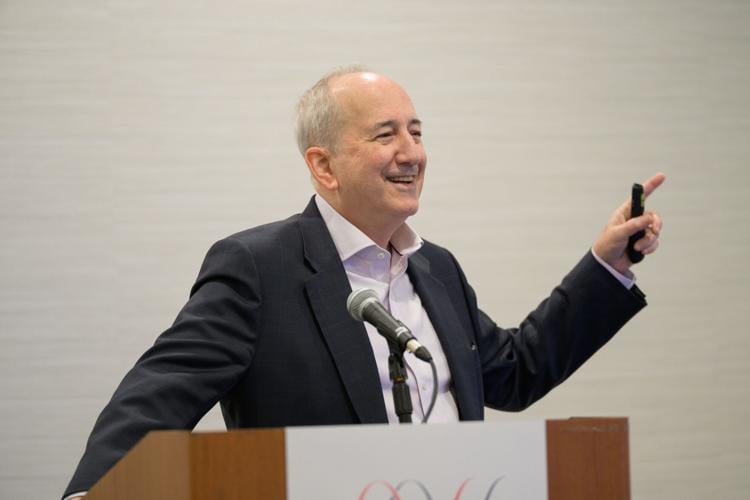
Eric Isaacs, CEO and president of the Tucson-based Research Corporation for Science Advancement, speaking at a Science Philanthropy Alliance conference on Nov. 4.
Eric Isaacs, a leader in physics research and the president and CEO of the Tucson-based Research Corporation for Science Advancement (RCSA), is also president-elect of the nationwide American Association for the Advancement of Science.
People are also reading…
He said there’s never been a more interesting or exciting time to be in science, especially with all the fascinating and interesting problems the science community is yet to find answers to.
Foundations across the country, including his, are willing to fund early-career researchers and support important and bold ideas in science, Isaacs said. RCSA, which has funded early-career scientists since 1912, was the nation’s first foundation dedicated to exclusively funding research in the physical sciences.
But foundations and private companies alone cannot pay for science without the backbone of federal funding, he said.
“Of all the things they (Republicans and Democrats) disagree on, which is a lot of things, science just seems to come through,” Isaacs told the Star in an interview two weeks after the Nov. 3 midterm elections, which saw sweeping wins by Democrats as they won control of both chambers of Congress.
An article in Chemistry World said researchers and science policy advocates in the U.S. are feeling “widespread relief and optimism,” and hoping that a Democratic Congress will act as a wall between the Trump administration’s “interference” in decision-making in the world of science and its termination of numerous federal research funds.
On the other hand, the Association of American Universities released a statement after the election’s initial results and said: “While Democratic control of Congress will create new opportunities to scrutinize the administration’s science policies and defend research investments, continued divided authority between the executive branch and Congress means that many of the challenges and uncertainties facing higher education and the research enterprise are likely to persist.”
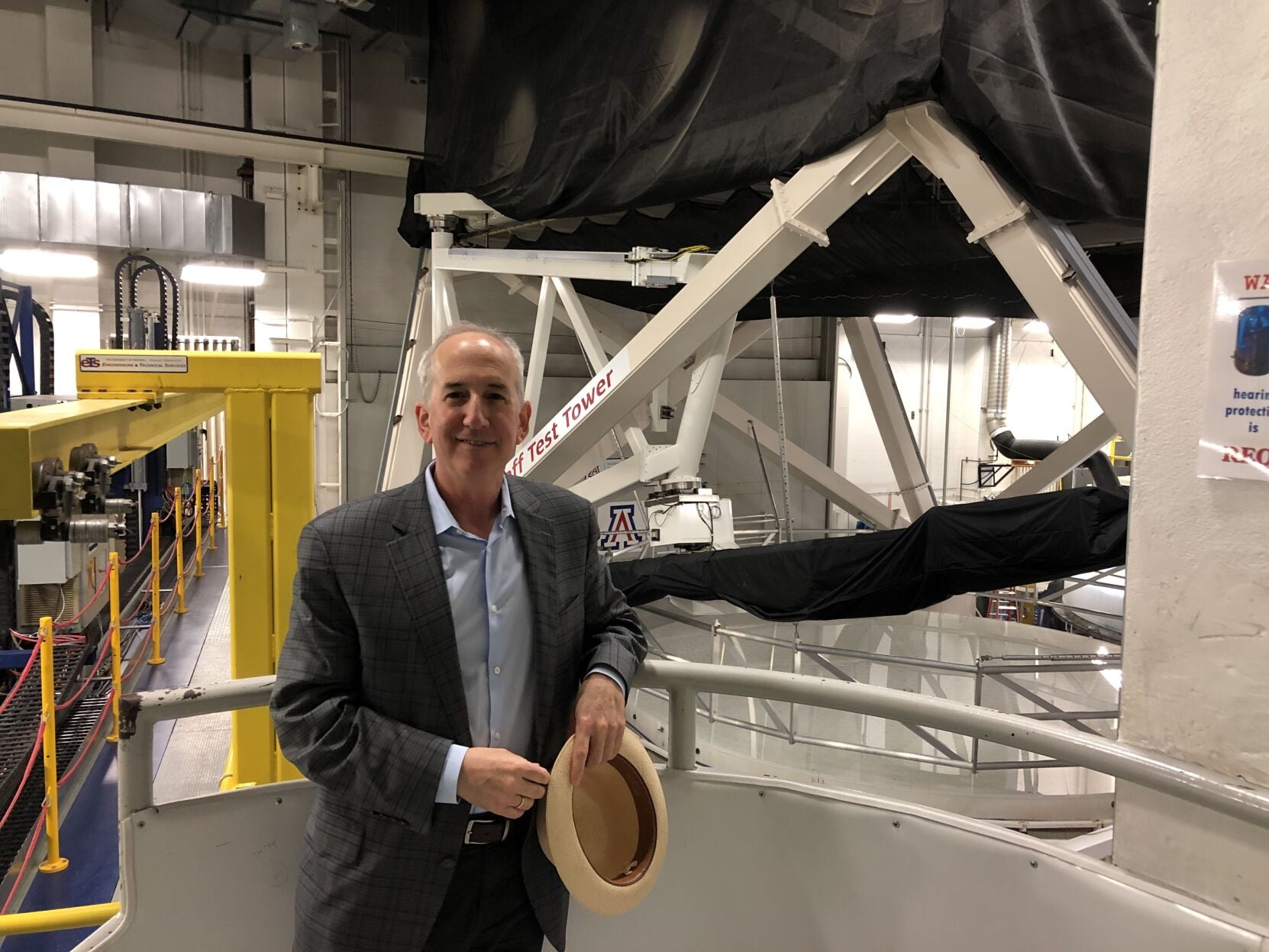
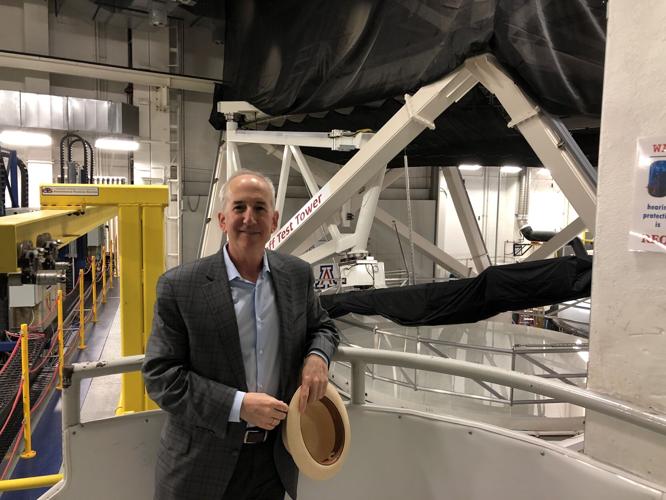
Eric Isaacs of Research Corporation for Science Advancement in a 2019 visit to the University of Arizona’s Richard F. Caris Mirror Laboratory.
Isaacs told the Star, “At some point, it’s the uncertainty, not the absolute dollars that becomes a real problem, and that’s something that we need to pay attention to. I don’t think, I don’t know if that’s going to change much with the Democrats. We have to wait and see. But, as I said, historically, both sides of the aisle have been pretty supportive of science.”
During his career, Isaacs has served as president of the Carnegie Institution for Science, provost and executive vice president for research, innovation and national laboratories for the University of Chicago, and director of Argonne National Laboratory. Early on, he also spent 15 years at Bell Laboratories.
At RCSA, his focus is to help early-career scientists and create bridge funding programs so they have support to survive through funding gaps. Under Isaac, the organization gave out $800,000 in bridge funding to people experiencing gaps in their research grant funding.
Since the second Trump administration came into power in January 2025, myriad changes have occurred in science and research policies and funding, including:
— Many federal research grants were paused, stopped or terminated nationally, including research projects with the U.S. Agency for International Development.
— Caps were proposed for indirect cost rates that pay for administrative costs tied to research work, including a 15% cap proposed by the National Institutes of Health but stopped by a judge.
— Universities were offered access to preferential federal research funding if they agreed to a list of political and ideological demands in White House's 2025 “Compact for Academic Excellence in Higher Education.” The University of Arizona turned this down, as did other universities.
— The White House Office of Management and Budget (OMB) released a proposed rule change in the summer. It would give political appointees final decision-making power and the ability to override traditional scientific peer-review panels for federal research grants, Scientific American has reported. Critics say the White House is trying to replace scientific review of research grants with political review.
The University of Arizona, for instance, lost at least $60 million in unspent federal funds across at least 67 terminated research awards as of July 2025. It would have also potentially lost $40.5 million a year if the NIH 15% cap on indirect costs had gone through.
Here are excerpts of the Star’s interview with Isaacs:
Lately, we have been seeing what critics call a politicization of science and research, with the OMB proposal this summer, and the White House compact. What’s your take?
A: That (OMB) order, that’s not a great thing, right? But it’s not a done deal yet, so there’s still a lot of hope that it’ll be worked out. … It’s very important, in my mind, that scientists get to review the quality of science. For 70 years, it’s been the important way to go. So, you can ask whether the Democrats or Republicans will pull it one way or the other. I don’t know, I’m not in that fight, but I think there’s a lot of people who are pushing back on it, and hoping that they can succeed. I don’t think it’s good to politicize science. But that order is not a done deal yet.
Considering the changes under the Trump administration to science and research funding, what do you think the change in congressional leadership will do?
A: I don’t want to predict what’s going to happen. I can say, for example, if there are deficits in certain areas, we focus on those at the research corporation. So, for example, last year, we gave away almost a million dollars ($800,000) to some of our awardees because they were struggling with canceled grants. We’re trying to respond to that. And I will say, foundations to a larger extent are responding to some of the disruption. It doesn’t mean we can replace all of government funds if it’s moved around.
The second thing I’ll say — I tend to be optimistic — is certainly things will change. I’m not going to tell you it’ll change because Democrats are in power or Republicans are in power. I’m not going to say anything about the difference between Democrats and Republicans. All I’m going to say is that both of them have always agreed on a robust budget. It’s taken work.
The politicization, certainly from the point of view of how we adjudicate grants, is something that can be improved. And I think most scientists agree.
Now, I don’t want to be naive either, and I do want to say that our faculty are worried, as they should be, but I think the good forces are trying to figure out what kind of scientific economy we should have, and it will be different, and it may be better.
Do you also have a positive outlook on research areas including health, environment, women’s health and reproductive research, under a change in the D.C. balance of power?
A: I do. I’m confident that all people have cousins, relatives, mothers and fathers, and want health research to go forward. I have no doubt that people in Congress want research on health things to go forward. I won’t justify decisions made by any administration or not, but all administrations have priorities. But I have no doubt that health will end up coming back, and especially women’s health. Half the country ought to be treated as if they’re half the country and positively.
At the U of A, with its recent research focuses on fusion energy, mining, defense and space security-related research, it appears there may be a strategy to leverage the university’s research strengths in areas that are a priority for the Trump administration. What do you think of this as a strategy?
A: The great thing about the universities — both the University of Arizona and ASU — is they’re very broad, so they have a lot of different kinds of science. So, there may be a period in which they amplify certain kinds and certain ways, but going where there’s money for fusion, which there is right now, is a good idea. A big institution like that has to always balance things.
... When you think about fusion or you think about investing in that kind of energy, it’s great. I mean, if we can make fusion work, it’s phenomenal. You can’t do healthcare without energy. You can’t do healthcare without physics.
You've said federal research funding provides 'an irreplaceable backbone.' Where do faculty and researchers go for other forms of funding, including your organization?
A: First of all, no matter what happens politically, foundations are playing a more important role. Philanthropists and foundations. You have these very big, wealthy donors now who are having a huge impact on science. I would strongly encourage faculty to seek out foundation funding. We focus entirely on early-career scientists, early-career faculty in the physical sciences, and the reason we do that is because the leverage there is tremendous. We take risks, we find people who are great, and then we invest in a really important problem they have.
There’s a lot of enthusiasm, and in a way, it’s never been a better time to be in science. There are so many interesting problems in science right now. We don’t know what 95% of the universe is. We still don’t have a answer for cancer. We still have a minimal understanding of how the brain works and how cognitive disorders occur, and the brain being so complicated, it’s just fascinating science. And so, when I go out and talk to young people or early-career people, I remind them that there’s never been a more exciting time in science.
After weathering all the changes to science and research since January 2025, how long do you think it would take for the U.S. to get back to where it was?
A: I just came back from Berlin, I was at an international meeting there, and there’s certainly some concerns about what the U.S. is going to do. We have been and still are the leaders in a lot of fields in science, and we’ve also been a reliable partner in certain ways — competitive but a reliable partner.
This country has long been the place where people from overseas want to come. So, a place like University of Arizona has a large foreign-born (contingent), or citizens of foreign countries come and get an education there, and they’ve often historically stayed. It’s the immigration which people are worried about. But I just want to say that that’s not broken at this point. …
It may take a few years to gain back some of the trust that we’ve lost, but it’ll come back. It will come back, as long as we continue to do great science.
Reporter Prerana Sannappanavar covers higher education for the Arizona Daily Star and Tucson.com. Contact her at psannappa1@tucson.com or DM her on Twitter.

Prerana Sannappanavar
Higher Education Reporter